Menu Close

All Things Thriller

A Celebration of Thrillers, Noire and Black Comedy by Pamela Lowe Saldana

Babysitter (2022), a Novel written by Joyce Carol Oates; Suspense/Thriller

Joyce Carol Oates is a big deal among the literary elite. So much so the eighty-six year old author is considered a living legend. Her resume–Professor of Creative Writing, Princeton, over fifty novels published, three of them finalist for the Pulitzer Prize, as well as volumes of poetry, short stories and plays–bespeaks gifted intellect, hard work and considerable talent.

So the lady’s got cred, but I’ve never heard of her. That’s no slight. Just means she’s a little rich for my blood.

Not that I read trash. More like “literary pulp”. And that’s what I put in the search. Out popped Joyce Carol Oates. Babysitter.

I immediately recognized the preface. It coalesces around a horrifying true crime case that took place in the 70s in which the killer is known as the Oakland County Child Killer (OCCK) or The Babysitter Killer.

Although the Babysitter claimed four known victims, it is thought that there were many more inner city children trafficked, molested and some murdered by the killer(s) and/or individuals involved in a vast pedophile network that dipped into the most decrepit hovels of Detroit as well as some of the most exclusive, wealthy suburbs in all of the United States. The killer earned the name Babysitter because the four Oakland County victims were found meticulously clean and well fed, though they were held days and, in one case, weeks before they were murdered.

Against this backdrop enters a (bored to tears) upper echelon suburbia wife and mother teetering on forty (and legs as long as Byron’s Don Juan) nearly poreless, bedecked in understated designer wear (logos discreetly–she thinks— forward facing) one Hannah Jarret married to a (moderately) wealthy executive named Wes.

Here I will interject, as I was miming Miss Oates verbose style–in Babysitter at least–the run on sentence, its copious parentheses and inordinate italics. The style is befitting of the character Hannah: exhausting. How you will feel about its prose may very well depend on how you feel about long distance running.

If not acquainted with Oates, you may want to “train” on her earlier works such as the short story, Where Are You Going, Where Have You Been? I have recently read it and it is superb.

In any event back to Babysitter: Hannah does what any bored, upper echelon suburbia housewife from the 70s would do –or, at least, that’s what Oates in her indictment of time and place would have us believe–she has an affair. It’s her choice of paramour that is eyebrow raising. She knows him only as Y.K.

Whereas as husband Wes is relatively handsome, Y.K. is not. No, not with his heavy, blue lidded eyes. Not with his tawny skin and thick curled toenails; his wire bristled hair and brow of Frankenstein.

His character, no less surly: sadist.

He brutalizes Hannah, yet she is drawn to him. Y.K. is a man of discerning taste. He has money–and designer clothes. These are the prerequisites that Hannah requires.

Oh…and his audacity…he strokes her wrist with his thumb at a gala she’s hosting. She prepares to introduce her children to Y.K. as Babysitter is wreaking havoc, terror and murder, going so far to attack a child in an even more affluent suburb than Hannah’s.

Husband Wes is quick to lay blame at an inner city black man’s door…any inner city black man’s door…but not Hannah. Though comically neurotic to the point of nervous breakdown, poisoned by passive aggression, feminine mystique and white privilege, Hannah knows Babysitter is not in the order of the other, but a grandmaster of us.

Still she hesitates to sound the alarm, stymied by fear of gossip…Wes’ secret Swiss bank accounts…his influential family…their high priced attorneys…her Saint Laurent wardrobe. Indeed, Hannah could loose everything.

As a near fembot navigating Oates cliched environs, the question is not will she, but how could she not?

Revanche, A Film Directed by Gotz Spielmann (2008); Thriller, Revenge Yarn; Austria

Do I recommend the thriller Revanche?

It should be simple to answer, right?

Just a yea. Or a nay.

But it’s not…simple. Not for me.

If you’ve read my blog before then you know I can’t…that I’m just not capable of one word answers. You know that…not that there aren’t exceptions to the rule…it’s like grammar…English…there’s always an exception.

Case in point…Die Hard. Now, I could give it a one word answer…review…what have you…and be done. It would be bold–just like the sobriquet character, John McClane.

But Revanche is not like that. Revanche is much more nuanced. It’s foreign. Artsy. There are no easily discernable tropes that scream–this is a thriller. It’s not taut…it meanders… but not in a hazy, surrealistic way. And there are subtitles.

So what’s the plot, you ask?

Well, revanche is French for revenge so it’s a revenge yarn. And when I say yarn, I’m using the term metaphorically… like it’s actual yarn. That doesn’t make it bad…if you like knitting. Or crochet.

But, here’s the twist…or I should say, a twist…Revanche is an Austrian film. And Austrians speak German. In the German language Revanche has a double meaning. It means revenge, yes…but it also means re-match…or second chance.

Anyhoo, there’s this young woman. Her name is Tamara. She’s being sex trafficked. Despite this…and worrisome cocaine habit…she has retained a gentle childlike quality that glints unexpectedly…like when she clasps her hands and prays.

Tamara has a boyfriend…an ex-con named Alex. He works for the traffickers, but he’s not a bad guy…he’s just lazy…and scruffy. He is also madly in love with Tamara.

Alex devises a plot to rob a bank so they can escape and start a new life together. He’s very enthused and pleased with himself over this caper.

Tamera?…not so much.

Alex tries to assuage her by demonstrating that his gun isn’t loaded. He does so by putting it to his head and pulling the trigger. He likes to do silly things like that…things that border on creepy…like pointing the gun at Tamara…and waking her up with a ski mask covering his face.

Needless to say Tamara is not assuaged…she won’t sign off unless he takes her with him . Alex reluctantly agrees, but makes her wait in the car while he robs the bank. He laughs at her when she prays.

Oh…the car. It’s blocking an alley…so there’s that…and of course a cop comes a long…

Alex manages to escape with the money, but not with Tamara. He’s devastated… and very pissed off. He hightails it to his grandfather’s rustic, rural home where he hides out…and relentlessly chops a mountain of wood.

At first grandpa is none too pleased to see Alex–let alone put him up. Alex says his mom told him to come help. Grandpa is skeptical. He’s aware of his grandson’s indiscretions with the law…just not this latest one…plus Alex barely says two words to him.

But gradually…remember what I said about the yarn?…their relationship begins to thaw. Much to his surprise, grandpa actually benefits form the arrangement. Now that he doesn’t have to shoulder all the chores, he has more energy. He takes up playing the accordion again.

Grandpa has a young woman friend…a neighbor who looks in on him from time to time. Her name is Susanne.

Susanne desperately wants a child…she has recently miscarried…but her husband, Robert, suffers from some psychological issues having to do with a trauma suffered at his job. He is rarely interested in intimacy of any kind.

Even though it’s out of her character…she’s a very nice woman…Susanne throws herself at Alex. He makes it monosyllabically clear that he wants nothing to do with her. But she persists.

Then one day while Alex is grocery shopping with grandpa, he overhears Susanne…she works at the store…talking about a bank robbery. She says her husband, Robert, happened to encounter the robbers…a man and a woman…in a car…blocking an alley…

Baby’s Breath

The bed is cold
but you must rest
A sweater worn
of fashion sense
Room with view
at your behest,
and lattice weaved
in baby's breath

If you could run
you'd walk with them,
but bide the time
until then
spring looms and blooms
with the scent
of seaside breeze
and baby's breath

May God Save Us, a Film Directed by Rodrigo Sorogoyen; Police Procedural, Psychological Drama, Thriller; Spain

It is very rare to run into a perfect movie…but it happens. That’s why it’s rare .

And, it goes without saying, what is and isn’t perfect, what is nearly perfect, or a far cry form it, is subjective. Case in point: McCabe & Mrs. Miller.

Everything…the screenplay. The cinematography. The acting. The soundtrack…yes, even the bits of conversation that can’t quite be heard…is perfect.

But some people are meh about McCabe & Mrs. Miller. And some people just don’t like it. And that’s okay. It’s not like E.T., or Jurassic Park. It’s not for everyone.

Anyway, as you might have guessed, this movie–not McCabe & Mrs. Miller–but this movie, may not be your cup of tea. Then again, if you like gritty police procedurals with strong thriller elements…if you speak fluent Spanish…or, even if you don’t and don’t mind subtitles…you’re gonna love May God Save Us. I’d bet money on it.

But you’ve gotta have a strong stomach. Keep that in mind.

That said, the movie begins with a gorgeous, broad camera shot of a busy intersection of Madrid. Director Rodrigo Sorogoyen takes us into the architecture and vibe of a second tier artery system–its markets, its cafes, its apartments–so that we can see with our own eyes, hear with our own ears, and feel with the nerve endings down our own spine, the pulsating, multidimensional rhythm of the city.

It’s quite prosperous. Beautiful. And religious…Catholic.

So Catholic, in fact, the Pope is scheduled for a visit and everybody’s pretty happy about it–except for the cops. And that’s understandable since everybody in Spain (shoot, people from all over the world) are going to be flooding into Madrid. Makes their job that much tougher.

True. But that’s not the reason they’re so upset.

The cops are upset because a serial killer is attacking their city. And he’s targeting old ladies. He rapes them. Beats them to death.

Very grim…just awful…I told you up front it might not be your cup of tea. And it’s graphic…not gratuitously, but still. Proceed with caution.

That said, May God Save Us is what you call a two-hander–that’s where there are two main characters in a film, a play or a television program. And since I already told you it’s a police procedural, you’ve probably already guessed that the two main characters are cops.

Two male cops…who don’t like each other.

One, Javier (Roberto Alamo) is an impulsive, tall and muscular, physically expressive man child. He’s got a little sumpin’, sumpin’ going on in the sex appeal department, but has problems with his wife and step-daughter. Oh, he loves them, alright…tries to be good to them, but he doesn’t speak their language. Plus he’s selfish.

The other cop may be a little younger, but he doesn’t look it. Bookish, awkward, smart, he’s not tall at all. He has a crush on a maid in his apartment building…doesn’t have clue what to do about it. That, and he stutters. His name is Luis (Antonio de la Torre.)

Meanwhile the Pope is going to be in Madrid soon. The police chief wants the serial killer caught before the Pope-jet touches down. We’re going strictly by the book here, until there’s a shift. It happens quite abruptly. We’re on the same streets as before, but now we’re seeing them through the killer’s eyes. We’ve seen him before, too. He’s not what we expect.

Well, he is and he isn’t…he’s very young. Mid twenties. And he’s handsome in an unsettling sort of way. It’s as if his whole being is fashioned into the tip of a long thin blade. His nose, his chin, his lips…he’s very fastidious about his clothes and appearance.

Though we are shocked when we first encounter him, we watch his ritual with a dreadful awe…the stride of his step, how quickly he sizes up his prey…we think we know what makes him tick. But his mask is still on. We have seen his crimes only through Luis’ psychological profiling. Now, within the films shift, we are voyeurs watching the killer’s process. It is, I suppose, like watching sausage being made. Not only do we see his mask slip, we watch him rip it off. Terrifying.

In his country of Spain, Sorogoyen is an acclaimed artist winning seven Goya awards for direction and original screenplay for The Realm, The Beasts, Stockholm, Mother and May God Save Us. In the latter film, Sorogoyen merges the genres of police procedural, psychological drama and full out thriller with a deft hand, splicing it into three acts, the first of which is the procedural where we are introduced to the methodology and victimology of the killer and the unfortunate women who star in his crimes.

The middle portion of the film takes the form of a psychological drama where the focus is on police officers Javier and Luis and their secret inner world. There we are like flies on a wall as they go about their day to day life, interacting with one another, their fellow officers and those in their private life.

The third act is all thriller, with Luis and Javier drawing ever closer to identifying the killer and reconciling their own demons. It’s as twisted and tortuous as an unregulated rollercoaster ride.

And then, there’s the epilogue.

Transversal Intersection: Psychological Thriller; Insomnia (1997),Erik Skjoldbjaerg; Strangers on a Train (1951), Alfred Hitchcock

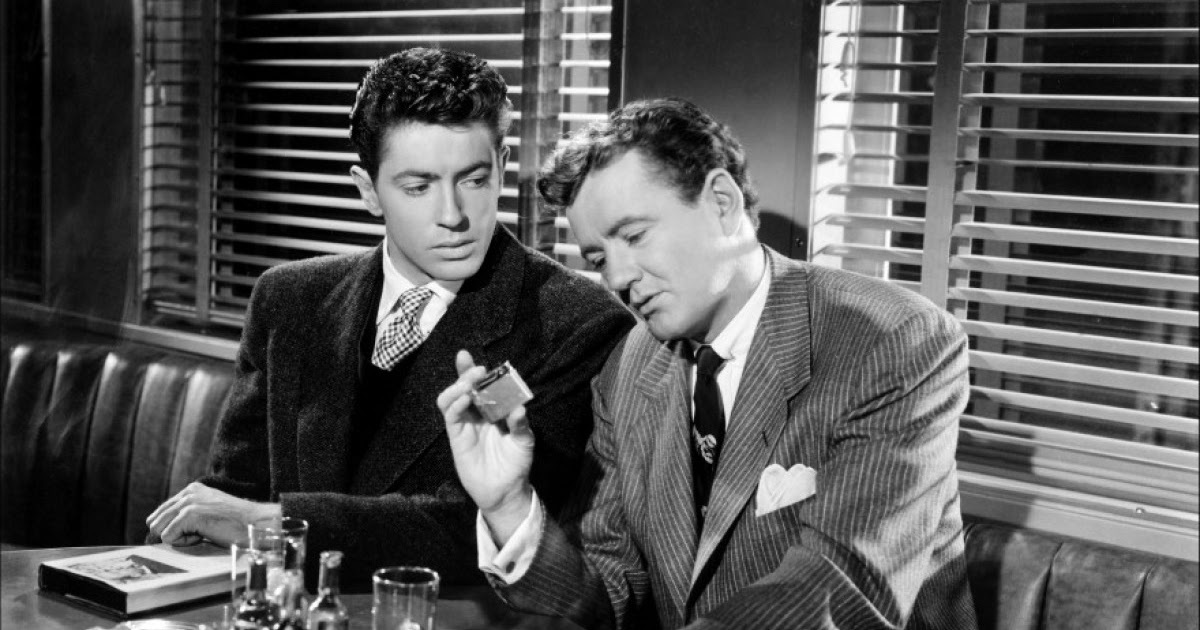
Of course, everyone has seen Strangers on a Train, the quintessential psychological thriller by the master, Alfred Hitchcock. Quintessential not because it is the best, though it is deservedly in the top 2o of just about every cinephile’s list, but because it is the best representation of the genre through the lens of its elements: light verses dark, the shades of gray in-between, twinning, egocentric love and hate, the physical, dogged pursuit of control, the fear and anguish of losing it.

In fact, in all of cinema, no director’s cannon is more ubiquitously symbiotic with the psychological thriller than Hitchcock’s, with the possible exception of the great Ingmar Bergman. (That the latter’s work tilts more toward drama is duly noted.) Still, it is interesting that Erik Skjoldbjaerg, director of the equally quintessential new wave Scandinavian psycho-thriller Insomnia (1997), tips his hat not so much to his fellow Swede, but to the Englishman.

Bleak. Intriguing. Haunting. Insomnia is more noir-like than Strangers on a Train. It is also more economical with action and more reliant on atmosphere and rumination. In this way, more like Bergman.

Yes, there are chases, combat and gunplay–but not because they are formulaic. Here realism trumps style. Action is the consequence of physics.

In Strangers on a Train, the plot coalesces around a complicated conspiracy between two men, one of them as fundamentally decent as he is desperate to find a way out of circumstances orchestrated by the other, a sadistic psychopath. Their conspiracy represents the intrusion of evil, via circumstance and stress, into an otherwise stable psyche. Insomnia is about much the same thing, but here the conspiracy is less grandiose, while the conspirators are similarly troubled souls– one a cop, the other his quarry.

Jonas Engstrom (Stellan Skarsgard) is the cop, a high ranking homicide detective; a star of sorts–this in spite a rather public incident in which a skeleton escaped his closet. Thus he’s sent to a snow drift above the Arctic Circle in the hinterlands of Norway, tasked with leading the investigation into the murder of a seventeen year old girl. The local cops are worried; the killer’s MO is sophisticated and there are possible signatures pointing to serial homicide.

In Tromso, he is assigned to a reginal supervisor, Hilde Hagan (Gisken Armand) with whom he may or may not have history. Though friendly, even coy–like Strangers’ provocative Barbara (Patricia Hitchcock)–she is leery of him too.

Taciturn, enigmatic, clocked in steely attractiveness and stylish attire, Engstrom is not an easy man to like. He makes insensitive comments about untoward observations of which he either thinks are funny, or doesn’t bat an eye.

His male colleagues whisper behind his back. Hagan does not.

Engstrom checks into an inn where a no nonsense, yet comely clerk is attracted to him. Appreciating that he doesn’t hit her up for drinks or intrude on her personal space with innuendos, she mistakes his uneasiness for politeness. She gives him tape so that he can fix the shade to the window. Daylight is as unrelenting as the temperatures are cool in the city of Tromso–the phenomenon of the midnight sun.

As Engstrom makes the rounds of his investigation, attending the dead girls autopsy–her name is Tanja–sifting through belongings that are too expensive for her to afford, interviewing school mates, getting rough with an uncooperative boyfriend, the ever present sheen of sweat above his top lip spreads across his face. This despite snow still visible in summer. The tape isn’t working. And Engstrom is a man who needs what little sleep his is accustomed to.

Increasingly erratic, he is unable to suppress his inner tawdriness. When the comely hotel clerk makes an advance, his response is inappropriately aggressive. He reacts similarly with Froya, a cynical, world weary teen who he intimidates into disclosing the identity of Tanja’s fifty-something suitor.

His name is Jon Holt (Bjorn Floberg), a writer of pulp fiction, a man of means though he no longer looks it. Gamy. Desolate. Frayed. In him, Engstrom meets his match. More harbinger than doppelganger, Holt is older than his pursuer. That he isn’t as smart is of little consequence. He knows Engstrom’s secrets; he has the receipts.

Unlike the sadistic Bruno (Robert Walker), who relishes Guy’s (Farley Granger) predicament in Strangers on a Train, he takes no pleasure in witnessing Engstrom’s pain or doling out his punishment. When Engstrom announces his plan to frame Tanja’s boyfriend, Holt’s piercing blue eyes blink before they film over, first with surprise and then with empathy.

In his full length picture debut, Skjoldbjaerg turns the essence of noir upside down. Here sunlight pervasively penetrates and darkness is largely confined to the mind, so demons are left to crouch in coastal Tromso’s atmospheric fog more than shadow. Fittingly Skjoldbjaerg films within the glare of white on white–curtains, walls, latex gloves, blanched skin–and in miry hues of seafoam, sage, cornflower and slate. It is a sickly pallet offset with pops of richness.

The camera work is largely straightforward, giving Insomnia a weathered, wind swept look. But Skjoldbjaerg embellishes Engstrom’s sleep deprivation induced psychosis with hallucinatory jump cuts, filmed from angles that blur his perspective of time, space and place, as well as his sense of self.

All this begs the question, is Insomnia really a thriller?

And is Skjoldbjaeg really channeling Hitchcock’s Strangers on a Train?

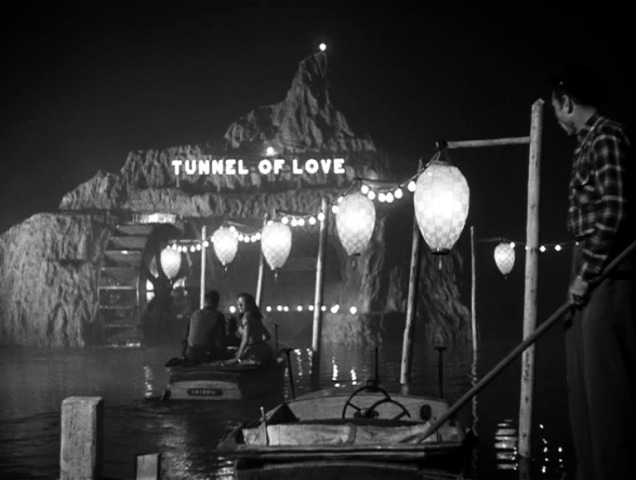
In one of the only sequences filmed in darkness, Engstrom chases the killer through a bunker and we are reminded of Bruno pursuing Miriam in a boat through the tunnel of love. There, Hitchcock ratchets up the tension by using a night time setting against a continuum of light: the glare of carnival rides; silvery flashes in the tunnel; the subtle glow of a lighter. Though Miriam is aware she is being pursued and who is pursuing her, she is unaware she’s being stalked. Sexually charged, she looses sight of Bruno and her head is on a swivel. He is chasing her and she is chasing him.

In the bunker scene, the chase is on foot. Engstrom doesn’t know who the killer is, having seen him only from a distance. The killer escapes into a bunker and Engstrom, with cohorts in tow, runs after him toward the light at the end. But when he gets there he finds it isn’t really light–it’s fog. He disappears into it where he is unable to discern who is who, and who is chasing who.

If that’s not an homage to Hitchcock and, more specifically, Strangers on a Train, I’ll eat Erik Skjoldbjaerg’s hat.

Worth Another Look: I Walk the Line (1970), a Film Directed by John Frankenheimer; Drama

Henry Tawes (Gregory Peck) strides with an air of superiority, decked out in a perfectly pleated, crisply pressed sheriff’s uniform, patrolling the East Tennessee hill country and, by extension, its humble folk in John Frankenheimer’s drama, I Walk the Line (1970). Tall, broad-shouldered and lean, he is bestowed with a shock of salt and pepper hair that sweeps across his brow. A sharply pointed nose and narrow lips betray a common Scotts-Irish ancestry, though Henry’s are sculpted with privilege whereas most of his constituents’ are shaped by harsher elements.

The good sheriff’s home is equally impressive, well built and roomy with a covered porch and rocking chairs painted white. His wife (Estelle Parsons) is an overly accommodating, talkative bird open to pleasing her husband by way of articles in The Readers Digest. He reciprocates her advances with an iceberg shoulder.

Similarly, he barley tolerates his daughter–she is about twelve–acknowledging her with pursed lips and a slight tilt of his head. He treats everyone this way, yes even himself.

One day he pulls over a shabby pickup bearing a load of sugar and a comely blonde somewhere in her early twenties. She too is talkative, but to her Henry actually listens as his unaccustomed lips form the beginnings of a smile.

Her name is Alma (Tuesday Weld). She is the daughter of an itinerate bootlegger and the sibling and caretaker of his two sons. The sheriff’s attraction to her is instantaneous, but he tries not to show it. Alma is not fooled.

Later, around a slovenly dinner table, she and her father plot the good sheriff’s seduction. It goes off without a hitch–at first. What Alma and her father underestimate is their mark’s susceptibility to obsession through the conduit of unrequited passion. Of course, Henry underestimates it most of all.

Director Frankenheimer’s film cannon is comprised most notably with early 1960s political dramas (The Manchurian Candidate, Seven Days in May) in which his masculine protagonists are besieged by external plots that coalesce around their own psychological disturbances. I Walk the Line, made in the early 70s but set a decade earlier, is a continuance of such themes with Alma and her family representing a festering rebellion threatening to erupt in response to suffocating repression.

Unfortunately, coming on the heels of revolutionary counter culture films like Easy Rider, The Swimmer, Midnight Cowboy and Five Easy Pieces, Frankenheimer’s offering got lost in the turbulence of the times. However, when viewed without the late 60s early 70s coke bottle lens, focusing instead on its panoramic photography, affecting cast and a starkly eloquent screenplay–not to mention the Johnny Cash infused soundtrack–I Walk the Line is a simple, yet, convincing personal drama about the unraveling of a tightly wound man.

I Walk the Line was filmed in Gainesboro, Tennessee and along the dam and banks of the beautiful Center Hill Lake, some eighty miles from our Nashville home. My family and I use to boat, camp and hike there when my children were small.

Piggy (2022), a Film directed by Carlota Pereda, Starring Laura Galan, Spain; Horror, Exploitation

From time to time, I remember hearing my mother say to her sister, to one of her friends, or to a patron at work (she was a hair stylist), “kids can be cruel.” This was no revelation to me since I had experienced it first hand; I skipped kindergarten and went straight into first grade in a private school with rigorous academics. I knew my colors, could count to 13 and say my ABCs…and that was about it.

So yeah. I got made fun of. But not like Sara (Laura Galan) in Carlota Pereda’s Spanish horror film Piggy, thank God.

You’ve probably guessed from the film’s unflattering title (not to mention the featured image) that Sara is overweight. If so, you’re wrong.

She’s obese. And she doesn’t try to hid it. To do so would be futile.

Sara is also, as my mother would say, “pretty in the face.” She has a thick mane of wavy brown-black hair and expressive eyes of the same color. Her skin is as smooth as her expression is forlorn. There are many reasons for her despair, of which obesity is only a symptom.

Numero uno: Su madre (Carmen Machi). She’s…how shall I say it? A bitch.

There’s absolutely nothing Sara can do to please her. What’s more, she goes around announcing–quite loudly–her daughter’s sizeable, but typical teenage foibles. For example, when Sara unexpectantly gets her period her mother makes a big deal out of it, turning down a gentleman who has offered them a ride home because her daughter might mess up the white seats of his car.

Seriously? Who does that?

Wait. It gets worse.

The gentleman in the car? His son is setting next to him. And he’s a teenager too, about Sara’s age.

See what I mean?

Even so, as crazy as it might sound, Sara’s mother loves her. She does. El madre does her best to protect her daughter, although that refuge usually collapses on Sara–and everybody else in the vicinity–instead. Nonetheless, Sara needs all the protection she can get.

Case in point: Maca (Claudia Salas).

Maca is a sadist rich-girl bitch who sets her sites on Sara–hence the nickname Piggy. What’s more, Sara’s used-to-be-best-friend, Claudia (Irene Ferreiro) pals around with Maca and her cohorts now.

One day Sara decides to go to the community’s pool built around a natural spring. She shoots for an off hour when she hopes nobody will be there. And seemingly she’s in luck because when she gets there nobody’s around. Not even the lifeguard.

She dives in. When she’s pops back up she comes face to face with a hulking man whose stomach is as robust as her own.

She’s shocked. And, as usual, clumsily embarrassed.

She dives again, deeper this time, and we see that she’s quite the underwater swimmer. We watch as she obliviously, gracefully streamlines by the submerged body of the lifeguard whose hands are lashed behind his back. When she resurfaces the hulking man has disappeared, but now she is face to face with something far more insidious.

Maca.

The teenage harpy plumets Sara with the pool net and manages to trap her head under the water with it, almost drowning her. All this while her cohorts gleefully laugh, as Claudia looks on a little uncomfortably.

Sara manages to escape her tormentors, but she does so without her clothes or benefit of a towel. She is forced to make a harrowing trek through the woods and down a rural road, trying desperately to avoid prying, disapproving eyes.

It’s during this journey that she runs into Maca and Claudia again, only this time the tables have turned and they are the one’ being tormented–and abducted–by the hulking man at the pool (Richard Holmes). Maca and Claudia scream for help. Sara sees the hulking man and he see’s her.

In one bloody hand he wields a huge serrated hunting knife. In the other he has a towel.

Like Tobe Hooper’s iconic Texas Chainsaw Massacre (1974) and, to some lesser extent, Greg McLean’s Wolf Creek (2005) director Carlota Pereda infuses her film with an eerie, washed-out beauty. But while the former films have sudden busts of splendorous cinematography, Pereda imbibes hers with the disconcertingly sunny paradox of Galan’s gift of physical comedy, all of which she does with a hardcore, realistic despondency.

It’s a brilliant performance in an equally brilliant film. And though it never really scares us, it horrifies us all the better.

Happy Halloween everybody.

Ron DeSantis Tortures Sleeping Dogs

I can’t stand Florida Governor Ron DeSantis. And, yeah, it’s personal.

Like a lot of other politicians (of both parties, I might add) I think he’s a pompous blow hard. But that’s not why I can’t stand him.

No. It’s his cruel streak, his over-the-top maliciousness in general and his snidely air that I find truly appalling. But more than even that, it’s his cruelty to sleeping dogs that really gets me.

It’s disturbing. Sadistic even.

I think DeSantis must really hate sleeping dogs, even though he acts like he’s on their side; his actions speak louder than his words. Just look at the way that he treats them:

He gets these huge truckloads of M80 fireworks…you know, those little mini bombs that your mom wouldn’t let your brother get for the 4th of July because they blow off peoples fingers and hands and stuff…

Yeah, those.

He ignites the fuses…he’s got these ball machines all lined up, like they use in tennis or baseball…only he loads them up with the M80s…and he just rains them down, just carpet bombs the you know what out of these poor sleeping dogs.

I’ve personally witnessed this. It’s awful.

The dogs jump up, they’re scared to death. Some of them cower. Some yelp and whine. They all bark and howl. They attack each other. It’s a spectacle.

And if that’s not bad enough, then DeSantis blasts about a gazillion vuvuzelas at them. (I’ll let you google that; they are loud.)

I know…I know. It’s terrible. It really is. But that’s not all. Nope. DeSantis is just getting started.

Then he gets about a ton of raw meat…chicken bones, porkchop bones, all that…and he just hurls it at them...

Yes…while the vuvuzelas and M80s are still going off. It’s like all hell’s breakin’ loose. Of course the poor dogs go even crazier.

But here’s the worst part of it: after he’s done all that, he unchains the gate…you know, where the dogs are…he just opens it up and lets them loose.

Yeah…and they are in a frenzy.

You know, come to think of it, this might really be the worst part…it all depends on your perspective, your circumstances…some people blame the dogs for everything. That’s right. They want to put the puppies in eco-friendly backpacks and throw them into the public pool…after it closes, of course. Be done with it.

Those people just don’t like dogs. They exaggerate things about them, or make stuff up…like they say the dogs have rabies…or they’re inbred…and it’s really sad because I use to know a lot of them. The dogs.

Sure, some were vicious and crazy from the get go, but they were the exceptions. And those dogs…the really mean ones…they don’t sleep.

But most of them–in my experience, anyway– weren’t like that. Not at all. They were just nice, normal dogs…and then DeSantis and his buddies started messin’ with them.

Of course, DeSantis isn’t the first one to get them all riled up. Hardly. But he may be the smartest one. And that’s why I can’t stand him.

And it’s also why he scares me a lot more than the dogs do.

A Brood Of Vipers: My Investigation Into A Child Abduction In Nashville; Chapter Two

The Trek

There was only about six weeks to go before summer break when Tabitha Tuders walked out her front door on a morning like so many other mornings–yet different. She was on her way to 15th and Boscobel where she would wait with other neighborhood kids for the school bus that arrived at eight a.m.

Out the door by 7:45, folks along a route that began two houses from the corner of Lillian and 14th could set their watches by Tabitha’s routine. At 14th, she would turn right and walk up the hill to the next street, Boscobel. There she would cross 14th and continue on Boscobel, walking one block to her bus stop.

On that morning Tabitha carried a report card signed by her parents, usually a custom of little consequence to her. Though whip smart, she was an average student. But recently she had buckled down; this report card had straight A’s. Now, not only was she thirteen–a fully fledged teenager–she was briming with accomplishment, all of which should have turned an already nice morning (the temperature was in the 70s with hardy a cloud in sight) into a really great one.

And so, on the morning of April 29, 2003, Tabitha Tuders began her trek like she always did, on the bustling streets of a tightly packed neighborhood. But she did so with a newly emerging sense of self.

Her bus stop was less than a quarter mile away.

Denizens of Shelby Park

With over three hundred acres of lush greenery that includes a golf course, nature center, dog run, baseball fields and miles of fitness trails, Shelby Park is the crown jewel of historic east Nashville. Opened in 1912, its original acreage was designed for the Nashville “elite” who resided on the east side.

But neighborhoods (even those with ornate Victorian homes) change when hordes of the “heroic underclass” encroach on them, taking advantage of low interest loans and mortgages (i.e., the G.I. Bill) like the veterans of WWII did–the white veterans, that is. And neighborhoods especially change when the strivers move on and are replaced with a more fixed underclass.

That’s what happened to great swaths of east Nashville before the hipsters and corporate newcomers converged. Just twenty years ago, glorious Shelby Park was in a state of disrepair–a dangerous hangout for addicts, thieves and perverts like Leslie Paul a.k.a, “Sonny” Duke.

In April of 2003, Sonny was a sixty year old fixture in Lockland Springs, known to ride his bicycle up and down 14th, on his way to and from Shelby Park. He lived on Granada with his mother, just a few houses down the street from Roni Villescaz, one of Tabitha Tuders closest friends.

Before Sonny moved in with his mom he had his own house and a family that included four daughters whom he viciously, repeatedly raped over an eighteen year period. Finally, in 1986, one of the daughters came forward and Duke was charged with and convicted of aggravated sexual assault, but not before he and his son, Leslie David Duke, warned one of the sisters not to testify against him.

As a result, both Duke’s were charged with threatening a witness, but those charges were dropped when the young woman did not show up for court. Regardless, Leslie Paul Duke served over twelve years in prison, escaping for two days in 1992, before he was released in 1998.

Sadly Leslie Paul Duke wasn’t the only debauched soul tooling about Lockland Springs, April 2003. Hardly. Take, for example, the violent saga of rapist and habitual parolee Millard Earl Smith.

In 1986 the then thirty five year old Smith met four teenagers while cruising a park in Murfreesboro, a city thirty miles from Nashville. He invited the teens into his car and gained their confidence by showing them an illegal machine gun he had stowed in a duffle bag under his seat. Then, after taking them for a ride, he sweet talked some alone time with one of the girls while her friends drove to the store in their own vehicle.

Once he had the girl to himself, he put a knife to her throat, raping the seventeen year old in the back seat, a crime for which he was sentenced to twenty years. At the time of this offense, Smith was an experienced sexual offender who had already spent many years in prison .

In 1976, while on bail for attempted rape, he drew twenty year sentence for the rape of a 28 year old woman whom he offered a ride after pointing out something amiss with her car. Instead of taking her to her home as he had promised, Smith took her to an isolated dead end road where he attacked her. Before that, he had been convicted of attempted rape in 1970, earning a one to three year sentence.

On April 29, 2003, Millard Earl Smith was out of prison living with his sister in Porter Heights about four miles from Tabitha Tuders Lockland Springs address. But he was hardly a stranger to her neighborhood. His former fiancé had lived on Boscobel and his father and brother lived on Ordway, both addresses less than a mile from the Tuders home.

When Smith wasn’t working in his brother in law’s garage, he liked to hang around Shelby park where he was known to give kids rides on his motorcycle.

To be cont’d…

Brood Of Vipers: My Investigation Into A Child Abduction In Nashville; Chapter One

A Pretty Picture

Tabitha was two years older. Not that a two year age difference means much, but back then it was kind of a big deal to have a best friend that was thirteen. It made Chelsea feel good. Cool.

Truth be told, hardly anyone could tell their age difference. They were two peas in a pod. Intertwined. More than friends, closer than sisters, they had known each other since Chelsea was two. Their houses were on the same street, just a short walk away. Their moms and dads were friends.

And though they were growing up, their interests and bodies changing, the transition was reassuringly gentle. Yes, they were watching horror movies now, but Scooby Doo was still their favorite.

Sometimes, like when they were in the grocery store line or at the beauty shop, they might hear their moms talking with other moms. The other mothers would say stuff about their daughters like “she’s eleven going on eighteen” or “mine’s thirteen going on twenty-two.”

Not their moms. Their moms just laughed.

Tabatha and Chelsea still liked to play hide and seek, though they were beginning test the boundaries of their world a bit. It was only natural; they knew all the hiding places their yards accommodated–the shed, behind the shrubbery, beneath the the hull of a battered boat. Sometimes they took their outdoor games inside. Neither mom minded. Everybody knew they didn’t live in the best neighborhood. They felt better when they could lay eyes on the girls, fast.

One blonde. One brunette. Both with freckles. Tomboys.

The house is small–two bedrooms, one bath–covered in white clapboard with low ceilings and a front porch only a few steps from the most narrow block of Lillian Street.

Just the right size for Tabitha and her parents, Bo and Debra. Cozy.

Tabitha especially loved her lavender painted room with gleaming white trim. It was a haven where she diligently kept up with homework, listened to music and doodled the names of boys she thought were cute. But it was also a fortress of girly trinkets and stuffed animals–some old, some new—a sacred few baring scars from the rough but loving hands of the child she’d been.

Bo and Debra Tuders worked hard to provide for their family. Debra rose early to make it to her job at Tom Joyner Elementary on time. She worked in the cafeteria. Bo got up a little later, but not much. He was a short haul truck driver. He could have made more money driving cross country but that would mean not being home most nights.

Tabitha was the youngest of three children and her parents doted on her. She was an easy child to deal with even though, there toward the last, she was a little put out with the situation at the little house. Her big sister Jamie and her two children had moved in. Naturally they slept in her bedroom. They got into her stuff too.

And, naturally, she had to babysit.

It wasn’t that she didn’t love them. She did. No question. It was just that they were cramping her newly emerging style and invading her time and privacy.

Sometimes, after the little house had settled and everyone was sleeping, Tabitha would gather blankets and pillows and creep into her parents bedroom. There she would make a pallet at the foot of their bed and sleep.

Life wasn’t perfect. It never is. But, according to her family and friends, for Tabitha it was good.

The Neighborhood

Lockland Springs has traditionally been a working class enclave of Nashville’s east side,  the eclectic epicenter of artists, laborers, LGBT activists, churches, sprawling Victorian homes and humble GI bill cottages.

Nowadays, gentrification has pocked Lockland Springs; a host of its cottages have been razed and replaced by modern module condominiums and single family homes–many of them luxurious. But some of the cottages have been lovingly restored or–in today’s parlance–flipped. Depending on size and condition, many of these humble abodes are fetching between 400,000.00 to 600,000.00.

Some, more than that.

In 2003 the little cottage at 1312 Lillian would have sold for around 70,000.00. Bo and Debra Tuders still live there. They have chosen to stay put and not cash in on Nashville’s housing boon. It is their home, after all. But most importantly, it is the only home Tabitha has ever known. They want to be there if and when she returns, though they never say “if”. For Bo and Debra it is always when.

It’s a straight one mile jot from the door of the Tuders home to the the door of a similar cottage on Granada Avenue. Just take a right from the driveway, then an immediate left on 14th and follow it north to the intersection of Granada and turn left again. The house is right there, one house from the corner. In the spring of 2003 that’s where Leslie Paul Duke lived with his mother.

Sonny, as he was known, was at one time a friend of Bo Tuders brother. Both Bo and Debra knew him. To them he was just one of many east Nashville hell raisers. Of course they had no idea how Sonny was, or what he did, behind closed doors. If they had known, surely they would have been shocked and appalled.

Surely they would have called the cops.

Newer Posts
Older Posts