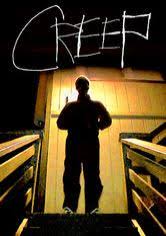
So, director Patrick Brice’s Creep franchise isn’t really horror–at least not in the pedestrian sense. It’s not slasher, though from the title and the title cards you might expect it to be.
That or exploitation.
See what I mean?
And in my opinion, that’s a mistake. Not that I have anything against slasher or exploitation, it’s just that–for the most part–those particular (sub)genres aren’t very sophisticated.
(Relax. I said for-the-most-part.)
And Creep and Creep 2 are very…well, they’re more clever than sophisticated, but still…
It’s kind of like false advertising–the old bait and switch–and like any good sales agent will confirm, that can backfire on you. Hence, I’m not so sure that Creep has really found its audience.
If that’s the case, then that’s too bad. A lot of people are missing out.
The franchise falls into a hybrid subgenre that can best be described as psychological/found-footage horror (with a healthy smattering of black comedy thrown into the mix.) Much like the title character, the films are disquietingly approachable, yes, even weirdly–NO—horrifyingly, yet, adorably unique.
Cute even.
Confused?
That’s part of the fun.
Josef (Mark Duplass) is the creep, of Creep. He’s the kind of guy who lives to freak people out. Literally. That’s his job.
(Well, he’s independently wealthy so he really doesn’t have a job, but you know what I mean… )
For instance, he might tell you that his mom has cancer…or that he has cancer…and when you get all sad and empathetic, he’ll pull a Joe Pesci in Goodfellas on you. “You should have seen you’re face” is one of his favorite games. And he will go to elaborate extremes to pull you in. He’ll drop trou, trick you into confessing an embarrassing story, jump out of a closet and scream in your face…
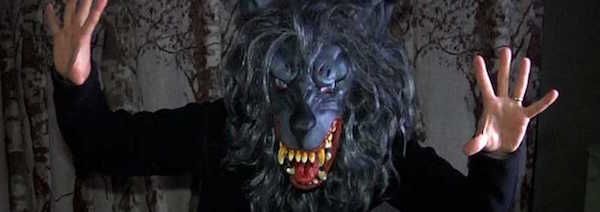
And then there’s Peachfuzz.
Yeah. That’s him above.
Peachfuzz is a mask that Josef’s father designed, or so the story goes. Josef likes to scare people with it…he likes to make them feel uncomfortable…unnerved…like when he does this crazy little song and dance…
Hello, my name's Peachfuzz
I might look like
I'll eat you up
But I'm friendly as a rabbit
Scary. And funny. It really is.
I mean, even though the guy’s a real creep, you can’t help but like him. I’m serious. He has these boyish good looks and this mischievous charm, the way he just goes for it.
And there’s this alluring–I don’t know that I would call it a twinkle–it’s this impish glow in his eyes. That’s how he gets people to go along with his shenanigans even as they grow increasingly wary. And worried.
The people, not the shenanigans…
That and his money. He runs ads in search of videographers on Craig’s List, offering a thousand dollars a day.
And just what does he want videoed?
Himself, of course…just like any self-respecting malignant, psychopathic narcist would.
Stream Patrick Brice’s masterful horror franchise Creep and Creep 2 on Netflix. Skip it if you’re looking for gore.
When I was a kid I had to take an afternoon nap. And though I’ve always required more sleep than most, I hated it.
My mother was very strict about naps. (Apparently, if I didn’t get enough rest I would turn into a near demon, the transformation reeking havoc with my respiratory system.) She, or my sitter, Mrs. Hughes, would stealthily crack open the bedroom door. If caught reading a comic book or listening to my transistor radio with the ear piece, the items would be taken away, banished to the top shelf of the hall closet, temporarily, but still…
And I would be doomed to an even longer nap.
Consequently, I became an excellent fake sleeper. Mrs. Hughes was almost always fooled.
One time I rolled off the bed in my sleep. The loud thud prompted Mrs. Hughes to rush through my door where she found me, miraculously, fast asleep on the floor.
Never one to betray much emotion, I could tell she was worried when she sat me on my bed. She peered intensely into my eyes as she ran her large and meaty fingers over my scalp, an ever present cigarette dangling from her lips.
The ruse worked and backfired at the same time. I was allowed to get up, but I had to stay inside all day.
My mother–though far less gruff than Mrs. Hughes (in fact, not gruff at all)–was a harsher critic of my acting skills. But she had to earn a living, so Mrs. Hughes oversaw the “siestivities”.
You got what I did there, right?…siesta…”siestivities”…
Just making sure. Anyway…
The required duration was about two hours. In other words, an eternity. There was no clock in my room, though it wouldn’t have mattered if there was; I had trouble telling time. By the time I learned, I no longer had to nap.
I was off the clock.
But prior to that, there I would lay, miserable, with nothing to do. Perhaps I could have gone to sleep if I’d tried, but that never occurred to me. I had to resist. And resistance hinged on my ability to gauge the lapse of time.
Obviously, Mrs. Hughes enjoyed my naps more than I did, during which she ate lunch, folded laundry and rolled cigarettes–all while soap operas droned.
How much more she enjoyed them is debatable. Mrs. Hughes wasn’t the soap opera type. (When I was at her house she watched Gunsmoke and Wagon Train.) But we didn’t have cable so that was that.
That and PBS.
Of course, I couldn’t have cared less about soap operas if not for one thing…
At noon I ate lunch. I knew this because that’s when Mrs. Hughes would turn on the television. Hi Noon, the local afternoon news and “entertainment” show was on. I ate my lunch on a TV tray so I could watch Hi Noon regular, Roscoe the clown, draw clowns…and dogs, and cats, and cowboys, etc…
I didn’t like Roscoe, not because he was a clown–he wasn’t creepy–but because I just didn’t. Nonetheless, I pretended to. It would have hurt Mrs. Hughes’ feelings if she’d known truth. Her son, Travis, a surly high schooler who spoke all of five words to me, was a great artist (of that I can attest–I saw some of his cartoons; amazing and amazingly explicit.) Apparently, as a child, he was inspired by Roscoe.
After Hi Noon it was nap time. No sooner had Mrs. Hughes situated me between the the blanket and the top sheet ( I wasn’t allowed to untuck the sheets like I did at night) I would hear the those painfully pretty piano chords, then the dramatic counter chords, the swell of strings…and more strings…building…building…toward the bridge…
The Young And The Restless was on.
After The Young and Restless, there was As The World Turns. And then, The Guiding Light.
A marriage is a living thing–kind of like an entity, or a soul. Within are the experiences of two lives merged into one.
A birth. An infancy. A childhood.
Then comes the teenage years. And the young adult stage.
Many marriages don’t survive beyond this point, which is usually seven to ten years. Circumstance rears its ugly head; the unexpected looms large and then lowers the boom. The marriage is overcome. Neglected. Or just abandoned.
In this regard marriage shares more qualities with a mistreated pet than it does with a soul. It ages fast. Especially if there are children involved.
Even so, a marriage can live a long, long time. The phrase ‘until death do us part’ comes to mind.
Resilience is key. And commitment. And compromise.
And what of passion? Of love? One might ask.
One might…if one is young. At least, that’s the thesis of first time director/writer/producer Robert Machoian’s achingly quiet, visually stunning dramatic film treatise, The Killing of Two Lovers, in which journeyman actor Clyne Crawford (in a mesmerizingly compelling performance) plays husband, David.
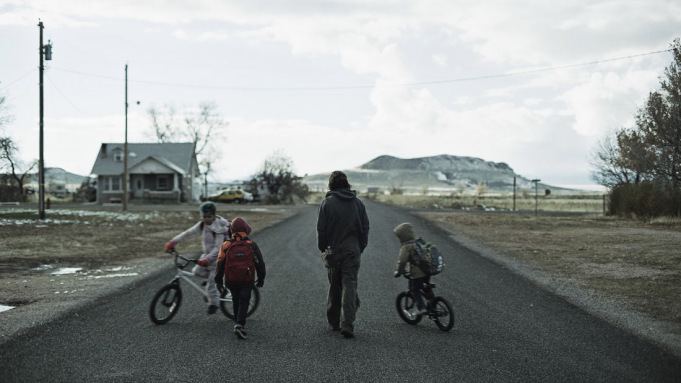
David is young, in his early thirties, but he and his wife, Nikki, have been married for years. She too is young–his age. They have children–a teenage girl and three young boys.
As high school sweethearts in a tiny town they’ve never left, they had their daughter, Jess. For David, Jess is the catalyst of their marriage; for Nikki, she is the reason.
Their story and their images are woven into a stark, purposeful vision that fixates, from a distance, on the expanse of prairie land, of unencumbered skies and tumbleweeds, of the loneliness of barren roads and a windswept playground, sweeping over the desperation of peeling paint, of a crushed cup littering a discount store’s parking lot.
Nikki has grown tired of this life. An aspiring paralegal, she has only recently tasted the first fruits of a career as opposed to a job–they are sweet. The possibilities are sweeter still. A lawyer in the building where she works encourages her to aim higher. They begin an affair.
David knows about it. Even if Nikki wanted to, it would be impossible to keep it secret in a tiny town.
But she doesn’t hide.
She and David have agreed to a separation which means that he lives in his old bedroom of his father’s house, just a short jog down the road. They have also agreed that they can see other people.
Nikki asks if he’s thought about getting his own place.
Still, David clings to hope. He adores his family. All he’s ever wanted to be is Nikki’s husband and a father to their children.
Well, almost. David’s a decent singer songwriter. He was once in a punk band, but he let go of those dreams and never looked back. Nikki’s audience is enough. He loves her.
She loves him too, but differently, gently, even as she steers him toward the roaring waters of divorce. When, during an argument, he is barely able to contain himself, she scolds him, careful to protect his impetuous inner child, though it’s the child she’s grown weary of.
Daughter Jess is weary of him too. David knows this so he coerces her to spend time with him, but spends it romping around with the boys, buying them expensive toys the family can’t afford…rockets. He buys one for Jess also.
When her rocket fails to lift, he doesn’t understand why she storms off. His love for her is oceans wide. Why can’t it be enough?
Funny how it’s not enough to stop him from stalking Derek with a gargantuan pistol, ready at the reach. And it’s not enough to startle him out of blowing Nikki and Derek’s heads off with it either–a toilet flushing thankfully does the trick–when he finds them sleeping together in the home where his children lay. He slinks away as Nikki and Derek barely stir, only to act as if nothing happened when he stops by later to walk the boys to school.
So yes, it’s complicated.
Yet despite David’s dance with murder and Nikki taking her lover into the marital bed, there are no monsters here.
No Jezebel. No Mr. Hyde.
Just David. Just Nikki. Their children. And their marriage.
Therein lies the tragedy. And the movie’s battered, but still beautiful soul.
THIS IS A STORY BASED ON THE TRUTH. IT FALLS WITHIN THE GENRE OF HISTORICAL FICTION. THE NAMES OF THE CHARACTERS, THE LOCALE AND MANY OF THE CIRCUMSTANCES ARE HISTORICAL AND FACTUAL. I HAVE TAKEN LIBERTY WITH SOME INCIDENTALS AND THE DIALOGUE, BASING THEM ON THE ERA, THE SITUATION AND THE CHARACTERS INVOLVED.
CONCULSION
Par for the coarse; that’s what Vito Genovese thought about the whole Little Augie thing. The way he tried to hide behind a woman in the end…par for the coarse.
And Janice Drake?
He didn’t think a thing about her. She was incidental as opposed to accidental.
Now, if she’d been accidental, there’d be hell to pay. Especially if she was a “nice woman”…a “God fearing woman”, like Donatella, his first wife; God rest her soul. So young and beautiful, she died from tuberculosis because she was such a saint…
It’s true. She took the sacraments of the holy church very seriously. Not only that but she went above and beyond the sacraments; she did good deeds. During the Depression, she volunteered in soup kitchens and homeless shelters where unemployed Italian laborers and their families suffered the often slow death of depravation…that’s what his Donatella did…the mother of his Nancy.
That’s how she got sick.
He wanted to forbid her from her volunteer work, but he feared standing in her way. It was one thing to assist in the commission of sin. It was another thing to obstruct the commission of good.
She contracted mililary tuberculosis, which, under a microscope, appears as hordes of tiny concave millet seeds. It’s like cancer. It can spread from the lungs to other organs until a person is consumed by it, that’s why they call it “consumption”…or they used to call it that…so he gave her the biggest funeral New York had ever seen.
Yes. Even bigger than Frankie Yale’s.
But she wasn’t a nice woman…Janice Drake wasn’t.
She wasn’t like Donatella at all. She was more like his second wife, Anna, who trotted out their dirty laundry for everyone to gawk at…
Her lovers. Men and women.
And she had the nerve to cry to the press about his unfaithfulness.
He felt bad for her kid, though…Janice Drake’s kid…
She had a boy…her and that comic.
The Drake Family in morning
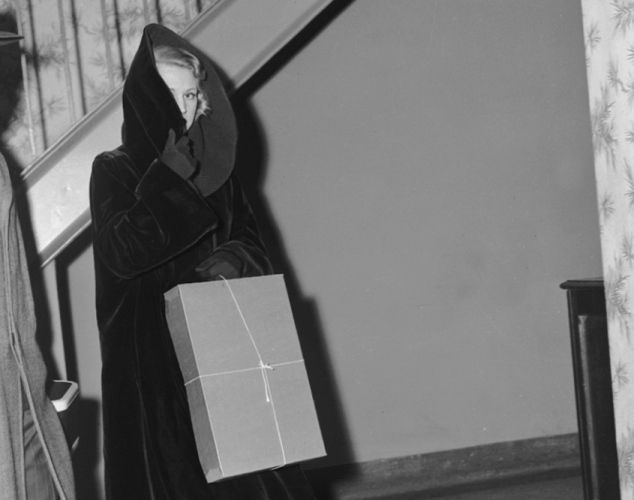
The family of slain Janice Drake (l. to r.) June Hansen, her stepmother; Harold Hansen, her father; Harold Hansen Jr., her step brother; Alan Drake, her husband, and Michael Drake, her son. (Photo by Phil Greitzer/NY Daily News)
Drake was onstage at the Lotus club when he got the word. The front of the house manager came onstage and whispered in his hear.
“There’s a call for you backstage, Drake. It’s urgent.”
And that’s when he felt it, yet, again–a wave of nauseating revulsion that gave way to the briskly crisp, the startlingly clear shiver of fear. He knew, immediately, before he was told.
He chartered a flight to New York and took a taxi straight to the morgue. When the medical examiner pulled down the sheet he vomited on the floor.
The press awaited him as he left the morgue. “I just lost the greatest wife a man ever had,” he said.
If the sentiment fell a little flat, if it seemed too rehearsed, too canned–there were tears in his eyes.
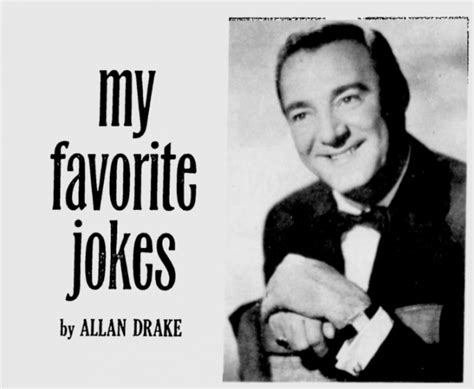
It was pure Allan Drake.
Back in the day, back in the early 60s, Redd Foxx…Sanford and Son…yeah…he played Sanford...he got pretty tight with Allan Drake.
Redd worked this little club in Vegas. And he worked “blue”…he was a dirty comic…underground records…paper bag stuff, like a dirty magazine. Same time Lenny Bruce was doin’ it, Redd Foxx was doin’ it. Hell, he was doin’ before Lenny Bruce.
Redd Foxx got away with it though.
The word was, Redd got a lot of blow from Allan Drake. Cocaine.
That’s where a lot of Redd’s money went. Straight up his nose. And Redd was a big time player. He burned more money than Allan Drake ever made. He was a real talent. A pioneer.
But he lost everything. Even his house…and it wasn’t a mansion or anything…just a nice brick house. Ranch-style.
Eddie Murphy had to pay for his funeral.
To this day, people in the industry don’t like to talk about Allan Drake. That whole episode with his wife…it was scary.
Not a good guy. Sorry.
Things didn’t just dry up and blow away when Little Augie and Janice were killed. They didn’t just dry up and blow away because Drake kept his mouth shut and his head held high. He carried on with dignity.
People felt sorry for him. So he got plenty of work.
He became a journeyman of the small screen where he was a regular guest on The Jackie Gleason Show and a semi regular on The Ed Sullivan Show and The Dean Martin Comedy Hour.
And, yeah, he was on Johnny Carson. Several times.
He showed up as a guest star on series, too, like Cheyanne, Get Smart, The Courtship of Eddie’s Father, Too Close for Comfort and even snagged a reoccurring role on Sandford and Son as Fred’s brother-in-law, Rodney Victor.
Of course he worked Vegas. He opened for some big timers : Tom Jones, Engelbert Humperdink, Tony Martin and Vic Damone.
And then there were his side hustles. He was connected.
All and all, he made a nice living.
His son, Michael, grew up to be a physician.
One time, Drake was doing a show in Vegas and he had a heckler. This guy was giving him a real hard time. He yelled something like, “…don’t worry. I’m not gonna hurt you. I feel sorry for you.”
Drake walked right up to the edge of the stage. It was the 70s and he had some age on him, he was too heavy…but he was a big guy…an ex-boxer. He was wearing those big, thick frame glasses they wore then. So he takes them off and just stares at the guy. Stares at him a good…I don’t know… ten…fifteen seconds. Then he points at the guy and says,
“Don’t feel sorry for me, pal. Don’t you ever feel sorry for me.”
The way he said it. Cold. Quiet. His eyes got real black.
The guy shut up.
So did everybody else. You could have heard a pin drop the rest of the night.
≅
“Allan Drake was just a comic, a funny man and… I’d rather not talk about the rest of it.” Lou Marsh (actor, comic, writer, Miami nightclub mainstay.)
“There was nothing wrong with him. He was sweet. Kind of a hard guy, but sweet and charming.” Saul Turteltaub (writer, television producer, comic)
“I wrote for Allan Drake for quite a few years. I lost track of him. I did understand at one point he was selling cocaine toward the end of his career. A lot of the things that he did were scary, immoral things.” Sol Weinstein (novelist, humorist, sitcom writer, radio talk-show host)
He bet on the wrong horse. It was as simple as that.
He bet on the wrong horse because he let himself be influenced by his emotions, by his likes and his dislikes. He should have just stuck with the odds. He was a gambler, after all.
Time and distance. That’s why Luciano’s word no longer had the influence it once did. People forgot how rich he made them. They resented it when the newspapers called him a genius.
And they were tight bastards, too.
Little Augie knew all of this and, yet, he bet on the wrong horse…that’s how much he hated Vito Genovese.
The first time Genovese called him, after the botched hit on Frank Costello, he didn’t go. He disrespected Genovese. But Anastasia was still alive then.
The second time Genovese called him, Little Augie had to go. There was nobody standing with him.
∼
When Drake had the opportunity to help out some comic in over his head with a bookie or a drug dealer, he usually would. He was shrewd about it though, because he didn’t want to aggravate Little Augie by asking for a bunch of favors. So he went into his own pocket.
Sometimes, Drake was the one the comic was in trouble with and he would let it go. He didn’t push his weight around like he could have.
Stuff like that got around.
So when things started going south for Little Augie, Drake knew all about it because people told him things he wasn’t supposed to know. The trouble was, he didn’t know what to do about it.
It’s not like he could quit. You don’t quit the mob.
But when Anastasia got hit, that’s when it really hit home. Little Augie was no longer the benefactor; he was the albatross. Drake knew he and Janice had to get out of town before Little Augie made him his driver again.
That’s when he started hording cash and hiding it around town.
∼
Janice was getting ready for a night on the town with her girlfriend Madeline when she got the call from Drake; that was part of her job, to make herself available. Drake called from D.C. where he was headlining a show. He sounded frantic. It bristled her.
“Steer clear of Little Augie,” he warned her. “He’s hot as a firecracker.”
“Yeah, sure,” she agreed, but what could she do? Make an excuse? Feign an illness? When you’re in the game you have no choice but to play.
She told her son to answer the calls that came in while she was away; he was twelve at the time. She told him to tell every caller that she was out for the evening and to ask if he should take a message. Any caller that he called uncle or auntie, he was to tell them that she was at the Copa.
If she and Drake were going to skip town they had to keep their cool about it, she reasoned. Go on as usual. Then they would lay low in some Podunk town, like Fayetteville, until things settled down. Drake would leave a good chunk of their assets behind for the vultures to pick through until they showed back up…like nothing ever happened, of course.
That was the idea, anyway.
∼
At the Copa, Janice and her girlfriend, Madeline, ran into a stock broker friend of theirs, Irving Segal. Originally they were supposed to meet up at Mariano’s with Segal and his wife for dinner, but the wife couldn’t make it.
Nonetheless, they welcomed him to their table…that meant he would be picking up the check. They were having a grand old time when Little Augie sauntered by.
Of course they made it a foursome.
∼
Little Augie suggested that they have a few more drinks and head over to Marino’s for dinner. Everyone agreed.
Since he made the suggestion it was presumed that he would pick up the check.
∼
Nobody knows for sure who made the call to Marino’s that night…and if they do know, they’re not saying. The Maitre d’ most likely knew who it was. He’s the one that took the call. He’s the one who came to the table and whispered in Little Augie’s ear–in the middle of dinner.
According to Madeline Unger, Janice’s girlfriend, Little Augie went as white as a sheet when he left to take the call. When he came back to the table he was a little shaky, like his feet weren’t under him. He made a slapdash excuse–that he and Janice were called away to watch a closed circuit televised boxing match.
Janice said she really shouldn’t go…that she needed to get home to her son whom she had left alone. Little Augie said he’d drop her off before going to the match.
Irving agreed to make sure Madeline got home all right.
Little Augie and Janice made their way to the auto lobby.
∼
I’ve heard this is how it went down…I don’t know that it happened this way, but if it didn’t, I’m sure it’s pretty damn close:
So, Little Augie and Janice got into the elevator which took them to the garage. Somewhere, between the time they got into the elevator and the time they contacted the valet driver, they were intercepted by fellow capo, Anthony Strollo and Bonanno crime family hitman, Tony Mirra.
They were warned not to make a scene. When the valet brought the car, Little Augie and Janice got in the front. Strollo and Mirra got in the back.
The valet was paid off. He told the police that only Little Augie and Janice got into the car.
Around 10:30 that night, a ’59 Cadillac was discovered in a deserted section of Queens, by the airport, with the engine running and the headlights on.
Anthony Carfano and Janice Henson Drake were found slumped inside the cabin, both shot dead with a 22 round in the temple and neck.
So everybody’s heard it, that saying about “there’s no honor among thieves.” And, well, that’s a very ambivalent statement. Because it’strue, up to a point, like everything else. It depends on how you look at it.
The deal with Lucky Luciano, they were very loyal to him. The whole mafia. The whole syndicate. And that’s two different things, by the way–the mob and the syndicate.
The mob is basically another word for mafia. The syndicate is all organized crime, whether Mafia, or Dixie Mafia, or Bloods, or Crips…American organized crime.
It’s different in Italy…in Columbia..in The Philippines.
Different, but the same. Funny how that works.
You see, Luciano was in a very unique position. He was the boss of all bosses, but he refused to call himself that. In fact it’s the only time in American organized crime history that there really was a boss of all bosses.
Oh sure, there have been heirs to the throne, but in name only. Luciano’s the only boss who had absolute power.
And during a very small window of time, from 1931 to 1936, he ruled with impunity. Restrained impunity–which betrays a trait of genius.
That’s right, humility is a trait of genius…when you can reign in your own appetite…when you can have anything you want…but, he got himself in a serious jam, did a long stretch in the joint and got deported. Even then, he was immensely powerful.
And then, bam! Just like that, he wasn’t.
Well, to be fair, it happened over several years, but, when it did happen, it seemed like it came out of nowhere…like when Kennedy got killed. And that whole thing was years in the making.
But that’s the way life is. You’re up. You’re down. It’s a roller coaster ride.
The fact is, Luciano expected to be taken care of. And why not? He couldn’t earn. The feds watched him like a hawk, even when he was in Italy. It didn’t matter. They still watched him, so everybody pitched in. But not like Luciano wanted.
Frank Costello. Joe Adonis. Albert Anastasia. Little Augie. They were on Luciano’s side.
Everybody else was on Vito Genovese’s side. Vito wasn’t big on kicking up to Luciano…and he was in that little group that went all the way back with him, so he had clout.
Then Adonis got deported to Italy and Luciano expected him to be his benefactor. Joe got sick of picking up the check all the time…
So that’s when they all got together and put out the hit on Frankie because they knew he would never go against Luciano…that bullet just about took Frank’s ear off. Chin Gigante was the hit man.
He missed.
Costello wasn’t stupid. He retired in style. He was on good terms with everyone because he refused to identify Gigante. He got to keep his money and his life.
Anyway, then they went after Anastasia. They got him, famously. And nobody cared.
Everybody was pissed because of the way he handled the whole Lepke Buchalter thing. Lepke had a lot of friends. Plus, Albert Anastasia was a nasty guy. He really was.
Recently I started a podcast. My intentions were to start a true crime podcast about a missing persons/serial murder case that I have been researching (trying to solve) for the last two years.
But as I know next to nothing about podcast, I decided to get my feet wet in the podcast world with something I’m a little more familiar with–and so I settled on what I know best: music and cinema.
So my podcast is about the cinematic needle drop, that’s where a film sequence is accentuated with pop music–like in Goodfellas when Jimmy Conway, as portrayed by Robert De Niro, gets ultra-paranoid about loose lips regarding the Lufthansa heist and starts whacking his accomplices right and left…and the camera lingers on the dead bodies after the purge, going from one chilling death scene to the next as Derek and the Dominos, the piano coda from Layla, plays serenely.
That’s a needle drop.
And that’s what my podcast is about…music and commentary from and about various film soundtracks.
I will embed podcast episodes in my posts from time to time. You can also find my podcast on Podbean; I’m in the process of getting it on more sites so that it will be more accessible.
The episodes are an hour long.
Cheers.
I Heard it in a Movie: A Podcast about Music and Cinema – Musical Confetti
I Heard it in a Movie : A Podcast about Music and Cinema – Electric Eclectic
My husband and I held hands yesterday as the Chauvin verdict came in. When the verdict was read, my husband released my hand; he began to clap. Not me. I just felt empty. I remembered a post about this cruel tragedy from my friend Stacey. It expressed what I could not. Rest in peace, George Floyd. I’m so sorry this happened to you.
The timing of my last blog, Acting While Black, was a little ironic, coming as it did shortly before the latest incident of police brutality/murder in the U.S.
The premise that black characters rarely survive in movies of certain genres seemed absurdly laughable and it felt worthwhile to jog down that road a little bit, stopping at the glitziest and shiniest of hilarious examples.
After the past week, the humor of Acting While Black has soured in my mouth pretty much. The past week has been a case, for me, of tears over laughter instead of the other way around. I don’t know what’s going to happen. I don’t know if this is the beginning of the end or not.
But I know one thing. I know that a pocket wasn’t meant to hold a quiet hand while a heart stopped and a voice asked for his mother.
I share a love of film and music with my friend and fellow blogger, Mikey over at Wolfman’s Cult Film Club. Mikey has a huge, eclectic record collection; I’ll put it this way, I was quite impressed with my own collection–until I saw his. Wow!
And while I dabble in jazz, Mikey is a bonafide jazz aficionado. He walks the walk and talks the talk–and he’s got the records to prove it.
So, in light of my post on the jazz heavy noir, Odds Against Tomorrow, I asked Mikey’s permission to repost his very “hepcat,” Where Has Poor Mikey Gone?
A friend sent me word of this once rare, and I imagine, seldom seen British film oddity called Where Has Poor Mickey Gone? (1964). I’d never heard of it, however, I knew the filming location well. Set in the early 60s in London’s Soho area. Long before I would travel there on the train from my south coast hometown every other weekend to spend my wage packet on vinyl records. From the late 80s through to the early 2000s it was a mecca to me and many music heads for its vast assemble of filled to the brim, record shops. Most famously for Berwick Street, a street lined with the holy grail of crate digging flicking fingers.
A while back I was fortunate to review Robert Wise, The Motion Pictures by J.R. Jordan, a studious filmography about Robert Wise–of course. I say of course because, yes, the title of the book is titular, but I’m also referring to the tendency of American film critics to underrate the multi-award winning director.
It’s a total snob job, quite ridiculous. Certainly Wise had some missteps, but his greatest failing, according to his critics, is something that I won’t fault him for–directing a few sequences in the Orson Welles masterpiece, The Magnificent Ambersons.
That was his job. It fell on him to do what Orson Welles would not. Either that or quit.
The Magnificent Ambersons is a landmark film despite Robert Wise’s directorial contribution, not because of it. Everybody knows that.
Regardless, the rub against Wise is that he has no signature, which is another way of saying, he has no style. And that’s the worst thing you can say about an artist.
And it’s not true. Robert Wise did have a signature…
Realism.
That’s it, if I had to sum it up in one word. And his signature of realism didn’t just manifest itself within the genre of realism–no. It’s in the precise, almost microscopic, sense of detail present in every one of his films, regardless of genre.
That Wise’s signature is subtle doesn’t mean that it is inferior.
It means it’s intelligent.
And that composition of grit and intelligence drapes the contours of noir quite nicely. In fact, I would argue that in terms of consistency, Wise’s most artful films come from noir and that his best noir, the racially hard edged, The Odds Against Tomorrow, starring a spectacular Robert Ryan and an impeccable Harry Belafonte, is unfairly overlooked when it comes to masterpieces and near masterpieces.
While Robert Wise–rightfully–would never be described as subversive, he did collaborate with subversive artists. One such artist was Harry Belafonte. Another was Abraham Polonsky.
In 1958 Belafonte was at the forefront in the intersection of looks, talent, charisma and civil rights. At considerable risk to his personal and professional security, he openly associated with Communists and Communist sympathizers within the entertainment industry who were egalitarian. As the CEO of HarBel Productions, he tapped black listed director and writer, Abraham Polonsky to write the screenplay for The Odds Against Tomorrow, while navigating the aftermath of the McCarthy investigations and participating in the modern civil rights movement.
Though jazz and noir had hooked up many times before, Belafonte literally links them with his portrayal of entertainer/musician, Johnny Ingram. The parallels and contrasts between character and performer are intriguing.
Like the character Johnny, Belafonte is a jazz enthusiast, who famously performed with Charlie Parker, Max Roach and Miles Davis. But unlike Johnny, he is not a jazz purist. Belafonte is a stage actor, musician and pop artist who could–and did–sing just about anything.
Similarly, both character and artist are nightclub entertainers though Belafonte on a grand scale and Johnny not as much. Even so, if ornamentation is an indicator, Johnny makes a nice living if not for his gambling addiction, which has torn apart his marriage, separated him from his child and put him in debt to mobsters.
Like so many criminals, Johnny does not apologize for his choices. He is bitter about them, nonetheless.
Still, we are impressed as he suavely croons and plays the Marimba in a haunting rendition of My Baby’s Not Around with Modern Jazz Quartet at the club where he is employed. We admire him as he cruises the scene in a beautiful, white, convertible Corvette and we worry about him when he is confronted by a loan shark and his unapologetically gay henchmen.
And we worry about him because he is black.
It’s 1958…so we should be worried.
Johnny’s debt (and his beautiful, white, convertible Corvette) drive him to the apartment of Burke, (Ed Begley) a corrupt, disgraced former police officer living hand to mouth because his pension has been stripped. He’s the one, Burke is, who comes up with the “perfect” heist. At the apartment Johnny crosses paths with Slater, (Robert Ryan) an aging, vehemently racist, he-man desperate for a score.
In fact, all the characters are desperate in The Odds Against Tomorrow, except one.
There is Lorry–played by a terrific Shelly Winters–who despite being astute in the business world is attracted to Slater’s tough guy magnetism. Then there is Helen, Lorry and Slater’s next door neighbor, played by Gloria Grahame. She, too, is attracted to Slater–slovenly so.
Grahame sizzles as a defiantly promiscuous woman who is turned on by violence. Never lewd, her performance evokes both interest and disgust; it is brilliant.
And finally there is the newly single Ruth, (Kim Hunter) navigating her way around the landmines of mothering and breadwinning in a racist, sexist environment. Unlike her ex-husband, she is not bitter. Instead she is determined. She doesn’t shatter when Johnny accuses her of being cold. She doesn’t apologize for being responsible.
Under Wise’s generous direction, the talented cast channels his vision of stylistic verve tempered with wincing realism, creating an atmosphere of dread. And as fine of an ensemble cast as it is, it does have a stand out.
Robert Ryan.
He is scary good as Slater, a racist creep who resents the hell out of the smarter, better looking, more successful Johnny. Slater is volatile and unsophisticated. What he is not, is stupid. Consequently he understands his impulses enough to anticipate his own failures as he lurches from one disappointment to another.
As Slater, Ryan creates a memorable heavy.
For all that, where The Odds Against Tomorrow ultimately excels is in the vision of its director. Allow me to set the opening scene:
It could be a stream, the way it ripples. But it’s not…
They could be leaves carried by the rippling. They are not…
It’s rainwater collected in a gutter; the rippling caused by wind pushing trash–not leaves–up an empty street.
It’s kind of beautiful. And it shouldn’t be.
It’s art.
It’s Robert Wise.
I Heard it in a Movie: a Podcast about Music and Cinema – Musical Confetti
I Heard it in a Movie: a Podcast about Music and Cinema – Electric Eclectic












 All Things Thriller