
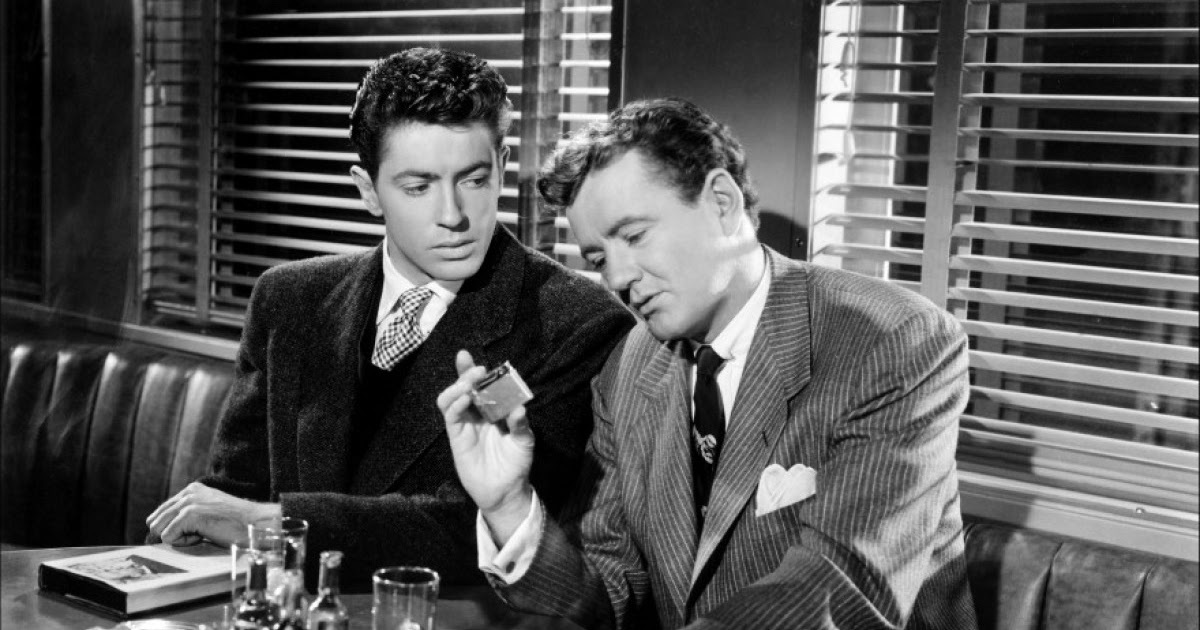
Of course, everyone has seen Strangers on a Train, the quintessential psychological thriller by the master, Alfred Hitchcock. Quintessential not because it is the best, though it is deservedly in the top 2o of just about every cinephile’s list, but because it is the best representation of the genre through the lens of its elements: light verses dark, the shades of gray in-between, twinning, egocentric love and hate, the physical, dogged pursuit of control, the fear and anguish of losing it.
In fact, in all of cinema, no director’s cannon is more ubiquitously symbiotic with the psychological thriller than Hitchcock’s, with the possible exception of the great Ingmar Bergman. (That the latter’s work tilts more toward drama is duly noted.) Still, it is interesting that Erik Skjoldbjaerg, director of the equally quintessential new wave Scandinavian psycho-thriller Insomnia (1997), tips his hat not so much to his fellow Swede, but to the Englishman.
Bleak. Intriguing. Haunting. Insomnia is more noir-like than Strangers on a Train. It is also more economical with action and more reliant on atmosphere and rumination. In this way, more like Bergman.
Yes, there are chases, combat and gunplay–but not because they are formulaic. Here realism trumps style. Action is the consequence of physics.
In Strangers on a Train, the plot coalesces around a complicated conspiracy between two men, one of them as fundamentally decent as he is desperate to find a way out of circumstances orchestrated by the other, a sadistic psychopath. Their conspiracy represents the intrusion of evil, via circumstance and stress, into an otherwise stable psyche. Insomnia is about much the same thing, but here the conspiracy is less grandiose, while the conspirators are similarly troubled souls– one a cop, the other his quarry.
Jonas Engstrom (Stellan Skarsgard) is the cop, a high ranking homicide detective; a star of sorts–this in spite a rather public incident in which a skeleton escaped his closet. Thus he’s sent to a snow drift above the Arctic Circle in the hinterlands of Norway, tasked with leading the investigation into the murder of a seventeen year old girl. The local cops are worried; the killer’s MO is sophisticated and there are possible signatures pointing to serial homicide.
In Tromso, he is assigned to a reginal supervisor, Hilde Hagan (Gisken Armand) with whom he may or may not have history. Though friendly, even coy–like Strangers’ provocative Barbara (Patricia Hitchcock)–she is leery of him too.
Taciturn, enigmatic, clocked in steely attractiveness and stylish attire, Engstrom is not an easy man to like. He makes insensitive comments about untoward observations of which he either thinks are funny, or doesn’t bat an eye.
His male colleagues whisper behind his back. Hagan does not.
Engstrom checks into an inn where a no nonsense, yet comely clerk is attracted to him. Appreciating that he doesn’t hit her up for drinks or intrude on her personal space with innuendos, she mistakes his uneasiness for politeness. She gives him tape so that he can fix the shade to the window. Daylight is as unrelenting as the temperatures are cool in the city of Tromso–the phenomenon of the midnight sun.
As Engstrom makes the rounds of his investigation, attending the dead girls autopsy–her name is Tanja–sifting through belongings that are too expensive for her to afford, interviewing school mates, getting rough with an uncooperative boyfriend, the ever present sheen of sweat above his top lip spreads across his face. This despite snow still visible in summer. The tape isn’t working. And Engstrom is a man who needs what little sleep his is accustomed to.
Increasingly erratic, he is unable to suppress his inner tawdriness. When the comely hotel clerk makes an advance, his response is inappropriately aggressive. He reacts similarly with Froya, a cynical, world weary teen who he intimidates into disclosing the identity of Tanja’s fifty-something suitor.
His name is Jon Holt (Bjorn Floberg), a writer of pulp fiction, a man of means though he no longer looks it. Gamy. Desolate. Frayed. In him, Engstrom meets his match. More harbinger than doppelganger, Holt is older than his pursuer. That he isn’t as smart is of little consequence. He knows Engstrom’s secrets; he has the receipts.
Unlike the sadistic Bruno (Robert Walker), who relishes Guy’s (Farley Granger) predicament in Strangers on a Train, he takes no pleasure in witnessing Engstrom’s pain or doling out his punishment. When Engstrom announces his plan to frame Tanja’s boyfriend, Holt’s piercing blue eyes blink before they film over, first with surprise and then with empathy.
In his full length picture debut, Skjoldbjaerg turns the essence of noir upside down. Here sunlight pervasively penetrates and darkness is largely confined to the mind, so demons are left to crouch in coastal Tromso’s atmospheric fog more than shadow. Fittingly Skjoldbjaerg films within the glare of white on white–curtains, walls, latex gloves, blanched skin–and in miry hues of seafoam, sage, cornflower and slate. It is a sickly pallet offset with pops of richness.
The camera work is largely straightforward, giving Insomnia a weathered, wind swept look. But Skjoldbjaerg embellishes Engstrom’s sleep deprivation induced psychosis with hallucinatory jump cuts, filmed from angles that blur his perspective of time, space and place, as well as his sense of self.
All this begs the question, is Insomnia really a thriller?
And is Skjoldbjaeg really channeling Hitchcock’s Strangers on a Train?
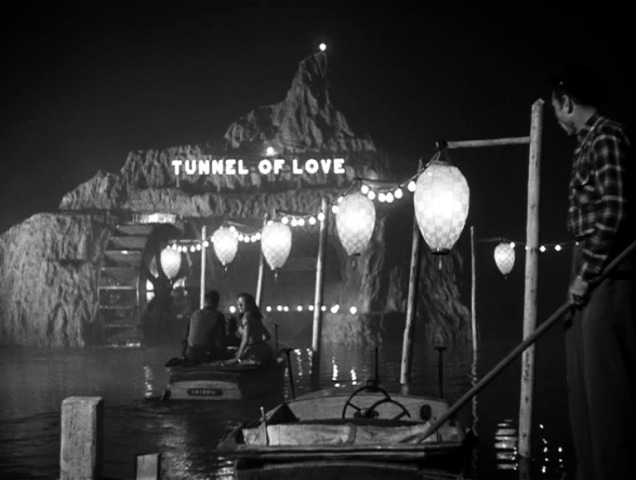
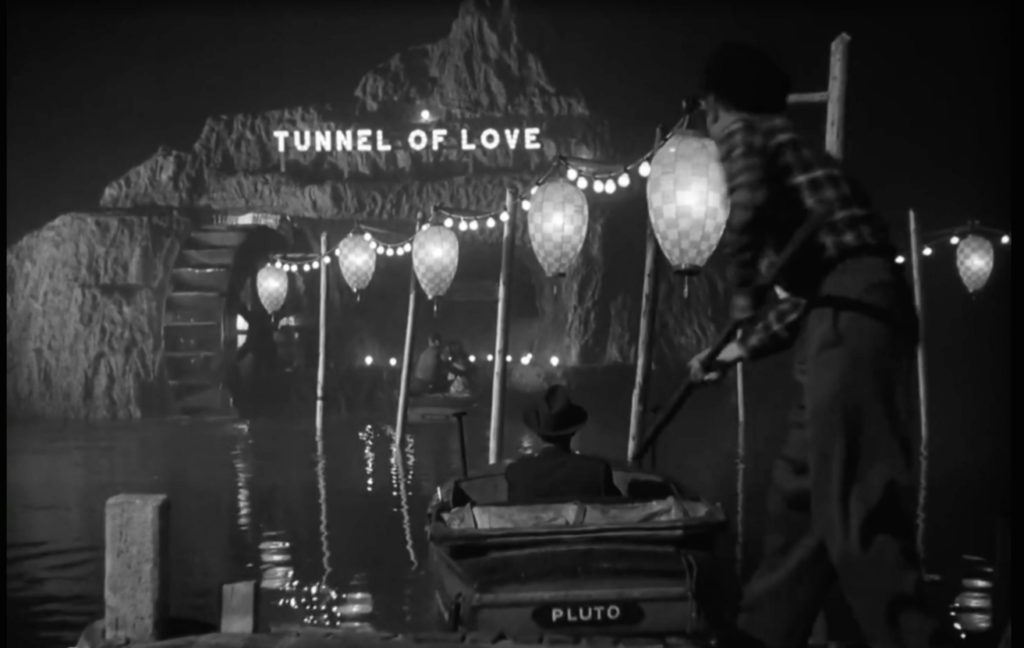
In one of the only sequences filmed in darkness, Engstrom chases the killer through a bunker and we are reminded of Bruno pursuing Miriam in a boat through the tunnel of love. There, Hitchcock ratchets up the tension by using a night time setting against a continuum of light: the glare of carnival rides; silvery flashes in the tunnel; the subtle glow of a lighter. Though Miriam is aware she is being pursued and who is pursuing her, she is unaware she’s being stalked. Sexually charged, she looses sight of Bruno and her head is on a swivel. He is chasing her and she is chasing him.
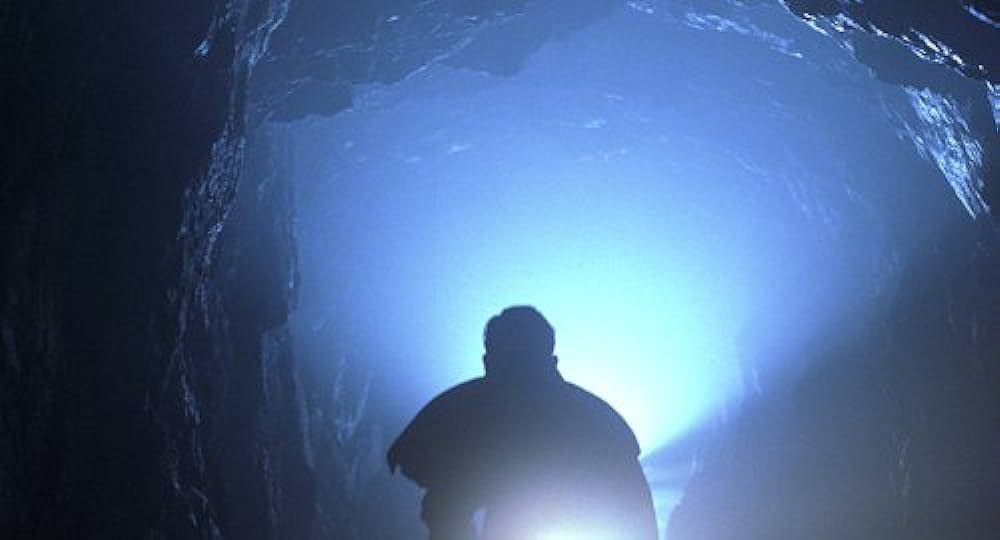
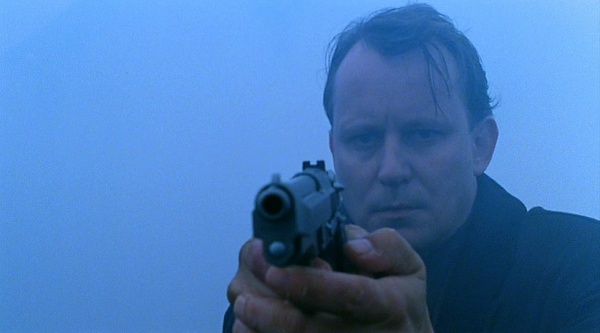
In the bunker scene, the chase is on foot. Engstrom doesn’t know who the killer is, having seen him only from a distance. The killer escapes into a bunker and Engstrom, with cohorts in tow, runs after him toward the light at the end. But when he gets there he finds it isn’t really light–it’s fog. He disappears into it where he is unable to discern who is who, and who is chasing who.
If that’s not an homage to Hitchcock and, more specifically, Strangers on a Train, I’ll eat Erik Skjoldbjaerg’s hat.
 All Things Thriller
Good to see you back, and a very interesting comparison, Pam. Strangers On A Train is one of the few Hicthcock films I like, and the original version of Insomnia is streets ahead of the 2002 remake with Pacino, in my opinion.
I hope you have rediscovered your blogging mojo, as I am looking forward to more.
Best wishes, Pete.
LikeLiked by 1 person
Thanks, Pete. I agree–the original Insomnia is a much better film than the remake. I enjoyed the remake–I’m a Christopher Nolan fan–until I saw the original. No comparison.
About blogging…all this time I’ve been on a Reddit true crime sub. I got pulled into a particular case–a real rabbit’s warren that was psychologically maddening. I wanted out, but I couldn’t find my way. It became an obsession.
I’m out of it now–thank the good Lord. Reddit, generally speaking isn’t a very nice place; so many trolls…but yes, I hope to be blogging more. Thanks for caring. Cheers.
LikeLiked by 1 person
Welcome back Pam 🙂 how was your break away from blogging? 🙂 It has been a while since I have seen both versions of Insomnia, but I do remember loving the original 🙂 As for Strangers on a Train, you are probably well aware by now that I love every single film that Hitchcock has directed 🙂
LikeLiked by 1 person
Hi, John. Nice to hear from you. My break from blogging was…interesting. I was busy with work and stuck on a Reddit true crime sub. The people here are much nicer, I assure you.
I’m going to watch the Nolan version of Insomnia again tonight. I only recently watched the original and I love it. I think it is the superior film. It is more of a psychological study than Nolan’s. Nolan’s is fancier. I think Nolan is better suited for conceptualizing big, sweeping films like Tenet, Dunkirk and Inception. I’m a big fan.
I’m not at all surprised that you love Hitchcock. He has a very big bag of tricks and he is one of the best visual storytellers of all time. I speak of him in the present because so many of his films are timeless.
LikeLiked by 1 person
Pam, oh what a treat to see you here again! I hope you are doing well.
As usual, I’m about the most ignorant person on the planet when it comes to films, but I enjoyed your description and the pace. I doubt I will watch the films – I’m so tension-averse these days that I don’t even watch my favorite teams play. I can’t bear the thought of watching UNC play Duke 😬. (Although I liked seeing the final score of the last game!)
Grace and peace to you…as always
LikeLiked by 1 person
Hello, DW. Nice to hear you from you–and thank you for your kind words…tad bit surprised that you haven’t seen Strangers on a Train. Lol! You disproved
my introductory statement. Lol!
So you are a UNC fan…what a rivalry between them and Duke with their back to back campuses and their almost identical colors! Fantastic rivalry! Can’t wait for March Madness!
LikeLiked by 1 person
Pam! So nice to see you back online 🙂
By chance, I watched Insomnia for the first time last year. Totally agree that it’s more noir and very nuanced.
LikeLiked by 1 person
Hey June! Nice to hear from you.
I know you liked Insomnia. It’s right up your dark alley. Lol!
Hope all is well. And thanks for stopping by.
LikeLike
Great to see you again!
LikeLiked by 1 person
Nice to see you as well. I would have commented on your latest post but I am one of the few film lovers who has never seen a Buster Keaton movie.
LikeLiked by 1 person
I meant Herold Lloyd…I’ve never seen on of his films either. Lol!
LikeLiked by 1 person
Safety Last! was my first Harold Lloyd movie. I felt it was special enough to be my 2,600th review!
LikeLiked by 1 person
Congratulations! You are undoubtably a prolific blogger!
LikeLiked by 1 person
Pam, it’s great to see you again! I saw this post when you posted…got distracted but now I’m back. Hope you have been doing well!
Strangers on a Train…I can’t believe it but I never saw it! I was going to watch a Hitchcock film this weekend called Lifeboat I have never seen…I might add this to it.
LikeLiked by 1 person
It’s a good one, Max. There are some scenes that are so technically perfect that, even with all the film advancements, you still look at them and marvel. Lifeboat is a very good film. Tallulah Bankhead was a trip. She’s very good here.
LikeLiked by 1 person
I’ve read about Bankhead…very lively woman for sure.
I’m looking forward to it.
LikeLiked by 1 person
Yes. That’s a very nice way of putting it, Max. Lol.
LikeLike
I cannot wait to see this! I hope I can find it. The way you describe it I wish I could see it today. I don’t know about this movie but Hitchcock style movies in general are great for me because I have a twisted way of looking at things that really suits me, but But I handle anything very gruesome So I never watch horror movies et cetera. I’m more into the psychological thrillers
LikeLiked by 1 person
Hey! Nice to hear from you!
Hope you are well. And yes, both of these movies are right up your alley.
LikeLiked by 1 person
I am doing well, and I wish you the same, thank you
LikeLiked by 1 person
I actually looked up “Transversal Intersections” thinking it was one of your suggestions. Shows you where I’m coming from
Anyways both these films are worth a second look sometimes a third (Strangers). I’m drawn to the atmosphere of Insomnia and the feel. Good film to settle into and get taken for the ride. You have nudged me to another watch soon.
Never thought of your “Strangers’ comparison” but I get it. I see Hitch in so many films I watch. Like you I’m an Alfred fan. I’m near the end of a second chronological trip through his work. He has a very high batting average with me. I have watched certain AH films various times. Just get the craving for them. Good stuff ATT.
LikeLiked by 1 person
If you haven’t seen the original, Swedish version of Insomnia, I strongly recommend it over the Al Pacino version. The American version is good but the original is so much better.
LikeLiked by 1 person
Agreed even though I havent caught Al’s turn. I didnt make that clear but it was the Swedish one I was talking about. The North American redos of a lot of these films just dont hit the mark with me. ‘The Vanishing’ comes to mind. The Bridges remake is good but I like the original more.
LikeLiked by 1 person
Ha! The Vanishing (the original) is the first film I review and the first post I wrote.
LikeLiked by 1 person
There you go. Just watched a Belmondo movie a while ago. I recognize one of the characters but couldnt place him. It was driving me nuts but it finally popped, it was the creeper from The Vanishing. Whole different look. Man does that Vanishing story stick with you.
LikeLiked by 1 person
It’s something else. Like you say…the villain is so awful, yet so realistic. Much more terrifying to me than Anthony Hopkins’ Hannibal Lecter. The David Mann Manhunter Hannibal was scarier to me. Don’t get me wrong…I like Silence of the Lambs a lot.,,Jodi Foster is a powerhouse actor.
LikeLiked by 1 person
Agreed. Brian Cox will always be Dr Lector to me. Just talking about him with a friend yesterday. ‘Manhunter is a must in my viewing. Great film.
I dont use the word “disturbing” but the ending in the Vanishing was that.
LikeLiked by 1 person