
Menu Close

All Things Thriller

A Celebration of Thrillers, Noire and Black Comedy by Pamela Lowe Saldana

Two Televangelist, a Prostitute and a Flat Tire; Part III, Conclusion

Recap of Part II–Pious televangelist mogul Jimmy Swaggart sets his sites on rivals Jim and Tammy Bakker’s PTL Network empire and their ally Reverend Marvin Gorman. A past infidelity with a fellow minister’s wife threatens Gorman’s influential and rapidly growing ministry.

“You hypocrites! You are like whitewashed tombs, which look fine on the outside but are full of bones and decaying corpses on the inside.”–Jesus Christ; Matthew 23:27

David Savage was eerily calm. If Marvin Gorman was afraid that the spurned husband would swing on him, his fear was relieved when Savage spoke.

“Brother Gorman, she told me that she confessed everything to another minister and right now he is waiting on a phone call from you. I’m so sorry she felt it necessary to bring someone else into this. If she had told only me, I know the three of us could have worked this thing out.” 

Gorman dutifully dialed the number Savage recited even as a tidal wave of panic threatened to take out his legs.  The “other minister” was Michael Indest, a fellow New Orleans pastor with close ties to Jimmy Swaggart. Swaggart’s long time attorney William Treeby, attended The First Assembly of God congregation in New Orleans where Indest preached.

Indest answered the phone. “Marvin, I’ve been expecting your call. We need to talk.”  Gorman reluctantly agreed. They set a meeting.

According to Gorman, Indest was inappropriately incensed during the meeting, even more so than Savage, who also attended. Indest demanded that they inform Jimmy Swaggart about the situation. Gorman, understandably, didn’t want to. He knew that Swaggart had been snooping around his friends, Jim and Tammy Bakker, looking for dirt on them and their extremely lucrative PTL Network.

Besides all that, it was none of Swaggart’s business.

“I would rather call the District Superintendent,” Gorman said. But Indest wouldn’t hear of it. “I don’t trust the Superintendent,” he said, knowing that Gorman was a member of the presbytery the superintendent presided over. Then he threatened to call Virginia, the preacher’s wife of thirty years, and members of his congregation’s board of ministry.

Gorman didn’t want his wife to hear the sordid details from Michael Indest. Plus, he held out hope–fleeting though it was–that maybe he could talk his way out of the whole sordid mess and still salvage his twenty million dollar bank loan that would secure his own television ministry. He was scheduled to sign the paperwork the very next day.

He decided to roll the dice on Swaggart.

What Gorman didn’t know was that Swaggart had been holding information about the Savage affair close to the vest for quite some time. In fact as soon as Lynda Savage confessed, Indest called William Treeby with the news. At the time, Swaggart was in Costa Rica on a mission trip. Treeby happily relayed the information to him. It was just what Swaggart had been waiting for. And this wasn’t the first time Swaggart had information about a sexual indiscretion of Marvin Gorman.

Lynette Goux was a close friend of Jimmy Swaggarts wife, Frances. Suffering from marital difficulties, Lynette had sought the counseling of Marvin Gorman. Despite the counseling Goux’s marriage failed. She moved in with the Swaggart’s during the divorce proceedings. During her stay, she confessed details of a sexual encounter with Marvin Gorman to the couple.

Jimmy Swaggart confronted Gorman with the accusation and he admitted to fondling Lynette Goux. He said the unhappy woman had thrown herself at him, going so far as removing her blouse and brassier. According to Gorman he was momentarily overcome with desire but stopped himself before things progressed any further. Swaggart and Gorman prayed about it and presumably put the matter to bed.

But Swaggart did not forgive and he certainly didn’t forget, even though he felt something of a kindred spirit, yes, even though he recognized a familiar vulnerability–one that had been rumored for quite some time. Swaggart knew of several women who had told friends, who in turn had told other friends and so forth and so on about disturbing encounters with Reverend Gorman during counseling sessions that resulted in groping and kissing.

Of course it was just hearsay and accusations alone wouldn’t sway the board of presbyters that Gorman was a member of and neither would the indiscretion with Lynette Goux. She was too close to him and Francis.

They wanted proof. And now he had it. Now he, Jimmy Swaggart–the fire and brimstone breathing evangelist from the bayou–had him, Marvin Gorman–the touchy-feely upstart with Italian loafers–exactly where he wanted him, between a rock and a very hard, lonely place.

The Travel Inn had seen better days. Back in the 60s when Airline Highway was the premier route linking the capital of Baton Rouge to New Orleans and the main corridor to the airport, the motel was upscale, catering primarily to the burgeoning executive. Its billboard boasted of: Swimming Pool, Air Conditioned Rooms, Tile Baths, TV, Carpeted Floors and Room Service.

The construction of Interstate 10 changed all that. By the time Debra Murphree set up shop there the pool was just a white washed sinkhole with a tad bit of black water so noxious mosquitoes avoided it. Still it was better than a lot of the motels on Airline Highway that had rooms so small you could barely fit a double bed in them.

In fact, by brothel standards, Murphree’s room wasn’t small at all. In addition to the bed, there was plenty of room for: Nightstand with Lamp, Chair, Side Table, TV and Chest of Drawers. On the nightstand and chest of drawers Murphree displayed pictures of her children, two boys and a girl. They lived with her mother in Indiana.

She had worked hard to build up a clientele so she didn’t have to walk the streets. She hated pulling tricks in the often sweltering, stinky, claustrophobic confines of a car. Plus it was dangerous. You never knew whose car you were getting into. But that’s what you had to do to get where you could work indoors. And that’s how she met him.

Despite what some would later say and write, Debra Murphree took pride in her appearance that, all things considered, was unremarkable except for two small homemade tattoos on either arm and a rather sexy little gap between her two front teeth. Yes, she had a taste for cocaine and a boyfriend who dealt it, but not to the extent that she didn’t bathe or comb her hair. She dressed relatively nice, deliberately low key, with just a trace of casual Friday. She was wearing slacks and sweater when he pulled over in his long tan Lincoln Continental.

“You looking for a date?” she asked. “Are you a cop?” he retorted. She raised up her sweater to prove she wasn’t.

He certainly wasn’t one. His jogging pants were cut at the inseam and he was playing with himself.

That’s how it started. For a whole year she saw him two or three times a month. He called himself “Billy” but she knew he was Jimmy Swaggart. At the London Lodge diner, where she took her meals, she initially bragged that the famous preacher was a client. Nobody was surprised. Or impressed. “He’s been cruising these streets a long time,” the cook said.

During that time he never admitted who he was. Nor did he betray the slightest empathy for her soul or circumstances. Some other johns did. Some talked to her about God, urging her to get out of town and to turn her life around. But not him. Not ever.

He was her cheapest trick. He never tipped.

At least he didn’t ask for much. He mostly just liked to watch. When he was done he pitched the money on the nightstand and dropped the tissue on the floor. He never stayed longer than twenty minutes and she was glad.

On the afternoon of October 17, 1987 their usually brief session was cut even shorter. Vice had been in the neighborhood and Murphree spotted an officer that she knew running across the Travel Inn parking lot. “Looks like we’re about to get busted,” she said.

Bam! He hit the door.

“You would have thought his pants was on fire,” she told private detective Reed Scott Bailey later. They both got a chuckle out of that. But it wasn’t so funny then. At least not at first.

On that day it was her turn to watch. And she did, through the peep hole of her door. He started up the Lincoln and started to back out. Lo and behold he had a flat.

Poor Jimmy. And he was in such a hurry. He hustled a spare and jack out of his trunk and started working on the lug nuts.

A blue four door barreled into the parking lot. A man got out and approached Swaggart as he struggled with the lug wrench. “Jimmy, what in the world are you doing here,” the man exclaimed. Swaggart rose and offered to shake the man’s hand. The man refused.

“Well, I’m changing a flat tire Marvin,” Swaggart replied.

The man shook his head. “No Jimmy. What are you doing here?” he asked gesturing toward her door. Swaggart didn’t answer. Instead he bent down and started messing with the flat again.

“I hope you know you’re in some serious trouble son,” she heard the man say.

There was some more stuff said between them that she couldn’t quite make out. Finally Swaggart got the spare on. “Can we go someplace else and talk?” she heard him ask.

“Fine by me. Let’s go,” the man said.

She watched as they got into separate cars and drove out of the parking lot. The man in the blue four door following Swaggart in his long tan Lincoln.

It was nice. As far as cars go.
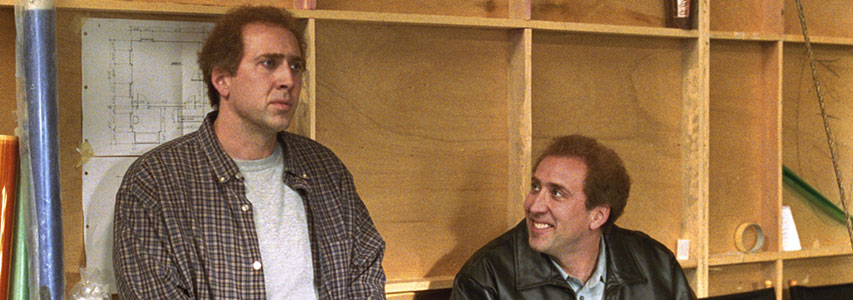


Adaptation, a film directed by Spike Jonze, 2002. Screenplay by Charlie Kaufman; Comedy/Metacinema/Thriller


I live in a relatively small, inconspicuous ranch style house. Don’t get me wrong, it’s a lovely, small inconspicuous ranch style house that I’m very thankful for. It’s quite comfortable and–although the kitchen is smaller than I would like–I have no desire to move.

My home’s signature design feature is its wide open living room with vaulted ceiling; that and a especially large master bedroom that we use as an office. So, yeah, there are those things…and our yard.

In fact, I would say that our yard–the backyard in particular–is the loveliest thing about our home. That’s because my husband has a fondness for flowers and a green thumb to go along with that fondness. It’s his hobby.

People take pictures of our yard. People that we don’t even know. (We also have security cameras. So…)

Anyway, despite my husband’s talented thumb, we’ve never had any luck with orchids. Every orchid we’ve ever had (five of them to be exact) has died. And that sucks.

Orchids are expensive. Even the ones you get at Home Depot.

The film Adaption is about orchids. It’s also about compulsion. And obsession. Lack of confidence. The attraction of opposites. Illegal drug manufacturing. Screenwriting. Filmmaking. Writer’s block and…Whew!

Oh, yeah, I forgot to mention twins. It’s about twins. So, yeah, back to Whew! And I’m just getting started.

Charlie Kaufman is a screenwriter. For real. He wrote the screenplay to Spike Jonez’s acclaimed 1999 film Being John Malkovich and to Michel Gondry’s 2004 comedy Eternal Sunshine of the Spotless Mind for which he won an Academy Award for Best Original Screenplay. He also directed the much lauded Synecdoche, New York.

Charlie Kaufman is also the protagonist (portrayed by Nicolas Cage) in his own screenplay Adaption. Confused? I’m just getting started.

The movie begins with Charlie, fresh off his success with Being John Malkovich, embroiled in the funk of…well, being Charlie Kaufman. Despite his obvious talent and intellect–or maybe because of it–Charlie has zero self-esteem. Compulsively analytical, he is pleased with nothing, and upset with everything.

But don’t misunderstand–he isn’t misanthropic. He longs for the companionship of a woman, for the sexual bond, to engage in the give and take of a relationship, but because he thinks of himself so hideously–he is paunchy, he slumps and his hair, what is left of it, is frizzy–he can’t imagine anyone of the female persuasion being attracted to him even though his smart and pretty friend Amelia (Cara Seymour) is clearly just that. She finds the disheveled writer fascinating and charming; she practically throws herself at him, albeit in a very ladylike way. He is oblivious to it.

Commissioned to write the screenplay adaption to writer Susan Orlean’s best selling non-fiction book about Florida orchid poacher John Laroche, (again, Laroche and Orlean are real people) Charlie suffers a debilitating case of writer’s block–in the movie and in real life.

In real life, try as he might, Kaufman could not figure out how to make a commercially successful and artistically viable adaption of Orlean’s book. So he wrote the screenplay Adaption inspired by his writer’s block instead. He used Orlean and Laroche as characters in the screenplay and wrote in appearances by actors John Malkovich, Catherine Keener and John Cusack who had starred in Being John Malkovich. To that stew he added real life screenwriting guru Robert McKee as a character and fictional twin brother, Donald Kaufman.

Johnathan Demme was slated to direct The Orchid Thief but bowed out of the project. His production partner Ed Saxon stayed on board as the producer and Spike Jonez agreed to team up with Kaufman again and direct. Likewise Susan Orlean and John Laroche agreed to Kaufman’s extreme embellishment of their biographies and, alas, Adaption was born.

In the movie, Charlie is none too happy that his congenial, happy-go-lucky twin brother Donald (also portrayed by Nicolas Cage, magnificently I might add) has moved in with him. Donald is paunchy too, and he has the same frizzy, thinning hair, but unlike Charlie, he is completely comfortable in his own skin so he dresses better, takes better care of himself, is friendlier and, consequently, has way better luck with the ladies. This baffles Charlie.

On top of that, Donald decides that he too wants to be a screenwriter and that pisses Charlie off. Donald is like Charlie’s irritating little brother who wants to copy everything big brother does only, of course, they are twins and Charlie can’t figure out why Donald likes him or why he likes himself, for that matter. Plus, Donald wants to churn out a cookie cutter thriller screenplay and “cash in on it”. To that end he buys some of Robert McKee’s ‘how to write a screenplay’ DVDs and signs up for his seminars. He suggests his brother check out the DVDs to help his writer’s block. This disgusts Charlie to no end.

Meanwhile, Charlie immerses himself in the book he is supposed to adapt, The Orchid Thief. True to his tendencies, he becomes obsessed with the book’s author, Susan Orlean  (gloriously portrayed by Meryl Streep). He convinces himself that if he could just meet her, his writer’s block would break.

To this gorgeous, convoluted mashup Kaufman adds a parallel story–actually more of a faux documentary–about Orlean and “the orchid thief” himself, John Laroche (Chris Cooper in an Academy Award winning performance).

In real life John Laroche is a tall, elegant horticulturist who managed to poach/pilfer an extremely rare and elusive species of orchid from a nature preserve in the Florida Everglades. In Adaption, he is a sweaty, scraggly, toothless (he is only missing his two front teeth, but you get the picture) swashbuckling, near vagrant, self taught horticulturist tooling around in a rickety cargo van who manages to poach/pilfer an extremely rare and elusive species of orchid…Whew! You get the picture.

In the movie, Orlean becomes enamored with Laroche’s passion and intoxicated by his curious sexual potency. They begin a passionate affair that is enhanced by a drug, illegally extracted from the orchids by Laroche and his Seminole Indian confederates.

Charlie and Donald become aware of this drug conspiracy because they have been following Orlean, ostensibly for research, and in reality because of Charlie’s compulsive infatuation. This knowledge puts the twins in the crosshairs of the clandestine lovers who are desperate and willing to do anything–yes, even commit murder–to keep their passion alive.

Adaption is the most original, creative film I have ever seen. For years I avoided it. I didn’t think I would like it. Too convoluted. Too gimmicky. Too cute, I thought. Then I saw it. And I was right. It is everything I thought it would be. And it is wonderful. It very well may replace Magnolia as my tenth favorite movie of all time.

And that’s high praise from me. I love Magnolia almost as much as I love my cat Stryper–and I think magnolias are much more beautiful than orchids.


Two Televangelists, a Prostitute and a Flat Tire; Part II

Recap of Part I: October, 1988–Powerful televangelist and right wing culture warrior Jimmy Swaggart is caught on camera in the company of known prostitute Debra Murphree at a dilapidated brothel motel in the New Orleans suburb of Metairie, Louisiana. Fellow Pentecostal evangelist and Swaggart rival/enemy Marvin Gorman prompts the sting. Gorman confronts Swaggart outside Murphree’s motel room. Swaggart is delayed at the scene of the tryst by a staged flat tire. 

“No one can serve two masters. For you will hate one and love the other; you will be devoted to one and despise the other. You cannot serve both God and money.”–Jesus Christ; Matthew 6:24

Ministers are not just preachers, they are counselors too, attending to congregations–and persons therein–that are not always inclined toward psychological counseling but in need of it nonetheless. Preachers wives have an especially difficult role in church life–moving often, always hosting and forever scrutinized they have very little privacy and precious little personal identity–so it isn’t surprising that Lynda Savage, the wife of Reverend David Savage sought Marvin Gorman’s counsel. Mrs. Savage was having marital problems, on that issue, her and Gorman’s account is compatible.

According to Gorman on December 28, 1978 Lynda Savage called him at his office. Alone at a local motel she said she was severely depressed. She threatend suicide. Reverend Gorman dropped everything and rushed to her side.

At the motel he found the door unlocked and, upon entry into the room, Mrs. Savage draped in a robe and sitting on the bed. An open bottle of pills was on the nightstand.

Afraid that she had taken the pills he rushed over to the bed and sat down with her.  That was when, he said, Mrs. Savage let the robe drop. She was naked.

They embraced and began to kiss. He unzipped his pants and attempted intercourse but was overcome by guilt and remorse. He stood up and composed himself. After apologizing to her profusely, Gorman told her that what they were doing was wrong, that he had to leave. And he did.

Naturally Mrs. Savage’s version of events differs considerably. According to her, she and Gorman had sex between eight and nine times during an affair that lasted two years. Savage claimed that the affair began during a counseling session when he diagnosed her with Anorgasmia (the inability for a woman to have an orgasm). He told her that he could show her how to achieve one. Mrs. Savage said she was the one who ended the affair because of conscience pangs and that Gorman tried on several occasions to reignite it.

As for threatening suicide, Savage denied it. “I did not threaten. I might have made a statement like, ‘I feel like the best thing might be if I just died.’ But I did not threaten.”

Both Gorman and Savage believed that only they knew about their “affair” even if they disagreed about the duration, intensity and number of indiscretions that comprised it. They were wrong.

The year 1986 was proving to be a good one for Marvin Gorman. Due to his good looks, impressive stature and genuine love of people and a willingness to meet them where they stood in life, (as well as his tolerance of, and outreach to, lapsed Catholics) the First Assemblies of God congregation in New Orleans that he pastored had grown from little more than 100 members to a jaw dropping 6,000 strong.

Not only that, Gorman had been elected to the national Executive Board of the Assemblies of God where he had a hand in the doctrinal and disciplinary matters within the denomination; and, perhaps most significantly, he was in the process of finalizing the purchase of two television stations with satilites. Additionally, he was about to break ground on a new building project only a few blocks away from his current church site.

Though things were clicking on all eight cylinders for Gorman in New Orleans, all was not quiet on the Pentecostal front from Baton Rouge, Louisiana to Charlotte, North Carolina. Just 80 miles north of New Orleans, Baton Rouge was the bastion of the Assemblies of God denomination and the home of its famous firebrand televangelist Jimmy Swaggart whose television show A Study in the Word was broadcast to over 3,000 stations at the time. Eight hundred miles northeast of Baton Rouge lies the major metropolitan area of Charlotte, North Carolina which in 1986 was the hub of Pentecostal televangelists Jim and Tammy Faye Bakker’s PTL (Praise The Lord) Network empire. The Bakker’s and Swaggart did not see eye to eye.

Jimmy Swaggart buttered his bread with a more traditional, fundamentalist Pentecostalism. He railed against “Catholic apostasy”. He forbade dancing of any kind, even aerobics, and demanded that women be subservient to their husbands. He was particularly strict on sexual matters going so far to denounce oral sex between a husband and wife as perverted and berating young men and women for masturbating. Pornography was anathema.

Swaggart’s preaching style was dramatic, accusatory and physical. He would contort his face to demonstrate the horror and vileness of sin. He whooped and hollered. A tall, broad shouldered man, he lunged and swung at the demons of the air. He pleaded and cajoled. He captivated and entertained. He asked for money from his “faithful friends of the ministry” so he could save the prostitute. The pornographer. The adulterer. The apostate. And the money poured in.

Jim Bakker, on the other hand, was softer–in every sense of the word. He and his wife, Tammy Faye, modeled their television empire on the Johnny Carson Show. The PTL club was conspicuously wholesome–the hosts chatted up well known preachers of the day and gospel singers performed–while at the same time ostentatiously garish–there was a fetid vibe to Jim’s baby fat face and luxury casual wear and Tammy Faye’s spider webbed mascara, bejeweled fingers and extreme crying jags. In his “keys to success” self help books Bakker extoled the tenets of the “prosperity gospel”: God wants you to be happy. God wants you to be succesful. God wants you to be rich.

Of course, according to Jim Bakker, ‘God’s largess was contingent upon “you” being generous. Therefore “you” should demonstrate your generosity by donating “whatever you can” to the PTL Network. The more you give, the more you receive,’ so went the preamble of Jim and Tammy Bakker’s pitch. And it was successful. At the height of the PTL’s popularity it was worth well over a hundred million dollars.

Swaggart took umbrage with the prosperity gospel, outwardly because it was unbiblical and anti-Christ, inwardly because he was envious and threatened by Bakker’s success. When he went on one of his many televised tirades about “limp wristed preachers” few, if any, viewers doubted who he was fuming about. Jim Bakker canceled Swaggart’s scheduled appearances and his televised sermons on PTL Network.

Though Marvin Gorman tried to stay out of the feud, he was friends with Jim and Tammy Faye. That friendship and his rising star within the Assemblies of God circles put Gorman and his energized ministry in Swaggart’s crosshairs.

It had been an unremarkable but busy, summer day in New Orleans when the phone rang in Marvin Gorman’s office. He took the call.

“Marvin, this is David Savage,” the caller said. “Do you have time for me to stop by and see you today?” “Sure,” Gorman answered. “But the earliest I can see you is four o’clock this afternoon.”

“Very well. I’ll see you then,” Savage said.

Gorman hung up and went about his day as usual, noting that whatever it was that Savage wanted, it seemed a little urgent. Even so, he wasn’t the least bit alarmed. He knew Savage well, having mentored him in the ministry. It wasn’t unusual for the young preacher to ask Gorman’s advice about church matters. At four o’clock Savage was right on time.

As soon as Savage entered the room Gorman sensed something was wrong. His guest didn’t bother to sit down. Instead he turned and faced Gorman, looking him dead in the eyes.

“We know about you and my wife,” he said.

It was July 15, 1986. Marvin Gorman’s life would change dramatically that day. And as hot as it was, things were about to get even hotter.


Two Televangelists, a Prostitute and a Flat Tire; Part I

There is nothing covered that won’t be uncovered, nothing hidden that won’t be made known. Therefore, whatever you have said in the dark will be heard in the light, and what you have whispered in an ear in private rooms will be proclaimed on the housetops.–Jesus Christ; Luke 12:2-3

Back in the early 80s Nashville wasn’t nearly as cosmopolitan, or as expensive, as it is today. With a stable economy and a relatively low cost of living, it attracted many of the disenfranchised looking for a more glamorous place that, like the lyrics of a Country song, was sympathetic to their hardscrabble life.

Debra Murphree fit the bill to a T.  A high school drop out at the age of sixteen, married at seventeen, giving birth to three children in the span of five years, she was all of twenty-two years old when she wound up in Music City.

Of course, only she knows why she came here. Perhaps it was because she wanted to break into the music business; or, possibly, she was traveling and found herself at the intersection of I-40, I-65 and I-24 and felt it was as good a place as any. Then again, maybe she was afraid if she didn’t get out of Podunk Indiana she never would and Nashville was the place on the map she settled on.

For whatever reason she was low on funds and in need of a job when she arrived. A “friend” told her about an escort service. It was way better money than waiting tables or running a drive thru window. With a whole life ahead of her, she could make some quick cash and then get out. That’s what she thought, anyway.

That’s how she got into “the life”.

One of the main signatures of Bob Guccione’s Penthouse magazine was its sexually explicit, soft focus photography of the nude and near nude female form–that and its  superb in-depth journalism. Guccione was very particular about his models. He wanted them young and beautiful. And glamorous. The sex in Penthouse had a mysterious voyeuristic theme. It was gauzy, upscale porn for the sophisticated peeping tom.

Ninety percent of the July 1988 issue of Penthouse was within its distinctive perimeters, the remaining ten percent was dedicated to an article and photo spread of Debra Murphree. The article, full of salacious details of her encounters with a john who called himself “Billy” yielded to the photo spread, a collage of replicated “poses” that “Billy” liked to direct. There was nothing gauzy or soft focus about them.

While Murphree was a reasonably good looking young woman–unremarkable facial features with a hint of Native American ancestry, black wavy hair and long slender legs–street walking is hard on the mind, body and spirit. Guccione could have made her look attractive and alluring. He choose to do the opposite. He used her to shame “Billy”.

At one time, Reed Scott Bailey was a police officer. That was before he got fed up with all the red tape and politics involved in law enforcement and became a P.I. instead. As a private investigator Bailey worked for lawyers from time to time. One of those was Marvin Gorman’s lawyer Hunter Lundy.

Reverend Marvin Gorman’s son Randy was also a police officer. He interjected himself into his father’s private investigation whenever he could. It was only natural that he would. He loved his dad who had adopted him and reared him as a son when he married the boy’s mother, Virginia, some thirty years before. Randy called the elder Gorman, “the most compassionate, tender-hearted minister I’ve ever met.”

Likewise, it was only natural that Reed Scott Bailey and Randy Gorman got along and worked together. As cops, they both worked and knew Airline Highway well. Then again, everybody in the New Orleans area knew/knows Airline Highway.

As the name implies, Airline Drive–as it is known today–is a gateway to Louis Armstrong New Orleans International Airport. A chunk of it, the Metairie Parish blocks 3000 to 5000, respectively, comprises a notorious hookers stroll. Though the Parish has worked hard over the last decade to clean it up, razing many of the decaying motels that served as brothels and replacing them with new development, the area is still seedy. It is still a stroll.

One of those razed brothel motels was the Travel Inn. In 1987, Debra Murphree was living and working there. That’s how she came to know Officer Randy Gorman. According to Murphree, during an encounter with the police officer, he became one of her clients.

But Gorman was interested in more than just sex. He liked to quiz Murphree about her clientele. At the time she thought nothing of it. He was a cop after all. Her perception of his inquisitive nature changed considerably after October 17, 1987.

Nervous because of police stings the week before, Murphree, who had just finished up a session with “Billy”, peeked out her room’s window. That’s when she caught sight of Officer Gorman running into Room 12.

“Looks like we’re about to get busted,” she warned “Billy”.

“Billy” hustled out the door and fired up his Lincoln Continental, only to find that he had a flat. As he hauled the jack and spare out of the trunk, Murphree stood in the open doorway watching him. “If they stop you on the way out, don’t say anything,” she pleaded. She was low on money and making bail would cut things perilously close.

Nervously she glanced across the way at Room 12. In the window a camera lens wrapped in a black towel was visible to only the most discerning eye. Six years on the street had made Debra Murphree’s eyesight especially keen. She slammed her door shut and locked it.

Immediately afterward a blue car raced into the parking lot and parked next to “Billy’s Lincoln. A tall, handsome man got out of the drivers side. Peering through the peephole, Debra Murphree didn’t recognize him.

As he walked around the front end of his car he said something to “Billy” that Murphree couldn’t make out. “Billy” didn’t look up. He kept fiddling with the jack and tire.

The handsome man stood over “Billy” his hands on the fine leather of his belt. “Jimmy, what in the world do you think you’re doin’?” he asked.

Behind the locked door of her twenty dollar a night motel room Debra Murphree smirked. All along she had known who “Billy” really was.

“Are you Jimmy Swaggart,” she asked him when he first picked her up on Airline Highway. “No,” he answered. “A lot of people ask me that.”

But of course he was Jimmy Swaggart. And of course she recognized him despite his pitiful attempt at a disguise ( he brushed his bangs forward, wore a headband and a sloppy jogging suite with a hole in the inseam.) How could she not? Swaggart’s face was all over TV where he preached from his mega church in Baton Rouge against the apostasy of Catholics, the evil allure of pornography and the wrongfulness of oral sex, even among married couples. Next to Billy Graham, her “Billy” was probably the most famous preacher in the whole United States, if not the world.

What she didn’t know was Jimmy Swaggart’s handsome inquisitor was none other than Reverand Marvin Gorman, a big time Pentecostal preacher in his own right with a six thousand member mega church that he pastored less than a mile from the very spot where he stood. At least he did before Jimmy Swaggart uncovered a sexual indiscretion and then blasted it across the Pentecostal Church hierarchy, effectively getting him kicked out of the denomination, casting him into the purgatory of bankruptcy and stressing his marriage of over thirty years.

Even more shocking for Murphree–or at least that is what she claimed–was the identity of the police officer who she had been seeing as a client about as long as she had been “dating” Swaggart. “I had no idea who Marvin Gorman was,” she insisted. “And I didn’t even know Randy Gorman’s name.”


Jerry Lee Lewis, “the Killer” of Rock N Roll

It was just your average hot and sticky July evening in Nesbit, Mississippi. Nesbit’s usually pretty quiet–and it especially was back then, in 1981–though it’s only about twenty miles from Memphis. But of course nobody knows what goes on behind closed doors–average small town or big city, for that matter.

Behind closed doors at 1595 Malone Road, the Killer stumbled down the long hallway of his rambling ranch style home. He clutched his stomach and slid down a wall. Searing pain engulfed his abdomen. “K.K.!” he called to his then girlfriend. The Killer was lucky she heard him. His voice was little more than a harsh raspy whisper.

Mary Kathy Jones stopped dead in her tracks when she saw him. He was white as a sheet and coughing up blood.

Jones and long time road manager J.W. Whitten carried the Killer to his El Dorado Cadillac. Whitten floor boarded it all the way Methodist Hospital in Memphis while the Killer leaned against Jones, drifting in and out of consciousness, constantly moaning and thrashing. All three of them were in the front seat. Jones had wanted to call an ambulance but there was no time. Jerry Lee Lewis, one of the founding fathers of Rock and Roll, was dying from a ruptured stomach brought on by years of knocking back fistfuls of pills with countless shots of whiskey and, yes, even shooting dope into his gut.

Nine days later singer songwriter Kris Kristofferson sat at the bedside of his long time friend and mentor. Myra Brown Lewis, the Killer’s third wife and cousin–he married her when she thirteen years old, setting off international outrage while simultaneously (and temporarily, as it turned out) destroying his career–had called him in. The Killer was on a ventilator but he was alert. His eyes were wide and blazingly intense. Kristofferson clasped Jerry Lee’s hand. “I’ve never seen someone so terrified,” the singer recalled. “That man willed himself to stay alive.”

The Killer had good reason to be afraid. He was deathly afraid of going to hell.

Jerry Lee Lewis was born in the small farming community of Ferriday, Louisiana to a good hearted, but hard-drinking, brawling father and a deeply religious–Assembly of God–mother. Inspired by the lively charismatic music of the Pentecostal church, Jerry Lee began playing the piano when he was five years old. His parents mortgaged their farm to buy him a used Stark upright.

Not much for school, Jerry Lee would rather slip away to Haney’s Big House, a juke joint frequented by African Americans where he would sit on the piano bench with famed blind bluesman Paul Whitehead.

 “Paul Whitehead done a lot. His lesson was worth a billion dollars to me…He taught me. I’d sit beside him, and say, ‘Mr. Paul, can you show me exactly how you do that?’ Mr. Paul was good to me.”

Mamie Lewis didn’t like her son listening to or playing the “devil’s music” so she sent him away to the Southwest Bible Institute of Waxahatchie, Texas with hopes that he would become a preacher. His sabbatical lasted all of three months. Jerry Lee got kicked out of the school for revving up a gospel song with R&B and country blues.

Back in Ferriday Jerry Lee’s mind was made up. Music was his calling, not gospel but the electric howling mashup of styles that he was on the cusp of. This was the music that drove teenagers to riot and their parents to despair. It was his music. He was a savant. A genius. His long fingers worked magic, flying up and down the keyboard with manic ferocity. There was nothing he couldn’t play. Hear it once and he could spin it, twist it, turn it inside out and make it his own.

On the Louisiana and Mississippi backroads Jerry Lee dove headlong into juke joints and night clubs where he passed the hat for dollars, honed his skills and developed his wildman stage antics. He grew his hair long on the top so that it flopped down into his eyes when he worked himself into a frenzy. He wore sports coats and slacks–and fancy shoes. He kicked over his bench, learned to hammer the keys with the heel of his foot and even set his piano on fire.

“I’m a stylist on songs. I do them my style, my way. And make them into whatever I want them to be. And that’s talent. Raw talent. It’s God-given talent.”

That talent took him to the mecca of the burgeoning rock and roll scene–Memphis Tennessee’s Sun Records and to producer Sam Philips. Philips had a stable of talented recording artists at Sun comprised of Johnny Cash, Carl Perkins, Howlin’ Wolf, Little Milton, BB King and Elvis Presley among others.

Cowboy Jack Clement–a successful singer and prolific songwriter in Country music before his death in 2013–was a studio engineer at Sun back in the 50s. He was at the front desk when Jerry Lee strutted into the studio asking for an audition. Philips was out of the country at the time but Clement decided to hear the cocky singer and pianist anyway. He was impressed and recorded the audition.

When Philips returned he agreed to give the tape a listen. Clement turned up the volume and the speakers came alive with Jerry Lee’s improvised intro to Ray Price’s Crazy Arms. Clement remembered Philips eyes being closed–as was his custom when listening to prospective talent–suddenly opening wide. A thin smile creased the producer’s lips. Philips reached across the console and switched off the recording listening to less than thirty seconds of the audition.

“I can sale that,” he told Clements.

Sam Philips tried to warn him. He knew it was going to be a disaster. It was a no brainer. But the kid wouldn’t listen. Jerry Lee was determined to take Myra to England. Myra was Jerry Lee’s second cousin.

She was also his wife. His third wife.

In 1958, nowhere–not even in the U.S. of A.–was Rock and Roll a hotter commodity than in Great Britain. Teenagers there stood in long lines to buy, clamor for and even fight over American records with that distinctive turbulent beat. And no recording artist rocked harder, played faster or shrieked louder than Jerry Lee Lewis. Only Elvis Presley caused more pandemonium– and he got drafted in ’58.

With Elvis in the Army, Jerry Lee was at the top of the heap with his huge singles Whole Lot a Shakin’ Going On and Great Balls of Fire. His twenty-seven confirmed concert dates in England was the biggest tour of any Rock and Roll artist of the time. Naturally the first stop on the tour was London.

Paul Tanfield of London’s The Daily Mail was just one of the many reporters and fans that awaited the plane carrying Jerry Lee Lewis at Heathrow airport. As Lewis and his entourage exited the plane, Tanfield noticed the exceptionally young looking woman on Jerry Lee’s arm. “Who do we have here?” he asked.

The young woman spoke right up. “I’m Myra. Jerry’s wife.”

Intrigued, Tanfield asked the most logical follow up question. “How old are you, Myra?”

This time Jerry Lee answered. “She’s fifteen,” he blurted out.

He lied. She was thirteen.

Other reporters began to shout out questions. One asked if fifteen wasn’t a little young to be married.

Again Myra piped up. “Oh, no, not at all. Age doesn’t matter back home. You can marry at ten if you can find a husband.”

Suffice to say the tour didn’t go well. Jerry Lee performed all of three concert dates where he was heckled and booed. Bottles and rotting fruit were thrown onto the stage. “Cradle robber!” “Baby Snatcher!” “Pervert!” When he ran a sparkling silver comb through his long, wavy blond locks, a move that usually drove the girls wild and piqued the guys admiration, the crowd was repulsed. “Sissy!” “Poof!” “Nancy!”  

The rest of the tour was abruptly canceled. Reporters and jeering protesters camped out at The Westbury Hotel where Jerry Lee and his entourage had reservations. The Westbury management asked them to leave.

They did. Then they left England.

“Get on the @#@#$$# phone,” a drunk-out-of-his-mind Jerry Lee hollered at Harold Lloyd who was on guard duty. “Call up there and tell Elvis I wanna visit with him. Who the hell does he think he is? Tell him the Killer’s here to see him.” 

Unbeknownst to Jerry Lee, Elvis was watching on his security monitor. “He crashed his car into the gates,” Lloyd said over the phone to his boss who also happened to be his cousin. “He’s waving a gun around.”

“Call the cops,” Elvis said.

When the cops got there Jerry Lee put up a fight. He swung, kicked and yelled, calling them all sorts names. They managed to get the cuffs on him. “What do you want us to do with him?”

“Lock him up,” Elvis said.

It was three o’clock in the morning, November 23, 1976. Eight months later Elvis Presley was dead of heart failure at age forty-two.

Two months before his arrest outside of Graceland, on September 29th, Jerry Lee had been celebrating his forty-first birthday with his bassist Butch Owens. He was drinking heavily and fooling around with his .357 Magnum.

“Look down the barrel of this. I’m gonna shoot that Coca-Cola bottle over there or my name ain’t Jerry Lee Lewis,” he boasted to Owens.

Then he fired. Twice.

The bullets plowed into Butch Owens chest. In shock, the bassist stumbled into the living room where Jerry Lee’s forth wife, Jaren Gunn Pate, was watching TV. The chest wound was pumping blood all over the place. Jaren screamed at him for bleeding on the carpet. It was brand new. And white.

Then on June, 8th, 1982 Jaren Gunn Pate was found at the bottom of her friend’s pool, mysteriously drown only weeks before divorce proceedings were to be finalized. It was an especially contentious divorce. Jaren and her attorneys were intent on taking Jerry Lee to the cleaners.

Your Plaintiff would further show that the Defendant has an extremely violent temper, especially when he becomes intoxicated on alcohol and/or drugs, and he has choked your Plaintiff on numerous occasions, has beaten her up, knocked her down the stairs, and threatened her very life.

Your Plaintiff would further show that approximately one (1) month ago when your Plaintiff called the Defendant for financial assistance for herself and the parties’ minor child, Defendant went into a rage and stated that she should not worry about any support because “you are not going to be around very long anyway, and if you don’t get off my back and leave me alone, you will end up in the bottom of the lake at the farm with chains on you.”

The following year, almost to the day of Jaren’s death, Jerry Lee married again. This time to a twenty-five year old beauty from Dearborn Michigan named Shawn Michelle Stephens. Shawn was a feisty young woman who wasn’t afraid to speak her mind to Jerry Lee or anyone else. Her friends and family described her as kind and loyal. The marriage lasted seventy-seven days.

On August 24, 1983 paramedics were called to 1595 Malone Road, not entirely unusual; they knew the address well. In one of the home’s bedrooms they found Shawn Michelle unresponsive under heavy blankets. There was blood in the web of her hand and bruises on her forearm. She was dead.

Lottie Jackson, Jerry Lee’s housekeeper of many years, knocked on Jerry Lee’s bedroom door. When he came into the room where Shawn lay, the paramedics noticed there were flecks of blood on his robe and deep scratches across his hand.

Shawn Michelle Stephens death was ruled a suicide by methadone overdose.

Jerry Lee began seeing Shawn Michele Stephens on the side in February of 1981. He was still married to Jaren Gunn Pate, but they had lived apart for years. He complained to Shawn about Jaren constantly. He told her he wanted to marry her as soon as he got Jaren out of the way.

Jerry Lee flew Shawn down to Nesbit Mississippi. Before long Shawn’s sister Shelly, their brother Thomas and friend Dave Lipke joined her at the Malone Road address.

Jerry Lee was consuming copious amounts of cocaine and amphetamines. At one point he stayed up for twelve days straight. Naturally he was paranoid. He thought Shelly had brought Dave down for Shawn to mess around with. And incredibly he still had the urge. Big time. He wanted Shawn and Shelly to participate in a threesome with him.

Shawn refused. She and her friends high tailed it out of Mississippi.

Though Shawn never thought too much of Jerry Lee, she was rather fond of his money. A few months went by and she called him. She told Shelly that the phone call didn’t go so well. Jerry Lee was pissed. He sounded like he was sick. That he was complaining about his stomach. A few weeks later he was in Memphis Methodist hospital with a ruptured stomach and a less than fifty percent chance of survival.

But Jerry Lee did survive. He promised the Lord that this time he would do better. That this time he really meant it.

It has been said that Jerry Lee Lewis earned his nickname the Killer with his onstage bravado and knock ’em dead piano style. It has also been said that “killer” is a term of camaraderie that boys from Northern Louisiana used back in the days of Jerry Lee’s youth. That he got the nickname from calling his friends and acquaintances “killer”.

In October, 2014 GQ reporter Chris Heath asked then seventy-eight year-old Jerry Lee if he thought the name suited him.

“I don’t know. Really don’t know. I couldn’t answer that. I’m scared to say yes and I’m scared to say no,” he said.

Shelly Stephens recalled Jerry Lee’s version of where the nickname came from. He and her sister were newly married and already having trouble. Jerry Lee didn’t like Shawn’s family hanging around. He wanted Shawn all to himself.

“You scared of me?” he once asked Shelly. “You should be. Why do you think they call me the Killer?”

Two months later Shawn Michelle Stephens was dead. She was the Killer’s fifth wife.

The Best Jerry Lee Lewis Albums

***** Live at the Star Club, Hamburg (with the Nashville Teens), Phillips (1964)

***** All Killer, No Filler, Rhino (1993)

***** Another Place Another Time, Smash (1968)

***** Jerry Lee Lewis’ Original Golden Hits Vol. 1 & 2, Sun (1969)

***** Jerry Lee Lewis’ Original Golden Hits Vol. 3, Sun (1971)

***** Jerry Lewis’ Ole Tyme Country Music, Sun (1970)

***** Killer Country, Elektra (1980)


Night Moves, a film directed by Arthur Penn, June, 1975 (the same year and month that Jaws came out); Mystery/Film Noir

The year was 1975, I was ten years old and my Mom and my cousin Charlotte were taking me to see Jaws. This was huge for me. Jaws was all the rage.

Everywhere you went you heard about Jaws, saw posters and T-shirts of Jaws. The commercials. The music. “We’re gonna need a bigger boat.” Quint getting chewed in half and blood spurting out of his mouth. It was wonderful.

And nowhere was Jaws a bigger phenomenon then at school. It was like Christmas. Our teachers were constantly having to settle us down, threatening us with, “…If I hear another word about Jaws everybody’s staying after school.”

So on that pivotal, transformative day we had to first drop my brother off at my aunt and uncle’s because he was too young to see Jaws. I wanted to wait in the station wagon because I was on pins and needles–I could barely contain my excitement– but my mother would hear nothing of it.

“No. We’re going in and have some coffee and cake with you aunt and uncle. Then we’ll go to the movie.”

It was at the table while we were eating cherries jubilee over sponge cake that my uncle suddenly raised his fork in the air and lobed a grenade my way. I remember it like it was yesterday. “I don’t think you should take Pam to see Jaws. It’s too violent,” he declared.

Well that’s when my world blew apart, right then and there. (My mother valued my uncle’s opinion. He was an elder of the church.) It wasn’t the first time it blew apart. There had been bad things that had happened like my parents getting divorced and my Mom undergoing a very rare and serious surgery from which she narrowly survived. So, yes, I had experienced worse things–but not too many.

Thank goodness my mother over ruled my uncle. (She had a habit of doing that. He didn’t pay any of our bills.) “Your probably right. She probably shouldn’t see it, but I’ve already told her she could. I think she can handle it.”

That was that. I got to go. And it was terrifying. And traumatic. I was afraid to take a bath or go swimming for months afterward…And I loved it. It gave me lots of street cred at school. (We went to a private Christian school so street cred was extremely rare and those that had it–no matter how fleeting–were held in high esteem.) It’s one of my most treasured memories.

My Mom was a warrior. God bless her.

Jaws premiered June 20, 1975. The director, Steven Spielberg, was a shaggy headed twenty-six year old, who had made a name for himself within the Hollywood film community by calming the notoriously difficult diva Joan Crawford when he directed her in an episode of Night Gallery. Then he directed the critically acclaimed television movie Duel and the well received full length feature film The Sugarland Express.

These endeavors earned him the right to direct Jaws after producers had second thoughts about director Dick Richards (Farewell My Lovely). Jaws was an unprecedented cinematic phenomena, breaking all previous box office records and propelling Steven Spielberg into upper most hemisphere of hallowed film directors where he resides to this day.

Nine days before Jaws opened another film by veteran and one time famed director Arthur Penn (Bonnie and Clyde, The Miracle Worker, Little Big Man) debuted. A smart neo noir in which the ocean, coincidentally, played a pivotal role, it starred one of the eras most prolific leading men.

Gene Hackman was on a roll having won the academy award for best actor four years before for his performance as Popeye Doyle in The French Connection and being nominated for the same award in 1974 for his role in The Conversation. In Night Moves, he re-teamed with Penn having played Buck Barrow in the director’s groundbreaking Bonnie and Clyde. But with everyone’s attention on a great white shark chewing up the scenery–and practically everything else–nobody noticed.

The opening musical theme of Night Moves alerts you right away that something is amiss. It begins with a gentle, yet ominous musical progression on the xylophone. The keys are struck ever so lightly so that the run is pleasant but cold with anharmonic suspended overtones.

The music accompanies Harry Moseby, (Gene Hackman) a Los Angeles private detective and ex pro football player, who likes to play solo chess on stakeouts in his vintage Mustang. Harry thinks of himself as a rugged Renaissance man. He’s not adverse to a nice glass of wine and fondue while lying bed but that begs the question: is it really smart to play chess on a stakeout? Might one miss something?

It is ever so easy to miss something in Night Moves. The plot is very complicated. And it all begins with a missing persons case. (Yeah I know. Who would’a thunk it?)

Harry gets called to aging sweater girl Arlene Grastner’s house. Her sixteen year old daughter has run off. She’s a real sleazebucket–the mother, that is. Her biggest assets are her pendulous breasts and–unfortunately for us–she lets them fly, unencumbered, in true 70s style.

The girl’s name is Delly and she is the recipient of a trust fund from her late father. Her slut of a mother won’t see a dime of the money if they don’t reside together, so mommie dearest hires Harry to track her down.

The trail leads Harry all the way to the Florida Keys where he finds Delly (Melanie Griffith) hiding out with Tom Iverson (John Crawford) one of her mother’s ex husbands and his fiance Paula (Jennifer Warrens). Harry finds out that Delly has been passed around by a group of stuntmen and show biz hangers-on all of whom have had trysts with Arlene. Tom Iverson is no different in this regard. He carries on a sexual relationship with Delly right under his fiance Paula’s nose. And she doesn’t care.

Harry, who is in his own unhappy marriage, has eyes for Paula. Before long they bed down in a pathetic one night stand in which there has never been a more obvious patsy besides Lee Harvey Oswald. Disgusted with what his investigation has turned up and with himself (when Paula rejects him the next day) Harry decides that Delly–who he has become protective of–would be better off with her mother. He also wants to give his marriage a second shot so he talks Delly into going back home.

Back in Los Angeles Harry reunites with his wife and things seem to be on the upswing when he hears that Delly–who had run away again–has been killed in a movie stunt. Devastated and demoralized, he can’t let her death go. Sensing something is wrong about the accident he begins to circle back through the scummy world of Delly and her mother’s Hollywood Lotharios and sugardaddies. This nasty bathtub ring encircles a familiar group of stunt drivers, mechanics and pilots and an amorous couple who live on an otherwise uninhabited island off the southern Florida coast.

Meanwhile poor Harry keeps going around and around and around. So many things have escaped his notice. And now he’s back at square one. I guess that’s what happens when you play solo chess on a stakeout.


The Battler, a “Nick Adams” short story by Ernest Hemingway; Abridgment and Analysis

Abridgment:

Nick Adams is a recurrent character and alter-ego in and of Ernest Hemingway’s famed short story serials chronicling the author’s coming of age in northern and upper peninsula Michigan. In The Battler, (1925) Nick has hopped a freight train, mainly, for fun and, supposedly, to make his way to and from some isolated villages doting the region.

He is caught and thrown off the train by the brakeman. During the scuffling and fall, Nick suffers a banged up knee and a black eye. He limps several miles down the tracks and spies a fire. Scrambling down the embankment he makes his way through the forest  following the inviting glow. It is getting dark and the air is crisp.

In a clearing there is a small man in a wool hunter’s cap standing in front of the fire. Nick announces himself and walks into the camp. They exchange hellos and Nick is taken aback by the man’s flattened nose, crooked mouth; his eyes narrowed by edema and sunken into blotchy lumps. Nick tries to play off his surprise but the man is sensitive to the reaction.

“Don’t you like my pan?” the man asked.
Nick was embarrassed.
“Sure,” he said.
“Look here!” the man took off his cap.
He had only one ear. It was thickened and tight against the side of his head. Where the other ear
should have been there was a stump.
“Ever see one like that?”
“No,” said Nick. It made him a little sick.
“I could take it,” the man said. “Don’t you think I could take it, kid?”
“You bet!”
“They all bust their hands on me,” the little man said. “They couldn’t hurt me.”

It turns out that the man is washed up boxer who at one time was quite famous. His name is Adolf Francis, “call me Ad,” he says. Ad prods Nick about whether or not he recognizes his name. Nick acts like he does, but he’s never heard the name before and Ad senses it.

Although Ad is friendly enough there are undertones in their exchanges that make Nick uncomfortable. Then Ad confides that he is mentally ill. He comes right out and says so.

“Listen,” the little man said. “I’m not quite right.”
“What’s the matter?”
“I’m crazy.”
He put on his cap. Nick felt like laughing.
“You’re all right,” he said.
“No, I’m not. I’m crazy. Listen, you ever been crazy?”
“No,” Nick said. “How does it get you?”
“I don’t know,” Ad said. “When you got it you don’t know about it…”

Nick is relieved when an African American man enters the campsite. His name is Bugs and he has brought ham and eggs for dinner. Unlike the small squat boxer, Bugs is a tall man. He is soothing and polite; his voice, gentle and soft.

Bugs puts Nick at ease while at the same time taking command of the situation. He is the leader. The caretaker. He calls Nick Mr. Adams and Ad Mr. Francis.

Ad and Bugs invite Nick to eat dinner with them. Nick is ravished and readily accepts. Bugs begins to cook up the meal. But things turn sour when Bugs asks Nick to slice the bread. Ad spies Nick’s knife and asks to handle it. Bugs tells Nick to keep hold of his knife. This offends Ad, but he is not mad at Bugs. He takes out his frustration and embarrassment on Nick.

“Who the hell do you think you are? You’re a snotty bastard. You come in here where nobody asks you and eat a man’s food and when he asks to borrow a knife you get snotty.”
He glared at Nick, his face was white and his eyes almost out of sight under the cap.

Nick stepped back. The little man came toward him slowly, stepping flat-footed forward, his left foot stepping forward, his right dragging up to it.
“Hit me,” he moved his head. “Try and hit me.”
“I don’t want to hit you.”
“You won’t get out of it that way. You’re going to take a beating, see? Come on and lead at me.”
“Cut it out,” Nick said.
“All right, then, you bastard.”

Unbeknownst to Ad, Bugs has stepped behind him wielding a blackjack–a small hand held bludgeon made of a lead weight and a leather strap. He strikes Ad in the head with it and the little man falls to the ground, out cold.

As Bugs tenderly cares for Ad, placing a folded jacket under his head and then bathing his face, he assures Nick that little man will be okay. He hates to have to resort to such harshness but sometimes that’s the only recourse when Ad gets out of control.

Then he goes on to tell Nick Ad’s story: Yes, Ad was a great boxer at one time; a handsome man who made a lot of money with his fists. He was extremely strong for his size and stubborn–he took too many beatings. It messed up his mind. Then, on top of that, his beloved wife and manager, who looked so much like Ad that she could have been his sister (in fact there were those who thought she was his sister) up and left him. All of this was too much for Ad to bear and he went off the deep end.

Bugs makes Nick a ham and egg sandwich and then asks him to leave the campsite.

“I can wake him up any time now, Mister Adams. If you don’t mind I wish you’d sort of pull out. I don’t like to not be hospitable, but it might disturb him back again to see you. I hate to have to thump him and it’s the only thing to do when he gets started. I have to sort of keep him away from people. You don’t mind, do you, Mister Adams?”

Nick walked away from the fire across the clearing to the railway tracks. Out of the range of the fire he listened. The low soft voice of the negro was talking. Nick could not hear the words. Then he heard the little man say, “I got an awful headache, Bugs.”
“You’ll feel better. Mister Francis,” the negro’s voice soothed. “Just you drink a cup of this hot coffee.”

Analysis:

The backdrop of The Battler is 1920’s America. Rugged individualism as a recognized philosophy had not been manifested but would be soon ratified by Herbert Hoover on the eve of an economic melt down known as The Great Depression. Yet, Hoover did not invent this concept, he merely put it into words: the individual is completely self reliant and therefore independent of any governmental assistance and or interference.

Ad and Bugs are the inconvenient residue of this uniquely American philosophy and way of life. Ad is mentally ill and disabled. Today we recognize his condition as Chronic Traumatic Encephalopathy (CTE). It is prevalent in athletes that participate in sports such as football, soccer, boxing and hockey and those in the military who endure repeated blows to the head. People suffering from CTE have a myriad of neurological symptoms including poor impulse control, marked impulsivity, aggression, depression and paranoia.

Bugs is an African American making his way above the Mason-Dixon line (the demarcation between Northern and Southern United States.) On the surface things are significantly better for Blacks like Bugs who are not ensnared in the Jim Crow South. But their reality is actually quite similar to their down South brethren.

Racial violence sporadically erupts into deadly riots in cities like Chicago, Saint Louis, Baltimore and Tulsa as an illiterate white underclass competes with black laborers migrating from the oppression of the former Confederate states. Even in the best circumstances African Americans are marginalized, scapegoated and victimized. Above all they are expected to be subservient to whites.

Hemingway explores these mores in The Battler. It is written from Nick Adams’ perspective. Nick displays typical male teenage bravado when he grapples with himself after being kicked off the freight train. He curses the brakeman and vows vengeance on him. But when he meets Ad, he immediately defers to the little man and tries to placate him with agreeableness.

Nick is relieved when Bugs comes on the scene and though he is very cooperative deferential, his inner voice displays his prejudice. When he hears Bugs shout out hello and sees the big man moving in the shadows he thinks to himself only a “negro” sounds and moves like that.

Moreover as he observes the interaction between Ad and Bugs, Nick sometimes refers to Bugs within his inner voice with a racial slur, though he has no overt animosity to the man. This is especially evident when Bugs must take the upper hand with Ad. These are the attitudes and belief systems about white privilege and black subservience prevalent in 1920’s America, above and below the physical and overt line of racial demarcation into the psychological response of an ordinary young man who owes a black man, perhaps, his very life.


Making the case for the film 8mm in our Orwellian Landscape and for Nicolas Cage as an Actor, past and future

For me watching the movie 8mm is kind of like eating gas station nachos. (Okay. I’m sure you know exactly where I’m going here, but if you’ve read a few of my blogs then you also know I can’t resist this stuff. So…) I actually like gas station nachos. I don’t live on them by any means but, yeah, every now and then I get the urge for some florescent orange goopy cheese and super vinegary canned  jalapeno peppers over stale tortilla rounds. What can I say? Call me crazy. What I don’t like is admitting to it. It’s a little embarrassing. And sad.

Likewise, nowadays, it’s a little embarrassing to admit to liking a Nicolas Cage movie. I know I don’t have to expound on this, any discerning cinema lover has been dismayed, chagrined or amused–sometimes all three at the same time–by Cage’s performances and the movies he has chosen to perform in over the last decade. Here’s a bit of a rundown just to belabor the point: (Refer to the rather lengthy aside in the introductory paragraph here.) Ghost Rider. The Wicker Man. National Treasure. Left Behind. 

And yes, I’ve seen it. Hasn’t Everybody? (I’m referring the YouTube film clip mashup entitled Nicolas Cage Losing his Shit.) “NOT THE BEES!!! THEY’RE IN MY EYES!! MY EYES!! AAAHHH!!!” (Ha ha ha!…Whew!…Hilarious…And sad.)

There’s just one problem with my whole analogy though: I’m not embarrassed about liking 8mm. Nope. Not in the least. In fact, I think 8mm is a good–albeit it significantly flawed–film that has gotten a bad rap. But even more than that, I think it is a culturally significant film, especially in our current environment.

Yep. You read that right.

And Nicolas Cage? Well, he’s always been weird. Even back in the day when he was a hot commodity in Moonstruck, Raising Arizona, Leaving Las Vegas and Adaption–all of which he was great in, by the way–he was weird. Back then people called him quirky and adorable.

He even won an Oscar being weird. Remember that? And then he was nominated for another one being even weirder.

That said, there’s a difference between being weird, i.e., quirky and adorable and going off the rails, i.e., The Wicker Man. Of late the Nicolas Cage train has derailed and is in perpetual crash and burn. No doubt.

Still, that shouldn’t diminish his prior quality contributions to acting and cinema. I think not. Like so many of us, personally and professionally, Nicolas Cage is a mixed bag.

Plus his most recent film, the yet to be released Panos Cosmatos directed Mandy, is supposed to be superb. There is talk that this is the film to resurrect Nicolas Cage’s career. I, for one, am rooting for him.

Now here’s my case for 8mm:

Tom Wells (Nicolas Cage) is a family man. His wife, Amy, (Catherine Keener) is smart, lovely and loyal. His six months’ old daughter, Cindy, is adorable. Tom works in the yard and helps Amy with the baby when he’s not traveling around the country as a surveillance expert/private investigator. He’s good at what he does, dutiful and discreet. His clientele is high profile.

One day Tom is summoned to a sprawling steel magnate’s estate in Cleveland. The magnate is recently deceased and his widow, Mrs. Christian, has made a disturbing discovery in her late husband’s safe–an 8mm film that depicts the brutal murder of a teenage girl. But is it real?

Tom watches the film privately. It’s a grainy low budget affair set in a squalid room encased with plastic sheeting. Sure enough there is a teenage girl–not an actress pretending to be a teenage girl–and if she’s pretending to be terrified, she’s doing a damn good job. She is not screaming. No. Her face is composed in abject resignation to her fate. A burly man dressed in S&M bondage gear whose face is sheathed in one of those terrifying leather masks menaces her with a knife.

Here we become the apex voyeur–we simultaneously watch the film and Tom, while he watches the film. We see no thrusting knife, no spurting, splattering blood but we see Tom as he see’s those things. We watch him cringe impotently in his seat, grimacing, recoiling; a big man shrinking in every sense of the word. Similarly there are no ear shattering screams but we do hear the girl’s anguished cries—and whir of the film running through the projector. It is a powerful, gut wrenching cinematic sequence. Not just the visual, visceral aspect of it but what it says about us and our place in an increasingly voyeuristic, surveillance, camera crazy society.

Keep in mind that Joel Schumacher directed 8mm in 1999. When Tom is asked why he chose surveillance instead of law like his brothers did, he answers that he chose it because he believes it’s the future. How eerily prophetic that proves to be eighteen years later.

In our current society, it is appallingly easy to witness murder. All you have to do is hop on YouTube or Live Leaks where you can watch hours of actual murder caught on camera if you so desire. We are constantly surveilling; constantly filming;  constantly watching. But at what cost?

Tom plunges himself into a horrific, wretched underworld in order to defend the teenage girl in the film. He senses the film is most likely real. It is. That the girl is dead. She is. But still his outrage, his humanity demands that he risk everything–even his own family–to find out who she is–was, to resurrect her existence, defend her identity and protect her personhood. He does. But the cost is almost more than he bear.

The cost is what he sees. And what he will never be able to forget.


Indian Camp, a “Nick Adams” short story by Ernest Hemingway; Abridgment and Analysis

Like Hemingway’s own father, Nick Adams’ father is a physician. This is just one of the many similarities between the recurrent fictional character Adams and Hemingway himself.

There are so many parallels, in fact, that Nick Adams acts as Hemingway’s alter-ego in a series of short stories that Hemingway penned between 1924 and 1933, roughly. The series, beginning with Indian Camp, is a fascinating glimpse into the psyche, upbringing and young adulthood of one of America’s most storied and influential authors.

Abridgment:

In Indian Camp, (1924) Dr. Adams is summoned to an isolated Native American settlement–most likely Ojibwe–in Michigan to attend a woman who has been in labor for two days. Dr. Adams takes his young son, Nick, and his brother, Uncle George with him. Two Ojibwe men from the settlement row the doctor, Uncle George and Nick across the lake bay.

It is predawn. Little is said on the boat ride. Nothing between the Native Americans and Anglo threesome. As they near the bank, Uncle George gives the Native American men some cigars.

They make the trek to the settlement and, along the way, are met by a pack of dogs. The Native Americans yell and scold, sending the curs scurrying toward the settlement. Finally they approach a row of shanties and are alerted to one by a light in the window and an elderly woman standing with a lamp outside the door.

Inside is a young woman in obvious labor and agony, writhing and screaming under a heavy quilt on a rough hewn lower bunk;  her husband, badly wounded from a mishap with an ax, lies in the bunk above her. Dr. Adams examines her and determines that it is a breech birth and it will require a cesarean which he will perform with a hunting knife and catgut sutures. He carefully washes his hands and sterilizes the primitive instruments.

Young Nick holds a basin of steaming water while his father operates. He looks away from the spectacle, staring over his shoulder. “Can’t you give her anything, daddy?” he asks, disturbed by the woman’s screams and struggling.

“No. I haven’t any anesthetic,” his father said. “But her screams are not important. I don’t hear them because they are not important.” The husband in the upper bunk rolled over against the wall.

During the operation three Native American men and Uncle George hold the woman down. She bites Uncle George on the arm. “Damn squaw bitch,” he yells. One of Ojibwe men laughs.

The operation goes well enough, though afterwards the young woman is white as a ghost and so weak that she is delirious. Still, Dr. Adams is especially pleased with himself. The baby is in good shape.

He was feeling exalted and talkative as football players are in the dressing room after a game. “That’s one for the medical journal, George,’ he said. “Doing a cesarean with a jack-knife and sewing it up with nine-foot, tapered gut leaders.”

The good doctor’s exuberance is diminished when he decides to check on the husband in the upper bunk.

“Ought to have a look at the proud father. They’re usually the worst sufferers in these little affairs,” the doctor said. “I must say he took it all pretty quietly.”

The man is dead. It’s suicide in the most awful way: he has cut his own neck from ear to ear with a straight razor.

Dr. Adams orders Uncle George to take Nick out of the shanty, but it’s of little use. Nick has seen everything.

Unceremoniously Dr. Adams and Nick walk back down the logging trail towards the lake. Uncle George has disappeared. Dr. Adams apologizes to his son for bringing him along, saying that the trip turned out to be a terrible mess with the suicide.

Nick asks about the woman.

‘”Do ladies always have such a hard time having babies?'” 
Nick asked.

“No, that was very, very exceptional.'”

“Why did he kill himself, Daddy?”

“I don’t know, Nick. He couldn’t stand things, I guess.”

”Do many men kill themselves, Daddy?”

”Not very many, Nick.”

”Do many women?”

“Hardly ever.”

Nick and his father board the boat alone and row themselves across the bay. With the sun on the rise and the fish jumping Nick feels relieved and content. He is confident that he will never die.

Analysis:

Ernest Hemingway’s famed economical prose is at its most sparse in Indian Camp. It is told simply and straightforwardly from young Nick’s point of view.

While we do not know Nick’s exact age there are clues that he is very young. Perhaps seven or eight years old since he is ostensibly old enough to accompany his father but young enough to still call him daddy; he reclines against his father on the boat ride to the settlement. Dr. Adams tells his son that they are going to help and “Indian” woman who is very sick.

That there is no conversation between the Ojibwe men and Nick, his father and Uncle George is telling. This is an arrangement of necessity. There are entrenched boundaries that will not be crossed. The alliance is strained and transient. The Anglos have the upper hand from years of delving out and befitting from institutional racism, oppression and forced subjugation.

The Ojibwe have waited until they have exhausted all of their means of delivering the child. The old woman waiting outside the shanty signifies this. She and the other mature women of the settlement have been tending to the laboring woman for two days. They have given up in order to save the mother. This action represents Native Americans finally relinquishing their land and freedom to the interloping Anglos and the Native peoples retreating to squalid reservations in order to preserve their lives and a fraction of their heritage.

Dr. Adams represents 20th century WASP male entitlement and privilege. He has little regard for the Native American woman. There is no sensitivity for her modesty, he barges into her home with his son and brother and has them observe and assist him without her or her husband’s consent. He has no sympathy for her suffering. He does not bring anesthetic, though he may not have access to it; he does not comfort her in anyway. He is purely clinical with her in his manner. He never speaks to her.

Although Dr. Adams undoubtedly knows that the woman has been in labor for days, which is reason for him to suspect a breech birth, he does not bring  surgical instruments. He wants to test his skills on her. Can he pull off surgery on this woman in a primitive setting and with ordinary layman’s tools?  She is a mere guinea pig to him. He admits as much when he tells his son that he is immune to the woman’s screams because they mean nothing to him. Upon hearing this the husband turns away from the scene and faces the wall where he will commit suicide stealthily.

Later when Dr. Adams and Nick walk back to the boat, Nick first asks about the woman. He feels guilty–he is thinking of his mother and what she must have gone through laboring with him. His father assures him that this was an extraordinary case. But even here he has signaled to his son that a woman’s birthing travails are of little consequence when he decides to check on the woman’s husband, saying that men usually suffer more “in these little affairs.”

When Nick asks why the husband killed himself, the doctor intimates to his son that he couldn’t stand his wife’s suffering. But that is only partly true. The doctor’s disrespect of his wife and their home is more than the man can take. It is the tip–albeit a huge one–of the iceberg of an entire peoples suffering at the insolent, arrogant hands of American Anglo Saxons in general. It is the final indignation, one that he cannot abide.

Once Nick and his father are in the boat and rowing across the lake bay, Nick is calmed and reassured by the distance between himself and the Ojibwe settlement. He is back within his cocoon of WASP male privilege. He feels that nothing, not even death, can touch him there, but the ramifications of what he has seen loom in the recesses of his mind.

Ten Underseen or Forgotten Films That Every Movie Buff Should Watch at Least Once

Obviously I love to write about cinema. In fact there are few things I enjoy more. I can expound all day long on the intricate artistry of The Godfather, (yes, I prefer the original) Bad Lands, Blow Out and Night of the Hunter. I can go on ad nauseam about There Will Be Blood, The Third Man and Strangers on a Train. But, really, what self respecting movie buff can’t?

The following are ten really good movies, that most people–movie buff or not–haven’t seen. They are small films, mostly independent, made without extravagant budgets and A-list star power, that still manage to enthrall, provoke and entertain impressively. Two are masterpieces.

10. A Blast of Silence (1961) directed by Allen Baron – Existentialist film noir; an emotionally destitute hitman (Allen Baron) from Cleveland makes a business trip to the Big Apple at Christmas  and gets a life altering hankering for human connection. Ultra realistic depiction of depravity and soullessness against a non glam NYC backdrop. Fantastic opening sequence and voice over from veteran character actor Lionel Stander. A precursor to Taxi Driver.

9. Bad Company (1971); directed by Robert Benton – Revisionist Western; in the vein of McCabe & Mrs. Miller and The Unforgiven, humorous deconstruction in a story of  two shiftless young men (Jeff Bridges, Barry Brown) dodging the Union Army draft and each other’s treachery during the Civil War. Witty screenplay and stunning cinematography complement a great follow up to then newcomer Jeff Bridges Oscar nominated performance in The Last Picture Show.

8. Blue Ruin (2013); directed by Jeremy Saulnier – Thriller/Crime Drama; bloody revenge yarn about a drifter, living out of his broken down car, who exacts vengeance on behalf of his murdered parents while seeking self respect. Winner of the International Film Critics Award of the Cannes Film Festival 2013, made on a shoestring budget with a no name cast (except for Eve Plumb of The Brady Bunch). Director Jeremy Saulnier (Green Room) is one to watch.

7. Cold In July (2014); directed by Jim Mickle – Thriller; a mashup of genres and influential films culminating in a story of intrigue, sex trafficking, serial murder, the Dixie Mafia, regret and retribution. Starring Michael C. Hall, Sam Shepard and Don Johnson. Convoluted, action packed, thought provoking and far-fetched–a flawed but sparkling gem.

6. No Way to Treat a Lady (1968); directed by Jack Smight – Black Comedy/Thriller; a tour-de-force performance by Academy Award winning actor Rod Steiger playing a serial killer who is bitten by the theater bug while suffering from a bad case of mommie issues. Skillful mining of familiar tropes and good acting all around, (George Siegel, Lee Remick) but it is Steiger that elevates this to a must see.

5. Runaway Train (1985); directed by Andrei Konchalovsky – Thriller/Action; an ambitious, masterfully directed film with fantastic special effects and stunt work and especially, outstanding editing on a modest budget of $9 million. Jon Voight and Eric Roberts (both nominated for an Academy Award, Best Actor and Best Supporting Actor respectively) star as escaped convicts on a train, sans a conductor, headed for a suicidal curve and a nearby chemical plant. Rebecca De Mornay co-stars as an apprentice engineer hurtling toward death with two murderous men and no access to the engine room. Riveting.

4. Transsiberian (2008); directed by Brad Anderson – Thriller; yet another “train movie”. This one’s about a straight laced, American couple on the Trans-Siberian Railway who befriend  another couple–friendly, but there’s something a little off about them– who are transporting a collection of  rare dolls. The funny thing is the straight laced couple keeps seeing high quality (identical, really) knockoffs of the dolls in souvenir shops. Starring Woody Harrelson, Emily Mortimer, Kate Mara and Ben Kinglsley. A Taunt, yet intricately plotted, movie that keeps you guessing.

3. Mystery Road (2013); directed by Ivan Sen – Contemporary Western/Crime Drama; Jay Swan (Aaron Pederson) an Aborigines detective in the Australian Outback investigates the murder of a teenage indigenous girl amidst corruption and not so subtle racism. Quiet. Atmospheric. Seamless. And then all hell breaks loose. Director Ivan Sen wrote the screenplay, the musical score and acted as editor and cinematographer. It is a gorgeously shot film. A landmark feat of filmmaking. Aaron Pederson–charismatic, handsome and gifted–should be an international star.

2. The Proposition (2005); directed by John Hillcoat – Revisionist Western; Australian film about a marauding band of bushwhackers and rapists, The Burns Brothers Gang, who terrorize the outback. Guy Pierce stars as Charlie Burns, commissioned by the military Marshal of the territory (Ray Winstone) to track down and kill his older brother and leader of the gang, Arthur, (Danny Houston) whereupon simpleminded younger brother Mickey–who is facing the gallows–will be released. Brutal, barren and unforgettably oppressive, John Hillcoat’s film is also steeped in truth and is eerily beautiful. With the screenplay and music written by the fabulous Nick Cave and famed French cinematographer Benoit Delhomme behind the camera, The Proposition is a little known masterpiece.

1. One False Move (1992); directed by Carl Franklin – Thriller/Southern Gothic; before Sling Blade there was One False Move. Billy Bob Thornton cut his teeth on the screenplay along with Tom Epperson and co-stared. Veteran television character actor and director Carl Franklin was tagged for the project with an estimated budget of two million dollars. Accustomed to directing sitcom episodes, commercials and shorts, the shoestring budget actually gave Franklin some unfamiliar wiggle room–and boy, did he make the most of it. Rarely do I describe a film as perfect. One False Move is one of those wonderfully odd exceptions.

The story is a relatively simple one: Three ruthless drug dealers/killers (Billy Bob Thornton, Cynda Williams and Michael Beach) are on a cross country crime spree, or so it would seem. But persuing detectives get wind that the female member, Fantasia, (Cynda Williams) has a son in a spot in the road town of Star Arkansas. They alert the hick town sheriff Dale “Hurricane” Dixon (Bill Paxton), who is excited about the prospect of rubbing shoulders with big city policemen and tracking down the two male killers. But when Fantasia is caught on surveillance tape killing a Texas Ranger, a skeptical Dale is confronted with the evidence and things get complicated. Dale knows Fantasia and her family. He likes them. They’ve gotten a raw deal in life to which Dale is all too aware.

One False Move is an absolute piece of cinematic art and superb storytelling at every level. They hardly ever make them like this. Now. Then. Or ever.


Newer Posts
Older Posts