Menu Close

All Things Thriller

A Celebration of Thrillers, Noire and Black Comedy by Pamela Lowe Saldana

The Mars Room, a novel by Rachel Kushner, Scribner; Women’s Fiction/Political Fiction/Crime Fiction


It’s easy to make assumptions about people. That’s because life has conditioned us for it. It’s reflexive, like muscle memory; like taking that little 15 foot jump shot from the key with barely a hand in your face. Purely routine. (Or, at least, it was before arthritis hijacked my kneecap. No more high impact sports.)

Take the cashier at the Daily’s convenience store, the one that barely acknowledges you even though you are consistently polite. She’s just acting like that because she’s resentful that she’s in a dead end job and you’re not. And the road maintenance guy that’s directing traffic, most likely he never got beyond fundamental math.  That’s why he’s out there baking in the sun, waving that orange flag around. Truth be told, he probably doesn’t even have a high school diploma.

See what I mean? It’s a sucky, hard-hearted thing to judge people, but most of us do it. Good grief, we have to in order to survive in this world. Otherwise we would be like an abandoned fawn with out its spots.

And here’s the thing, we’re probably right more often than we’re wrong. It’s not rocket science. Hardly. It’s common sense; a combination of instinct and experience. Where things get sideways–where wise becomes shitty–is when we judge without the influence of nuance.

That’s what the guards do at the prison where protagonist Romy Hall resides in the novel The Mars Room. They presume instead of assume–and they think that makes them experts on character.

The rap sheet on Romy Hall goes something like this: She’s a little ahead of the curve for her demographic (bad neighborhood, child of a single mother) since she did, at least, graduate from high school. But then she got pregnant–out of wedlock, of course– became a stripper in one of the seediest strip clubs imaginable and bashed a customer’s head in with a tire iron. She claimed self defense but her victim was disabled and could barely walk.

So when Romy’s mother dies and her little boy disappears into the system, because there’s no one else to care for him, there is no pity for the pretty young woman with the two consecutive life sentences. None. Na da. Zero.

Not when she collapses on the floor and dissolves into hysterical dry heaves and the abyss of despair. Nope.

Not when she begs for information–any tidbit of information–about her son’s condition (he’s in the hospital, this she knows) even though she’s not the begging kind. Uh uh. It ain’t happenin’. All she gets is this sage pronouncement from her counselor who dangles the information about her son so tantalizingly close: You should have thought about your kid before you bashed that poor guys head in. 

The rap sheet doesn’t lie. And convicts and strippers do. Habitually. We all know that…Or do we? And is it really that simple?

Kurt Kennedy is the guy who gets his brains beat out by Romy. He is disabled, can barely walk, yes, but not because of a combat injury. No. Though that’s what he tells the strippers at The Mars Room, the the strip joint where he meets Romy. The truth is he blew out his knee in a motorcycle accident while he was serving court summons. That was his job. He stalked people. Professionally.

It’s a seamless transition for Kennedy, from professional stalker to creepy stalker. So seamless that Romy doesn’t even notice, at first. But he just can’t resist showing up at the ratty little market where she shops, or parking in front of her apartment building for hours upon hours at a time, or calling her thirty times in a row and then hanging up when she answers.

Of course we understand perfectly why Romy is terrified even as Kennedy is mystified as to why she abruptly refuses to give him lap dances anymore, or why she goes to such exotic lengths to avoid talking to him. You see when it comes to social graces and social cues, Kurt Kennedy just doesn’t get it.

It’s not that he’s violent. He’s not. He’s not even extraordinarily pervey. He’s a guy. He has his needs. But Romy does more than soothe his sexual jitters. She makes him feel good. She gives his life meaning. That’s a new thing to him. And now that he has a purpose, he wants despertly to keep it.

Rachel Kushner packs a lot of nuance, and pathos too, into The Mars Room and yet it is an economical 330 page read. While Romy Hall is the main character, the book is not just about her tragic circumstances. It’s about the unrelenting breadth of the justice system and those among us who are plowed under by its wrath and swath.

Make no mistake, The Mars Room doesn’t come off as a sappy left wing lament. True, Romy Hall does not belong in prison but she is not innocent. Author Rachel Kushner makes that abundantly clear. She sympathizes with her protagonist, but she’s not fooled by her. Romy has played fast and loose with “the rules” all of her life and she’s done so by her own volition. What’s more, she’s smart–above average smart. Her life has been hard, but not as hard as most of her friends. She knows better.

For example, Kushner vividly conveys her protagonist’s apathy, yes, even her romanticism with anarchy when another stripper admonishes her about the way she conducts a lap dance. She is coming dangerously close to full blown sex and the other girl lets her hear about it. Romy tells her to get lost–to mind her own business. This is the way she gets deep into men’s pockets. It is also happens to be the very thing that attracts her stalker, Kurt Kennedy.

In fact, unlike Romy, most of the characters in The Mars Room belong right where they are, and that’s Stanville Women’s Correctional Facility of California. Most of them, but not all.

There’s Laura Lipp–a mentally ill religious fanatic who killed her own children. There’s Conan, a trans-gendered convict who spent a couple of months in the men’s prison before the guards found out he was anatomically female. Then there’s Sammy Fernandez, all gangsta and habitual offender who’s not so bad once you get to know her.

To that mix add Betty LaFrance, a narcissistic psychopath and, Doc, a hit man cop rotting away in ad seg at the men’s prison who knows all too well and, yet, somehow, not well enough, how long and seductive Betty’s reach really is.

Rachel Kushner’s The Mars Room is a cautionary tale for those of us–the privileged few, certainly–who live in this grand land of opportunity. Yes opportunity brushes against all of us here–even the poor and disadvantaged. But the poor and disadvantaged cannot afford to overlook it or take it for granted for even a minute. For them there is no time and no patience for anything less than unrelenting hard work and diligence–let alone youthful indiscretion. The sooner they learn that, the less likely they’ll end up in The Mars Room. Or prison.



Calculating the Odds of Winning the Lottery and Encountering a Weirdo…

So I’ve been taking a break…Working in the office, doing some home improvement stuff…I’ve also been reading. One of the books I’ve been reading is The Mars Room by Rachel Kushner. I plan to post about it when I get back to blogging–Lord willing. It’s really good. It’s about a young woman–a stripper, actually– who encounters a stalker.

Now this is going to sound very dramatic, especially in light of The Mars Room and a previous post I wrote about strippers, I realize that. Nonetheless I’m going to give you the rundown because it’s creepy and…well, just in case…

Yesterday, I went to the greenway to walk. I’m cautious, especially when I go by myself. No big deal. I’m cognizant of my surroundings–that kind of stuff.

So, I pull into a parking space and I notice that there’s a car that is backed into the parking spot, not unusual, per say, but it was the only car parked like that–a black 4-door BMW–and there’s a guy sitting in it. I get out of my vehicle and walk to the trashcan to throw away a coke can and the guy gets out of the BMW and heads for the greenway. He walks right by me and the way he’s dressed, cargo pants and casual shirt, is not typical greenway attire. I’m just sayin’. But he is wearing running shoes.

I stop there at the trashcan and watch him as he walks down the greenway. I make no bones about it. I’m watching him—and right before he disappears from my view, he looks over his shoulder at me. He’s an ordinary looking guy–about 6 ft. tall, dark hair that’s graying, normal weight, probably late thirties, early forties. He’s talking on his cell phone.

I decide not to walk on the greenway. I go someplace else to exercise. And that’s that.

Okay…So later, after I go back home, do a bunch of bookwork, make lunch, do some reading (yes, The Mars Room) I remember that my husband asked me to pick up some lottery tickets for tonight’s drawing. (Yeah, we’re playing Mega Millions with Megaplier. It’s up to about 2 billion dollars now so we just had to get in on it.) I needed to pick up some dog food so I decide to purchase the lottery tickets at the grocery store.

Anyway, I go to the store and get the dog food and some other stuff but you can’t purchase the lottery tickets from the check out line, you have to go to the manager’s desk, so that’s what I do. There’s nobody there.

“I’ll be right with you ma’am,” the manager calls to me. He’s sacking groceries for a cashier.

“No problem,” I say, “I’m not in any hurry.”

So I lean against the desk and I’m just thinking…about stuff I’ve got to do…about that mountain of bookwork…about how there’s no chance in hell that we’re going to win 2 billion dollars in Mega Million with Megaplier…and I turn around to see if the manager’s still sacking groceries…and that guy, the one at the greenway with the cargo pants, is standing right behind me. I’m not kidding. He’s just standing there, with this blank look on his face.

Well, of course, it startles me, but I play it off. I just shake my head and chuckle–and that’s an authentic reaction. I mean, who would think it…And if this guy is a weirdo…well, what he doesn’t know could hurt him…

And I want him to know that.


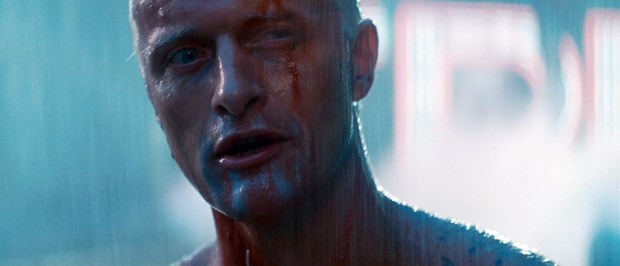
Great Cinematic and Literary Characters Series: Roy Batty (portrayed by Rutger Hauer), Blade Runner

Ahhh, yes…Roy Batty. He is noble. Brave. A proud antagonist but not a villain. A warrior.

So strangely beautiful. That wonderful hair–peroxide blonde. And spiked. Those fine, yet distinctive, angular features. Those steel blue eyes. Sculpted, muscled thighs. The broad chest of a sprinter. If not for his slightly crooked teeth, he’d be very nearly perfect.

As a biorobotic android “combat model” with super human strength and genius level IQ he is literally a killing machine. His theater of operations is “off world”; he guards and preserves intergalactic colonies.

But Roy has the audacity to want and that is a tricky thing in this dystopian, Blade Runner world of 2019. It is okay to want those basic things that he is programmed for, but to want more is subversive. To feel is anathema.

And he does feel. He experiences. Loyalty. Longing. Love. He knows what beauty is and perceives these, the most profoundly dangerous things of all: He feels empathy and he has hope, though his lifespan is programmed at a mere four years.

Roy fosters these emotions in other biorobtoic androids–“skin jobs” is the derogatory term some humans refer to them as–and they rebel violently, ruthlessly. Murderously. Roy is the leader because although the others have superhuman strength, they are not as beautiful or as beautifully smart.

Four of them–they are also called replicants–escape to planet earth on a desperate quest for more time, tracking down those who are complicit in their design. They interrogate; they punish. And they do what they were made to do. They kill.

But, just as they are hunters, they are hunted too. Death hangs over them and onto them, picking them off one by one, till only Roy is left. Roy knows that he has eluded and outsmarted it, even as he also knows, he can not outlast it. His last act is terrifying–he literally howls like a wolf because he is alone with no comfort as he confronts his demise with dignity and pathos. And, more than that, with empathy. Like the warrior he is. Like a real man.

“I’ve seen things you people wouldn’t believe…Attack ships on fire off the shoulder of Orion…I watched C-beams glitter in the dark near the Tannhäuser Gate…All those moments will be lost in time, like tears in rain…Time to die.”

NashVegas 80s; Strip Club, M.D. (Conclusion)

Recap of Part I: After working a series of odd jobs, ranging from construction to waiting tables, as newcomers to Nashville in the mid 80s, my husband takes a job as strip club DJ, despite my insistence that he not. In order to keep the peace in our relationship, he takes me to the club with him where I observe the goings-on from the DJ booth. One of the frequent customers is a notorious physician accused in local newspapers of sexual abuse and writing prescriptions in exchange for sex.

There’s something sad and seedy about a nightclub that’s open for business in the daytime. It’s even sadder and seedier when it’s a strip club that’s open then.

Dark, temperate and unaired, the atmosphere messes with your circadian rhythm. The only way you can tell that it’s daylight outside–aside from your own watch, there are no clocks in strip clubs– is by the customers inside. The nooners. That’s what we called them even though the club didn’t open up till 4 p.m.

I can still remember some…The slick in a business suit, some state representative that popped in from the capital just about everyday…The EMT who worked nights and spent his days buying lap dances…There was Beebo (I have no idea why they called him that) the limo driver who worked the same hours as the EMT. They sat at the bar together when they weren’t doing the lap dance thing…Then there was the clammy guy with greasy hair who the girls said smelled like he lived in his car. He was tolerated even though he habitually violated the club’s dress code. He bought sit outs and private dances.

They were the hardcore, the backbone of the strip club business that the girls counted on for loans and rides from time to time. They weren’t loud and they didn’t cause trouble. If there was trouble, it happened later, during the second shift. The last thing these guys wanted was to get kicked out.

My husband DJ’d the 4 p.m. to 10 p.m. shift. At least he did at first. The doctor usually came in during this time block, but not always; he didn’t qualify as a nooner. For the most part he didn’t really have a pattern except that he came in the the side door with Rodger. Rodger was the club owner’s right hand man.

And you never knew when Rodger was going to show up.

None of the girls used their real names. They all had stage names. For some reason I remember the name Ashley being popular. That always struck me as strange. I never thought “Ashley” was stripperish. There were a couple of Mercedes, an okay name, but it sounds more like a stage name than Ashley–to me anyway.

Then there was a Ginger. Star. Desiree. Gypsy…To name a few.

My husband got along with all of them. They told him what to play. They all had their special songs. Some were into Metal. Some liked R&B. A few of the girls got into Hank Jr. and Eddie Raven but Nancy only allowed about three Country songs an hour.

That was fine by us.

My husband was kind of like Nancy’s Sargent. She used him to keep the girls in line. It was his responsibility to make sure that they were ready to come on stage when it was their turn–when their song was played.

He also had to scan the club and make sure no shenanigans were going on. If there were shenanigans, my husband called in the bouncers to take care of it. (I saw a lot of stuff, but I kept my mouth shut. Not my job.)

Nancy handled the bar, the money and watched the bouncers. The bouncers watched the customers.

The customers followed the cardinal rule: No touching the girls. The guys were absolutely prohibited from it, not even when they put money into the G-strings. No flesh on flesh touching.

It was different for the girls. They could touch the guys, e.g., hold their hands, touch their shoulders, kiss them on the cheek, but that was all.

Nancy was very strict about touching. It was important to her that the club was “clean”. Rodger wasn’t as strict.

The doctor could touch.

Sometimes I sat at the end of the bar by the DJ booth. That’s where the girls sat when they weren’t working. I got to know some of them. Some I liked. Most I didn’t.

One was particularly strange. She was very quiet. Older. I would say mid to late thirties. Not pretty, but not bad looking either. When she talked, she spoke intelligently with no trace of accent. And when she did her “floor show” (that’s when they danced on the stage) she always touched her nose, closing off one of her nostrils. We all knew what that meant. Cocaine. The club was flooded with it.

One day she and I talked. She told me that she was just about to finish up nursing school. “That’s great,” I said. ” Then you can stop working here.” She looked at me like I had just said that I hated puppies. “Why would I do that?” she asked incredulously. “I love it here. It’s my hobby.”

When she got out of school she went to work for the doctor. But she still worked the club. Part time.

Have you ever seen those guys that are always in a perpetual sweat? Like Richard Nixon?

Nixon had that thin layer of sweat between his nostrils and his upper lip. People said that’s why he lost the debate to Kennedy. Too sweaty.

The doctor was like that, but he had a mustache. A thick black one. His hair was black too. Shoe polish black, an obvious dye job.

He wore pleated slacks, calf skin loafers and light weight zip up jackets– Members Only–over golf shirts. The girls said he carried a gun in an ankle holster. He was smarmy looking, though he thought himself very handsome. The girls flocked around him when he made his grand entrance with Rodger, but they laughed and made faces behind his back.

Rodger didn’t even like him, but he kept him around. I’m sure that had something to do with the prescription bottle Rodger kept in his pocket. Rodger was obese. He said the doctor was helping him loose weight.

One night while I was setting at the bar, the doctor approached me. I had never talked to him before. Didn’t want to. He said something obscene to me–having to do with his medical practice. My husband saw the exchange. He jumped down from the DJ booth. “What’d he say to you?” he yelled.

I told him.

My husband shoved the doctor against the bar and then pressed against his chest, bending his back awkwardly down. The doctor tried to push him off, but my husband is unusually, deceptively strong. Rodger hollered for my husband to stop. My husband wouldn’t. Rodger called for the bouncers. They wrestled him away from the doctor.

I was relieved–and happy. I just knew my husband was going to get fired.

He didn’t.

“You better not ever talk to her again,” my husband screamed at the doctor. I’ve never seen his face so red, his eyes so wicked.

He didn’t.

Rick was the second shift DJ. He worked 10 p.m. to 3 a.m. His fiance was Princess, one of the dancers. Rick was all right. He could work the light board like Jimi Hendrix could play the guitar. I’m not kidding. The guy was an artist.

Rick had a very wealthy father who had recently passed away. What his father did, I don’t know. All I know is Rick had a lot of money coming to him once the estate was settled. Three million dollars. When the money kicked in, he and Princess were out of there. They had plans to move to Montana.

Well, the money did kick in–sooner rather than later. Rick and Princess didn’t give the club any notice. I didn’t blame them. Nancy told my husband he’d have to work double shifts until she found another DJ. We were both pissed. Especially me. That meant my husband had to work eleven hour shifts Monday thru Saturday. The club closed Sundays.

My husband wore cowboy boots to the club. I never liked them but that’s what he wanted to wear. We’re from Texas, that’s not unusual there.

He stood on his feet most of the time in the DJ booth and would often complain that his feet hurt, especially his big toe–which big toe, I can’t remember. I told him to ditch the boots. He wouldn’t.

One morning when he pulled off his boots after work, his big toe was black. The next day he called Nancy and told her he needed to take a couple of days off. She said no.

Now my husband is probably the best employee Nancy ever had. He was always on time, didn’t put the make on the girls–consequently they liked him–never drank on the job, kept his wits about him and had/has a really good announcer’s voice. He went to college for it, after all.

He told her he was taking off a couple of days. And he did. When he went back to work two days later, she fired him. He was glad. We took off a month before we both got new jobs. I remember we slept for about a week straight.

Weight loss doctor chases, shoots at theft suspects

Published 9:40 P.M. CT Sept. 21, 2016

A man ran after two men he said stole his wallet, firing his gun at them multiple times just outside Green Hills mall Monday night in a Macy’s shopping trip gone bad.

____________age 68, said he was in the process of buying his girlfriend a swimsuit at a register in Macy’s when two men ran by him, grabbing his wallet off the sales counter as they passed.

__________ran after the two individuals, who he said got into a white SUV or minivan-type vehicle.

“That’s when I started shooting – when he opened the door,”________ said. “I was in fear for my life.”

He admitted to firing several shots with the Smith & Wesson revolver he was carrying in his pants pocket. Police confirmed_________ had a valid handgun carry permit.

________said he is a weight loss doctor based in Nashville, but a Tennessee Department of Health license search revealed that _________ license is currently revoked. His history as a medical professional is marred by disciplinary actions, hefty fines and court hearings from 1997 to 2011, according to the health department.

His license was revoked in 2008, and he was assessed $41,000 in civil penalties on several charges including unprofessional, dishonorable or unethical conduct, fraud or deceit and false advertising.

Aaron said the actions of the suspects and_______ remain under police investigation.


NashVegas 80s; Strip Club, M.D. (Part I)


My husband and I worked a series of odd jobs when we first moved to Nashville. That’s what you do when you move to a new city without job prospects and you don’t know anybody; when you’ve interrupted your education to get married–and to party.

Let’s see…I waited tables. I answered phones. I worked an assembly line hanging coiled wire and got one of my front teeth knocked out. I cashiered. And I worked construction with my husband.

The construction gig wasn’t half bad. We were roofers. Purely shingles. No tar. Just the two of us working for a shady contractor who built golf course maintenance houses.

We got on the job site early when the skies were streaked with color. We had our morning coffee and breakfast biscuit on the roof. It was pretty. Golf courses generally are.

This was back in the mid 80s when you could still make decent money working construction. But the gig didn’t last as long it was supposed to. The contractor had to leave town fast before a few of his jobs were completed. My husband got wind that he was skipping and…well, we got paid. Cash.

We lived downtown then, during the first Nashville renaissance. The Ryman Auditorium, the original Grand Ole Opry was boarded up, abandoned at that time. Lower Broad was still full of pawn and porn shops, but upper Broad and 2nd Avenue were rocking.

There was excitement in the air. And we were part of it.

The Market Street Apartments are on 2nd Avenue South. That’s where we lived, in expensive digs that cater to what we called yuppies back then. We were friends with some of them. Others looked down on us. It was hard for us to come up with the rent, but we managed. Our realtor/landlord loved us. He said he wished he had a building full of people like us. People that paid their rent on time. That made us feel good.

Anyway, there we were in between jobs with the rent due soon. I hoped we would work some of the construction contacts we’d made and get something similar to the golf course gigs, something where we could work together. My husband said that was unlikely. Cushy gigs like that are few and far between in construction.

Besides, it was getting cold. My husband hates the cold. He wanted to work inside. He wanted to DJ. That’s why we came to Nashville. So he could work in radio. And that’s how we met, in college radio.

But you don’t just walk into a mid-major radio market from a small radio market and go to work. It doesn’t work that way, no matter how good you are, especially back then when radio was a big thing and every job in the top 50 market was highly coveted. You had to pay your dues.

As the old story goes, we knew a guy, who knew a guy, who knew a lady that managed a strip club. The strip club needed a DJ.

I could name names in this post and from a journalistic perspective I should, but I’m not a journalist, so I’m not going to. If that puts you off, I understand. This is my hobby. I don’t get paid for it. I’m not going to risk getting sued over blogging. And this physician sues people. He also pulls guns on people.

That said, he’s been the subject of many write ups in The Nashville Tennessean and The Nashville Scene since I’ve lived here and upon researching him, I found articles concerning his weight loss and family medicine practice dating back to 1979.

Here’s a run down of some of the antics that he has been “disciplined” by the Tennessee Board of Medical Examiners for:

  • Molestation of patients
  • Sex with a minor
  • Abusing and insulting patients and employees
  • Frequenting a brothel
  • Unethical Billing Practices
  • Brandishing a handgun in the physicians cafeteria of a Nashville hospital

His discipline consisted of being required to see a psychiatrist, attend Sex Addicts Anonymous, be interned in a treatment facility, have a physician sponsor and pay various fines.

Several years ago my husband and I were watching the local news and a story came on about him. He was being accused of exchanging opioids for sex with prostitutes. One of the ladies had gone to the police with allegations that he abused her. His lawyer was excoriating the woman on the news. My husband and I looked at each other. It was the first time we’d heard about him in years.

I hated my husband working at the strip club. Duh. I threw few fits over it–to no avail.

“It’s good money,” he insisted. “I make more in tips in a couple of days than I can make all week working construction.”

I wasn’t appeased.

“I’m not working there for that,” he assured.

“Yeah. Right.”

“Then quit your job and go to work with me if it’d make you feel better. You can sit in the DJ booth. Nancy won’t care.” Nancy was the manager of the joint.

I was waiting tables again at a hotel coffee shop. The tips sucked and the manager was making passes at me. So I turned in my notice and went to work with my husband at the strip club.

It seemed like the logical thing to do. Of course I was twenty-two at the time.


Mandy, a Film directed by Panos Cosmatos, 2018; Horror/Fantasy


If you are a fanboy or fangirl who likes to drop acid, read Heavy Metal magazine and jam out to–oh, let’s say– Dio in a black light basement, then Panos Cosmatos’ Horror/Fantasy Mandy is for you. If you don’t engage or dabble in any of the above, then I would suggest you stay away–like I wish I had.

The plot? Pure revenge yarn. I’ll get down to it.

Red (Nicolas Cage) is a lumberjack in the mountains of…Oregon?… Yeah, I’m going with Oregon, who lives an idyllic life with his wifey–yeah, you guessed it–Mandy (Andrea Risebrough). Mandy is very lithe and fairy-like in a Gothic Horror kind of way. She wears Motely Crue and Black Sabbath concert t-shirts. And she has really big expressive eyes. Weird eyes, actually.

Red and Mandy are deeply in love and, on this, I’m not being tongue in cheek. Their romance is touching. They’re simpatico.

Mandy had a horrible childhood. Her father is a demon. I’m not kidding. He is a real demon–quite possibly the demon. But she escaped him.

Then one day she’s walking down the idyllic road (well, it’s scenic but there are these weird howling sounds at night) where she is spied by demonic cult leader, Jeremiah, (Linus Roache) and his slovenly followers who are out cruising in their conversion van. Oh yeah, I forgot…it’s 1983–Soooo yes, there are mullets…And aviator glasses.

So Jeremiah summons his denizens from hell (yes, he has that power) and they are scary, (think Pinhead, Jason Voorhees and Michael Myers if they were really oily and rode motorcycles) to kidnap Mandy. They do, but not before they ransack the couples tender lair and torture Red, leaving him tied up in barbwire and almost dead.

At the cult’s labyrinth lair, things don’t go well for Mandy when she encounters Jeremiah; he thinks he’s the son of Satan and she knows full well he is not. She is not impressed when he plays her his record and it has flute in it–and we’re not talking Jethro Tull. She laughs at him. (Yeah, I know. But she can’t help it. She knows demonic rock and this isn’t it.) This makes Jeremiah furious so he sets her on fire, though he does it with a wistful look in his eyes.

Meanwhile Red is tied up in barbwire with a very serious vendetta jones. He escapes the barbwire and forges a Medieval looking battle axe and goes to war with the denizens of hell.

And its bloody. Really bloody.

I didn’t like this movie. But that’s just me. From the dispassionate position of objectivity, Mandy meets, even exceeds its bold, grandiose and highly stylized ambitions. That said, Cosmatos could pick up the tempo a bit.

Visually, it is stunning. Cosmatos’ color palate is as vibrant and lush as it is dark and gritty. There were times I felt as though I was free falling into an abyss of shades of red.

The soundtrack by Icelandic composer, Johann Johannson is superb. I knew it was going to be special when, during the opening sequence, Red surveys his opulent forested surroundings as the gorgeous, haunting overture of King Crimson’s Starless plays. Best part of the whole movie, I thought.

Cage is good, particularly in the first half as he conveys his relationship with Mandy. It is a gentle, natural, seamless performance; one for which he will receive a lot of attention, perhaps even career saving attention. I hope so. I have an affection for him.

In the second half he goes predictably bonkers, albeit with a wink and a nod…And a leer. It’s effective, if you like that kind of thing.

Into The Vacuum

Normally I avoid being political, especially on my blog. The primary reason is practical. I want people to read my blog and to follow it no matter their political inclinations or affiliations.

Additionally, my blog is about cinema and literature; thematically it is about crime. And though I’ve been known to stretch the framework a bit, I like to keep it within this wheelhouse.

However, recently I heard something that scraped an exposed nerve so brazenly that I’m going to veer off course. So be forewarned.

Here is what I heard, verbatim:

“I will tell you that all the cable TV shows in the world, all the front pages of newspapers in the world, all the editorials, all the tweets in the world don’t matter a hill of beans when somebody you know walks up to you and says, ‘Let me tell you why I’m voting for Donald Trump. Everywhere I go in this country … I’m just telling people, go tell somebody. Because the sheer weight of you taking time to find somebody at work, at worship, outside the drug store, and just saying, put that great make America great hat on again, and just walk up to them and say, ‘For real, you know me, let me tell you why I’m so passionate about this.’ Because word of mouth is still the most powerful media in America, and it always will be.”–Mike Pence

This statement from our Vice President sounded an alarm with me because it is a variation of something that I have heard many times growing up from my late mother (a self employed hairstylist) and have said myself (as a small business owner):

“Word of mouth is the best advertising.”

So then, this is what it’s come to? It hasn’t happened overnight or in a vacuum, but here we are being encouraged by our Vice President, albeit it cleverly, almost subliminally–just like when we are coerced into to buying a bag of Oreo cookies or a SUV–to forgo professional journalistic reporting for word of mouth. Insidious. Ridiculous. But true.

Now before I go any further let me be clear, I do not revere the press, e.g., journalists, the mainstream media, etc. Hardly. In fact, I do not revere anything except God.

That said, I used to have a deep respect for journalists. No more. That’s because they’ve headed straight for the pile of excrement and not only stepped in it, but drug all of us through it in the process.

That’s right. They did it willingly.

They did it when they deluded one of the basic principals of their profession:

OBJECTIVITY

Journalists are expected to probe, to investigate, to gather information and report it objectively, in an equitable manner, so that we the people can make an informed decision. Hence we are not supposed to have stories presented from cherry picked facts and Republican and or Democrat news networks. We are not supposed to–but we do.

Little wonder that we are a divided nation touting our caste system of blue states and red states like the gang territories and colors of the Bloods and Crips. It has been said that we have entered a cold civil war. I believe it.

How did we get here? I think I have an idea.

You see, I come from a one television set family. Consequently, I watched more news than the average kid or teenager. From an early age I was aware that the news media leaned left. Notice that I have emphasized the word leaned.

So then, let’s look at the word lean. Let’s examine the contextual Merriam Webster definition: 

To tend or move toward in opinion, taste, or desire. “She leans toward the city life.”

Now let’s look at the word point and examine its definition contextually:

To show someone the direction in which they should go. “Could you point me in the direction of the lobby?”

Is there even anyone who denies that the mainstream news media has traditionally leaned toward the left? I dare say no.

The mainstream news media has not, however, traditionally pointed toward the left. This phenomenon has happened only within the last ten years when MSNBC took a blatant hard turn to the left, supposedly to counter and to compete with Fox News’ hard right reporting. Lately MSNBC has made some overtures at returning to more centrist based reporting style but their emphasis still decidedly points toward the left.

Ergo, the left leanings of the press have hardly been benign. They have irked and isolated those on the right and have given rise to Fox News which has become a virtual appendage of the Republican party and almost a rubber stamp for the Trump administration. Notice I have emphasized the word almost.

That’s because there has been some rumblings of late about President Trump on even this proud bastion of the right, namely from Fox News anchor and commentator Neil Cavuto. Cavuto has blasted Trump repeatedly, since May, on issues like his disastrous press conference with Vladimir Putin, on saying he knew nothing of payments to Stormy Daniels and Karen McDougal and then, finally, admitting that he paid them, and for threatening that the economy would tank and everybody would become poor if he is impeached.

This leads to the question, could it be a mere coincidence that in the midst of Cavuto’s subversion, Vice President Pence issues his pronouncement that the news media doesn’t really matter? That all we really need is word of mouth?

This possibility is profoundly chilling, for every dictator known to mankind has first undermined the free press before undermining anything else. But even more chilling is the hard cold fact that we the people are undermining our great country by dividing ourselves. And sadly, instead of holding fast to its ethical principals, the press, which is supposed to be a safety valve for our democracy, has followed us into our sectarianism.

But in this precarious, destructive environment does it really matter who started the decent into the vacuum? Isn’t it more important that we hit the brakes before we are not only divided but before we are conquered as well?

Tremors, a film directed by Ron Underwood, 1990; Creature Feature/ B Movie, Comedy

What would a film world without B movies be like? A bummer, that’s what. No Them! No Tarantula. No The Blob. No The Thing From Another World. Not a film world that I would want to live in, I’ll tell ya’ that.

It would be like a real world without soft serve ice cream. Without flamin’ hot Cheetos,  funnel cake or Krystals (the southern equivalent of White Castle sliders).

Some folks would be fine with that. Some might even think it would be a better place without these things. Not me. I’m a most–not all, but most— things in moderation person.

And that’s exactly why I like director Ron Underwood’s Tremors so much. It’s a straight up creature feature, a ‘Katy bar the door’ B movie and a comedy to boot–one that actually makes me laugh. And that’s a win, win, WIN in my book.

Ahem

Tremors begins irreverently and, under the circumstances, perfectly with Val (Kevin Bacon) relieving himself off a cliff into a canyon’s abyss. It’s funny. It shows us, in a tiny capsule, who Val is and what we are in store for.

While Val zips up, his older, chiseled pal Earl (Fred Ware) snores inside a sleeping bag in the back of his pickup. He shares the back of his pick up with lawn tools and junk. This shows us a lot about who Earl is.

From their boots and rugged but perfectly fitting Wrangler jeans, we gather that Val and Earl are cowboys–and they are. On good days. On most days they are handymen in a spot in the desert town of Perfection, Nevada.

Perfection is anything but perfection. And it’s not a town either. It’s a forlorn village (population 14) with not a single tree in sight, deteriorating trailers–not mobile homes–and a sprinkling of shotgun shacks. The center of town is Chang’s general store.

Understandably, Val and Earl long to leave Perfection for the greener pastures of Bixby, (Ahem…) a town some thirty miles down the road with roads that are actually paved, only every time they gather enough gumption they are waylaid by a local yokel with a chore, a fifty dollar bill and a twelve pack of beer. And so it goes until one day a very unpleasant encounter with a septic tank inspires them. They throw their belongings in Earl’s truck with plans to get the heck out of…Perfection.

On their way to Bixby they pass a transmission tower and notice ‘ole’ Fred, the village drunk, perched atop of it. Thinking ‘ole’ Fred must be on a hardcore bender, they play rock, paper, scissors to determine who will climb the tower and bring him down. Val looses and climbs, only to discover that ‘ole’ Fred isn’t on a bender after all. He’s dead.

They take Fred to the village doctor (yeah, I know, a town with pop. 14 that has a homeless drunk and a doctor… Ahem…). He tells them that Fred died of dehydration and most likely had been on the tower for about three days.

Something must have chased ‘ole’ Fred up the tower and kept him up there they surmise, but what? It doesn’t matter cause Val and Earl are still leaving. If anything, they are even more determined. But their escape is foiled when they are waylaid yet again at a sheep herder’s shack after discovering a pen full of mutilated sheep and the severed head of the herder in what looks to be a giant doodlebug hole.

Val and Earl may be beautiful losers, but they do have morals. Thinking a maniacal serial killer is on the loose, they put Bixby on the back burner and hightail it back to Perfection. On the way they stop to warn a road crew and in a panic–it appears–Val hangs up the back bumper of the truck, spinning the tires like crazy before he finally breaks free. This pisses Earl off.

Back at Perfection they round up the residents and hold an emergency town meeting at Chang’s. While the townsfolk are sorting out what to do, Melvin, the resident smart alec teenager, (Bobby Jacoby) discovers what appears to be a huge prehistoric snake attached to the axle of Earl’s truck. It has been pulled apart–that’s what caused the spinning tires–and it stinks to high heaven.

Obviously, it is also what has made waste of at least two of Perfection’s residents and several of its sheep–or so it seems. Only it’s worse.The huge prehistoric snake thing is just an appendage (one of three said appendages, actually) that flicks out of the mouth of a ginormous prehistoric earth worm thing that kind of resembles the flesh eating plant from Roger Corman’s Little Shop of Horrors. 

But wait…It get’s worse. There are four of these ginormous prehistoric earth worms counting the one who lost an appendage on Earl’s axle. It’s still alive and Earl admiringly, if not begrudgingly, nicknames it Stubby.

Stubby and his cohorts have knocked down telephone lines and because of the geography, Val, Earl and company are incommunicado with the outside world even with  CB radios. (Before you go Ahem… remember it’s the early 90s.)

Tremors is a profoundly, unabashedly 100% pure B movie. And like any good B movie–or otherwise–it has it’s fair share of bloopers and blunders, e.g., exposed wires, cables and boom mics and visible crew members. There are also liberal continuity mistakes like the sky going from cloudy to cloudless in what is supposed to be an uninterrupted film sequence. According to http://www.moviemistakes.com there are a whopping 46 such errors in the film.

But hey, Tremors is an ambitious, special effect dependent project on a very modest budget. As such, director Ron Underwood relies on a great cast (Fred Ward is his usual, gruff, terrific self, Kevin Bacon wears his Wrangler’s really, really well and Michael Gross is wonderful as a lovable right wing gun nut) pulling off an affectionate, charming homage to the creature feature of yesteryear–and bodacious directors who do more than they should with more than they have. If that’s not Hollywood and the future of filmmaking, i.e., YouTube, I don’t know what is.


Noble Warrior

Today a warrior was laid to rest. He lived imperfectly, as we all do. He died with dignity and honor as we all hope to.

He insisted that he was a fortunate son. As such, he fought hard for his country, charging death’s door with a broad, wounded shoulder–but it stood fast. It gave him time to prepare before it opened. Within that preparation the warrior sought to heal with inclusion even as he used exclusion as a sword.

He fought a noble, courageous fight and did not, would not, capitulate to expediency. He was better than that. Yes, better than this.  He demanded better of himself.

And so should we.

God’s Mercy, John McCain.

Thank you.

The Night of the Hunter, a film directed by Charles Laughton, 1955; Cinematography by Stanley Cortez; Fantasy/Southern Gothic/Film Noir

It would be a mistake to view Charles Laughton’s The Night of the Hunter through the lens of realism when it was created within the prism of a parable and filtered through the eyes and bad dreams of a child. Even so, its themes of sexual repression and “female hysteria”, misogyny, serial murder and gullibility are unmistakably adult. Accordingly it was ridiculed during its day just as it is now routinely lauded. But make no mistake, now as then, it isn’t a film for everybody–just those who are willing to watch and listen, humbly and discerningly.

Ben Harper (a disconcertingly young and un-gray Peter Graves) is a desperate family man, out of luck and short on money in the Great Depression south, who does the unthinkable–he commits double murder during a bank robbery and then runs home with the loot and the cops hot on his trail. There he hides the money inside his daughter’s favorite doll while she and her big brother forlornly watch. He tries to escape to no avail. He is pathetically chased down and apprehended in his own front yard, but not before managing to give his son frantic instructions: Take care of your mother and sister; don’t tell anyone about the money, including your mother.

Condemned to the hangman’s noose, Harper spends his last days with a seemingly ne’er-do-well preacher/car thief who is, in fact, much worse than that. The Reverend Harry Powell (Robert Mitchum) is a woman hating serial killer who knows Harper never divulged where he hid the money.

Wisely, Harper isn’t swayed by the reverend’s feigned concern or attempts at “counseling”; he has seen the switchblade Powell has smuggled in. He tells his cellmate where he can go. But Powell is privy to the condemned man’s fitful, nightmare induced murmurings and from them–and the grapevine–he puts two and two together.

Sadly, but–perhaps–fittingly, Ben Harper has his date with the hangman while the disproportionately evil and undetected serial killer is set free. Of course he heads straight for the Harper family home, but on the way he is sidetracked by a burlesque show. The reverend watches the cavorting with the raucous male crowd and becomes incensed as he is aroused. He triggers the switchblade and the blade thrusts menacingly through his jacket pocket.

Harry Powell shouldn’t fool anyone. He looks exactly like what he is. He even has jailhouse tattoos inked just below the knuckles of each hand. L-O-V-E and H-A-T-E.

Yes, he wears the garb of a preacher and carries a Bible wherever he goes but displays none of the virtues of Christianity or characteristics of it’s founder; he is all fire, brimstone and wrath. His mannerisms are those of a stage actor–broad and sweeping as if he is playing only to the cheap seats. When he cries for the lost souls it’s all sobs and no tears.

Still he is tall, square jawed and good looking, so there’s that. Plus he exudes a potent charisma and sensuality that attracts the very women he is so repulsed by–and then some. One of those women is the widow Willa Harper (Shelly Winters).

Willa Harper isn’t a bad woman. She loves her children and tries desperately to provide for them. But she’s weak. She is exactly the type of woman who would take up with the scoundrel Ben Harper and then feel so guilty about it–and so lonely for a sexual companion–that she allows herself to be seduced by a pious fraud much worse than her executed husband ever was.

Things move fast as they did during those times and Willa and Harry Powell are soon married. Everybody is happy, at least at first, except for the Harper boy, John.

John (Billy Chapin) is wise beyond his age which is about eight. He takes good care of his little sister, Pearl (Sally Jean Bruce) who doesn’t know any better than to be enamored with her “new daddy”. Her brother, though, is not impressed. He sees straight through the preacher and engages him in a war of wills.

Deducing that there is no way the boy will be seduced into telling where the money is, Powell resorts to threats and violence–behind Willa’s back of course.

At first Willa, aglow in the blush of being a new bride, is easily deceived. She soon finds out, however, that Harry Powell has a rather odd idea of the marital bed: it is for procuring children only. When she approaches him, he coldly asks her if she wants more children? “No,” she replies. “Good,” he says and then turns his back to her.

Disillusioned by her new husband’s lack of  interest and dismayed by his cruelty, Willa gradually allows herself to see Harry Powell as he really is. Though she has convinced herself that Ben threw the money into the river to avoid being caught with it, she overhears Powell trying to coerce Pearl into revealing where it is. When she confronts him with what she’s heard he accosts her with his switchblade. She does not resist. Instead she offers herself up as a lamb to his slaughter, leaving her children to fend off the fiend by themselves.

By the grace of God and some comical bungling, John and Pearl manage to escape into the night aboard a skiff, but not before Powell finds out that the money is in the doll. Passed out from exhaustion they are unaware that the skiff has beached, while the reverend doggedly peruses them on land. He is afraid of water.

Fortunately they are discovered by a kindly old woman (Lillian Gish) who takes in and cares for wandering, disaffected children of the Great Depression. She isn’t sure how she will feed an extra two mouths, only that she will.

Her name is Rachel Cooper. And while she is petite, angelic and truly Christian, she is no slouch with a switch, as John finds out, or a shotgun either, which is a good thing since the Reverend Harry Powell has tracked his quarry to her door.

The Night of the Hunter is a cinematic marvel to behold. It was lushly and curiously photographed in black and white at a time when studios were clamoring for technicolor films. Some sequences–the night time nature panorama in particular–have a strange phosphorescent quality that renders it utterly unique in cinematic history.

Cinematographer Stanley Cortez who also shot Orson Welles’ The Magnificent Ambersons, was a bold and experimental artist. Honing his craft in 40s film noir where he worked with the legendary creator of the genre Fritz Lang, Cortez was able to pull out every forced perspective trick in the book and he used many of them on the economical and inventive The Night of the Hunter set.

Take the famous hayloft scene in which John and Pearl, perched in the loft of a barn, see the reverend’s tiny figure in the distance riding a horse, his distinctive hat silhouetted against the moonlight. The entire locale was constructed on a very small back-lit set, the depth and distance engineered by the height of the loft built almost to the roof of the stage, and the scale achieved by a dwarf riding on a miniature pony.

Although Cortez’s fingerprints are all over The Night of the Hunter, it is not his film. He is merely a commissioned–though highly prized–artist hired to orchestrate Director Charles Laughton’s idiosyncratic vision.

Laughton conceptualized and delivered an overtly stylized film, rife with symbolism and exaggerated angles that mimic the blade of Powell’s ever present switchblade. He used the fairy tale as a motif and was inspired by pen and ink illustrations that were popular in pulpy periodicals of the 1930’s.

Perhaps most impressively, due to his own prestigious acting career, he was able to assemble an A list cast on a 795,000.00 budget that, while not B list, was certainly well below the extravagant multi million dollar budgets of the musicals Guys and Dolls and Oklahoma! that premiered the same year. Fellow Brit thespian and movie star Laurence Olivier wanted the role of Harry Powell but Robert Mitchum won it when, during the audition, Laughton described the character as “a diabolical shit” whereupon “Old Rumple Eyes” raised his hand and said, “present.”

Likewise Laughton’s casting of silent screen legend Lillian Gish was fortuitous. Originally he wanted his wife Elsa Lanchester (who most famously portrayed “the bride” in The Bride of Frankenstien) to play Rachel Cooper but she turned down the part and suggested Gish instead.

Gish’s portrayal of Miss Rachel is nothing short of inspired. She is the light that contrasts the black expanse of the hole in the Reverend Powell’s soul. In the same way, her characterization emphasizes the chasm between gullibility and Christianity; between devotion and religiosity.

Sadly, Laughton’s masterpiece was a critical and commercial failure in 1955. Though American audiences were/are aware of duplicitous men of the cloth, they rejected the depiction of the perverted, murderous Reverend Powell none-the-less. European audiences, largely spared and, therefore, ignorant of this primarily American charlatan, resented the representation as well. Charles Laughton never directed another film. Reportedly he was deeply wounded by his film’s failure. He died of renal cancer in 1962.

But the Director Charles Laughton and his film, like many so many other famous examples of artist and masterpiece, would fare much, much better posthumously. In 1992, the United States Library of Congress signified The Night of the Hunter to be “culturally, historically, or aesthetically significant”, and selected the film for preservation in its prestigious National Film Registry. It is just one of the many accolades heaped upon a provocative and beautiful film about the humble triumph of good over the seemingly overwhelming forces of evil.


Newer Posts
Older Posts