My husband and I held hands yesterday as the Chauvin verdict came in. When the verdict was read, my husband released my hand; he began to clap. Not me. I just felt empty. I remembered a post about this cruel tragedy from my friend Stacey. It expressed what I could not. Rest in peace, George Floyd. I’m so sorry this happened to you.
The timing of my last blog, Acting While Black, was a little ironic, coming as it did shortly before the latest incident of police brutality/murder in the U.S.
The premise that black characters rarely survive in movies of certain genres seemed absurdly laughable and it felt worthwhile to jog down that road a little bit, stopping at the glitziest and shiniest of hilarious examples.
After the past week, the humor of Acting While Black has soured in my mouth pretty much. The past week has been a case, for me, of tears over laughter instead of the other way around. I don’t know what’s going to happen. I don’t know if this is the beginning of the end or not.
But I know one thing. I know that a pocket wasn’t meant to hold a quiet hand while a heart stopped and a voice asked for his mother.
I share a love of film and music with my friend and fellow blogger, Mikey over at Wolfman’s Cult Film Club. Mikey has a huge, eclectic record collection; I’ll put it this way, I was quite impressed with my own collection–until I saw his. Wow!
And while I dabble in jazz, Mikey is a bonafide jazz aficionado. He walks the walk and talks the talk–and he’s got the records to prove it.
So, in light of my post on the jazz heavy noir, Odds Against Tomorrow, I asked Mikey’s permission to repost his very “hepcat,” Where Has Poor Mikey Gone?
A friend sent me word of this once rare, and I imagine, seldom seen British film oddity called Where Has Poor Mickey Gone? (1964). I’d never heard of it, however, I knew the filming location well. Set in the early 60s in London’s Soho area. Long before I would travel there on the train from my south coast hometown every other weekend to spend my wage packet on vinyl records. From the late 80s through to the early 2000s it was a mecca to me and many music heads for its vast assemble of filled to the brim, record shops. Most famously for Berwick Street, a street lined with the holy grail of crate digging flicking fingers.
A while back I was fortunate to review Robert Wise, The Motion Pictures by J.R. Jordan, a studious filmography about Robert Wise–of course. I say of course because, yes, the title of the book is titular, but I’m also referring to the tendency of American film critics to underrate the multi-award winning director.
It’s a total snob job, quite ridiculous. Certainly Wise had some missteps, but his greatest failing, according to his critics, is something that I won’t fault him for–directing a few sequences in the Orson Welles masterpiece, The Magnificent Ambersons.
That was his job. It fell on him to do what Orson Welles would not. Either that or quit.
The Magnificent Ambersons is a landmark film despite Robert Wise’s directorial contribution, not because of it. Everybody knows that.
Regardless, the rub against Wise is that he has no signature, which is another way of saying, he has no style. And that’s the worst thing you can say about an artist.
And it’s not true. Robert Wise did have a signature…
Realism.
That’s it, if I had to sum it up in one word. And his signature of realism didn’t just manifest itself within the genre of realism–no. It’s in the precise, almost microscopic, sense of detail present in every one of his films, regardless of genre.
That Wise’s signature is subtle doesn’t mean that it is inferior.
It means it’s intelligent.
And that composition of grit and intelligence drapes the contours of noir quite nicely. In fact, I would argue that in terms of consistency, Wise’s most artful films come from noir and that his best noir, the racially hard edged, The Odds Against Tomorrow, starring a spectacular Robert Ryan and an impeccable Harry Belafonte, is unfairly overlooked when it comes to masterpieces and near masterpieces.
While Robert Wise–rightfully–would never be described as subversive, he did collaborate with subversive artists. One such artist was Harry Belafonte. Another was Abraham Polonsky.
In 1958 Belafonte was at the forefront in the intersection of looks, talent, charisma and civil rights. At considerable risk to his personal and professional security, he openly associated with Communists and Communist sympathizers within the entertainment industry who were egalitarian. As the CEO of HarBel Productions, he tapped black listed director and writer, Abraham Polonsky to write the screenplay for The Odds Against Tomorrow, while navigating the aftermath of the McCarthy investigations and participating in the modern civil rights movement.
Though jazz and noir had hooked up many times before, Belafonte literally links them with his portrayal of entertainer/musician, Johnny Ingram. The parallels and contrasts between character and performer are intriguing.
Like the character Johnny, Belafonte is a jazz enthusiast, who famously performed with Charlie Parker, Max Roach and Miles Davis. But unlike Johnny, he is not a jazz purist. Belafonte is a stage actor, musician and pop artist who could–and did–sing just about anything.
Similarly, both character and artist are nightclub entertainers though Belafonte on a grand scale and Johnny not as much. Even so, if ornamentation is an indicator, Johnny makes a nice living if not for his gambling addiction, which has torn apart his marriage, separated him from his child and put him in debt to mobsters.
Like so many criminals, Johnny does not apologize for his choices. He is bitter about them, nonetheless.
Still, we are impressed as he suavely croons and plays the Marimba in a haunting rendition of My Baby’s Not Around with Modern Jazz Quartet at the club where he is employed. We admire him as he cruises the scene in a beautiful, white, convertible Corvette and we worry about him when he is confronted by a loan shark and his unapologetically gay henchmen.
And we worry about him because he is black.
It’s 1958…so we should be worried.
Johnny’s debt (and his beautiful, white, convertible Corvette) drive him to the apartment of Burke, (Ed Begley) a corrupt, disgraced former police officer living hand to mouth because his pension has been stripped. He’s the one, Burke is, who comes up with the “perfect” heist. At the apartment Johnny crosses paths with Slater, (Robert Ryan) an aging, vehemently racist, he-man desperate for a score.
In fact, all the characters are desperate in The Odds Against Tomorrow, except one.
There is Lorry–played by a terrific Shelly Winters–who despite being astute in the business world is attracted to Slater’s tough guy magnetism. Then there is Helen, Lorry and Slater’s next door neighbor, played by Gloria Grahame. She, too, is attracted to Slater–slovenly so.
Grahame sizzles as a defiantly promiscuous woman who is turned on by violence. Never lewd, her performance evokes both interest and disgust; it is brilliant.
And finally there is the newly single Ruth, (Kim Hunter) navigating her way around the landmines of mothering and breadwinning in a racist, sexist environment. Unlike her ex-husband, she is not bitter. Instead she is determined. She doesn’t shatter when Johnny accuses her of being cold. She doesn’t apologize for being responsible.
Under Wise’s generous direction, the talented cast channels his vision of stylistic verve tempered with wincing realism, creating an atmosphere of dread. And as fine of an ensemble cast as it is, it does have a stand out.
Robert Ryan.
He is scary good as Slater, a racist creep who resents the hell out of the smarter, better looking, more successful Johnny. Slater is volatile and unsophisticated. What he is not, is stupid. Consequently he understands his impulses enough to anticipate his own failures as he lurches from one disappointment to another.
As Slater, Ryan creates a memorable heavy.
For all that, where The Odds Against Tomorrow ultimately excels is in the vision of its director. Allow me to set the opening scene:
It could be a stream, the way it ripples. But it’s not…
They could be leaves carried by the rippling. They are not…
It’s rainwater collected in a gutter; the rippling caused by wind pushing trash–not leaves–up an empty street.
It’s kind of beautiful. And it shouldn’t be.
It’s art.
It’s Robert Wise.
I Heard it in a Movie: a Podcast about Music and Cinema – Musical Confetti
I Heard it in a Movie: a Podcast about Music and Cinema – Electric Eclectic
Aside from the fact that she genuinely loved her child, it was important to her to be a good mother. And she was–generally speaking.
What made her sensitive about it, was an incident that happened in the park when her son was three years old.
Now keep in mind, she was very particular about the way her son dressed; it was important to her that he had the best play clothes and the nicest play shoes…that his hair was cut just so. She didn’t care if his clothes got dirty, or that he tore his pants. She would just throw them away, or–if she had the time–donate them to the Church…
I’m referring to Janice. Janice Drake…I thought you knew that…
Anyway, she was the same way about herself. Immaculate.
So, she’s at the park, she’s swinging her son on the baby swings…and this woman, a mother with a little girl who was at the swings when Janice got there…she grabs her little girl and gathers up their stuff…
And she just runs off…
Well, she didn’t run…but she hurried, like Janice was a demon or a witch.
That really bothered her. She never got over it.
Allan used to get upset with her if she harped on it. He’d say…well, I’m not going to say what he’d say…but it was something like, “give it a rest why don’t you? Who cares what that bitch thinks?”
But she did care. She cared what people thought of her.
So did Allan, if you want to know the truth. They were both very self conscious.
The deal with Janice though…she was so striking…that’s why that harpy ran off like that…if she was little Suzy homemaker, she would have gotten the same reaction from that woman.
Janice was beautiful. She was sexy without even trying. And some women didn’t like that. They were jealous.
∼
It was her least favorite thing about her job–the sleeping around part. Most people thought that was all her job was. But they were wrong. They had no idea about her job–of everything it entailed.
There was a reason why she made as much money delivering a package to an apartment as most stiffs did working six months at their straight jobs.
Her job was dangerous. Her job was exciting.
Why should she apologize for monopolizing her number one asset? She was a business woman.
She didn’t want an empire. She just wanted a nice Manhattan apartment–and a lot of spending money.
And she wasn’t going to get what she wanted by letting Junior feel her up under the bleachers after the dance, even if Junior’s dad owned Wilkes pharmacy, and Junior was going to be entry level rich when he was in his twenties. It didn’t matter.
Entry level wasn’t rich enough to stomach Junior.
She didn’t like him.
Allan, she liked.
She didn’t know why exactly. They just clicked.
He was very honest with her. She felt that she could trust him. He told her the truth…private things about himself. Embarrassing things…
He talked to her like she was a real person…very respectful of her intellect. No man had ever really talked to her before.
She guessed she loved him. She felt differently about him than she did anyone else.
Except her son.
He, she loved.
Regardless of that, she had a job to do.
Some of the fellas she dated she liked better than others. Same as any other job.
Believe it or not, she didn’t mind dating Mr. Anastasia…
Albert “The Mad Hatter” Anastasia…
Absolutely. She knew that he was a very violent man, but she didn’t experience him that way. With her (she called him Albert; Mr. Anastasia too, but only when someone was around) he was very polite. He opened doors, pulled out chairs. He reminded her a lot of Allan.
Anastasia was either the third or fourth most powerful mobster in country at that time. He was head of Murder Inc. with Joe Adonis and Lepke Buchalter.
Uh-huh. Lepke went to the chair. He’s the only big-time mafia guy who was ever executed…In actuality, he was probably the most decent of them all.
Anyway, two nights before Anastasia got gunned down in the barbershop at The Park Sheraton…Janice was bar hopping with him.
Yeah. Just like Nat Nelson.
Anastasia was close to Little Augie too. Real close…Little Augie was upstairs, in the Sheraton at poker game, when the hit happened.
Drake was furious. It scared him. This was the second time. Granted the first time was years before, but still…
He couldn’t say a thing about it to Little Augie though. It was forbidden.
No. They never talked about Little Augie’s business except for his supper clubs that Drake looked over…and they talked about Little Augie’s horses…and Janice of course…
When it came to women, there was just something about Nat Nelson. Sure, he was handsome, but not “through the roof” handsome.
In fact, he was pretty soft. His face. His hands.
He described himself as hedonistic.
What he was, was elegant.
Nice face. Nice things. Nice manners.
He had lots and lots of girlfriends. He was what they use to call a lech.
One of his high-society girlfriends, Sandra Kelly, mentioned him in a suicide note before she leaped to her death from a high rise. It was a big story back then. Briefly.
Not just your everyday Lothario, Nelson was a fashion designer and wheeler dealer in the garment district. He was also a personal friend of gangsters Jimmy Dole and Tommy Lucchese, up to his neck in crimes that very few people knew anything about.
Arlyne Weiss, the subject of Teresa Carpenter’s treatise on the gangster groupie, Mob Girl, knew Nelson, personally. She carried on a years long sexual relationship with him. She called him Nattie.
One afternoon, it was probably 1952, Arlyne–an overly bosomed, brassy red-head–stopped off at Nelson’s luxurious West 55th Street apartment to finagle a hundred bucks out of him. She rode the elevator to the 5th floor.
When the elevator doors opened, Arlyne was face to face with another mob buddy of her’s, Jimmy Doyle, who looked startled and none too pleased to see her. He got on the elevator and she disembarked from it without either uttering a single word to one another.
Arlyne was spooked by the encounter as she crept toward Nelson’s apartment door. It was slightly ajar. The air tasted like gunpowder.
Inside she found “Nattie” sprawled on the floor. His upward turned face wore the blank expression of sudden death, a bullet hole reddened, widening between his eyes.
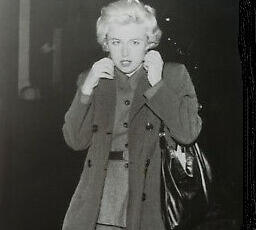
Later she saw a picture of one of her girlfriend’s in the paper. She was wrapped in a beautiful fur coat, pulled up past her neck, apparently in an attempt to obscure her identity. The article under the picture said that Mrs. Janice Drake, wife of comedian, Alan Drake, was the last person seen with Nelson, bar-hoping with him the night before the murder.
Arlyne was surprised, not that Nelson was seeing another woman, but that the other woman was Janice Drake. She just didn’t have an inkling about their “affair” and she felt–not jealousy–but empathy for her, and for Alan Drake, that he would now know about the cheating.
∼
But Drake already knew about it. The only thing he was worried about was the cops questioning Janice as if she might be involved with the murder.
And who knows? Maybe she was involved in it.
If she was, he didn’t want to know. So he didn’t ask.
It was part of the agreement that he and Janice had amongst themselves. They agreed not to let “the notions of the morality of others,” get in the way of their business, which was complete loyalty to each other and to Gus.
Within that agreement, there was times when Janice had to do what she had to do. She was always a lady about it and she only saw men that ran in Little Augie’s exclusive, relatively small circle.
Likewise, there was times when he got lonely on the road…Janice knew this. If his picture was in the paper with some bimbo, she didn’t think a thing about it...
IFNat Nelson was sleeping with his wife–and that was a big if–then, Little Augie knew about it…
They had an open marriage, he and Janice did.
He just didn’t like that Janice was that close to Nelson’s murder–because Little Augie had to know about that too–but there was nothing he could do about it…They both had to trust that Gus was looking out for them.
Within their agreement, he and Janice and their little boy lived a wonderful life. They lived primarily in Miami and New York, but they also traveled frequently to L.A.
Sometimes Janice and their son traveled with him–always first class accommodations–on the comic circuit. For the most part, Drake still worked the second tier clubs, but he had some big dates in the major leagues too…he opened up for singer Tony Martin at the Copa.
And that was a big deal in the world of the stand up comedian. To get a taste of big money…It was better than nice money…It was power. It was influence.
Once you’ve had it…you don’t want to give it back. Just like you don’t want to go back to nice money. To good money…
Drake knew that some of the guys talked about him. He knew what they said…that he was Little Augie’s lap dog. That stuff.
But they didn’t dare say it to his face.
And he knew them all.
Frank Sinatra. Jackie Gleason. Ed Sullivan. Rose Marie. Lucile Ball.
A lot of them lived just like he and Janice did…or worse, depending on your perspective. Some of the stories he heard about Sinatra…about the way he treated women…girls that liked to have a good time. He had that Madonna/Whore syndrome, thing going on.
And John Houston…the big director in California. That guy…he was into some sick, weird stuff. That’s what Drake heard, anyway…
He and Janice hired a private teacher so that their son could travel with them on his tour.
Weehawken was an alright town as far as towns go. But it was on the wrong side of the Hudson, so there was that. And since it was on the wrong side of the Hudson, that meant it was in New Jersey, so that was another thing.
And Jancie Hansen was a very good looking girl, so there was that too. Not beautiful…not really even pretty, but healthy. Vibrant. She had a good figure. Her legs were probably the most aesthetically pleasing thing about her. And her hair. It was long. And thick and blonde.
Plus she was a sharp gal; she really was. She knew how to keep her mouth shut. She didn’t gossip.
Janice was perfectly happy being eye candy on some gangster’s arm. She wasn’t adverse to delivering packages for her gentlemen either, or messages.
The police called it “being a courier.” That was pretty much her job, that and being a professional companion, a dancer and a beauty pageant contestant.
As far as she was concerned it was good work if you could get it. It got her a nice apartment across the Hudson, and some very nice clothes too.
She was young, but old enough to know better–by a mile…
Some people–the fellas and some of their girlfriends–told her they didn’t understand what she saw in him. He wasn’t handsome.
Janice agreed; he wasn’t, but he was a big guy and she found that very attractive…and he was a very good dresser. He had an eye for it. She knew because she had an eye for it too–fashion. But hers wasn’t natural like his was.
She had a gentleman friend, a fashion buyer and designer, in the garment district who taught her about the eye…
They said he was a simpleton; a hick, the fellas did. And their girlfriends….Janice disagreed. She thought he was quite eloquent. He was very careful of his pronunciations, but he wasn’t a jerk about it…
He wanted to be elegant because he thought it was the right thing to do.
When she met him, he was the announcer for, and she was a contestant in “The Best Legs in Jersey Contest.” He was a very old fashioned guy in a lot of ways…in charming ways, she thought.
Of course it didn’t hurt that he worked for Little Augie, either. And because of that, the guy was always flush with cash. And everybody was scared of him. And he didn’t even know it…gangsters, men that she knew to be power players, went out of their way to be nice to him.
“That’s Little Augie’s guy, he’s off limits,” they’d say…
They met and dated, long distance, for about a year. He was always making the backroad supperclub circuit where he was a headline comic. New Port, Kentucky. Cleveland. Pittsburg. Syracuse.
Plus, he kept an eye on things in Little Augie’s clubs. He did an audit of the club every time he gigged. That was his real job, but he didn’t realize that either…in his heart he really believed that he was a comic…
In 1945 Janice Hansen became Mrs. Alan Drake. She and Alan were very happy.
My friend and fellow blogger, Michael, is an independent film fanatic. He lives and breaths it. Just go to his site, Inner Circle, and you’ll see what I mean.
As a collector, Michael enjoys the tangible DVD. His pursuit of them could be described as dogged–but not to him. To him it’s a treasure hunt in which he scours bargain bins, roams thrift shops and frequents swap meets. He even reaches out to production companies.
Consequently, Michael knows a lot of actors and directors within the indie film community. He interviews them frequently on his blog.
For Michael, mainstream cinema has lost its sheen; there is too much glitter and not enough patina.
I was thinking of Michael the other night, when I was perusing my many apps, channels and services, looking through–literally–thousands of movie titles for something, anything, to watch. Its funny how often I can’t find something that appeals to me. So many good films that I haven’t seen, but that I no longer feel the desire or obligation to do so.
Probably why I’ve seen so little Asian noir. The Gangster, The Cop, The Devil, Memories of Murder and Man From Reno are about it.
Anyway, I ran across Super Dark Times, (2017) a great little independent teen, psychological horror film, that put me in this indie thread. I started going through them. I’d watch about five, maybe ten minutes and then bail out because of the acting, or the script.
So I’d blown through–probably– five films when I came across Delinquent (2016). It’s a crime drama in the vein of James Foley’s haunting 1986 noir, At Close Range, starring Sean Penn back in the day when he was married to Madonna.
Delinquent starts out with the lead, seventeen year old, Joey, (Alex Shaffer) speaking directly to the camera, which films from the perspective of his girlfriend, Allyson (Zoe Van Tieghem). Joey oozes teenage male bravado. More cute than dangerous, he is aware of his charm.
The camera is aware of it too. We see him as Allyson does.
When the camera catches her she is cool and aloof. They share an easy intimacy.
Then–boom!–out of nowhere, a burley jock type runs up on them and steals Joey. Joey fights back and we see that he is not all swagger. He unleashes an unexpected burst of violence on the dude before he is hauled off to the principal’s office where he slips back into his charming rouge persona. She is not fooled by him, but she likes him. She warns him that he is headed for trouble–probably sooner rather than later–that he won’t be able to talk his way out of.
From there the camera follows Joey as he cruises around his small New England home town, meandering slowly–90s style hip hop blasting–toward the house where he resides with his father and his two pre-teen sisters. There it is obvious that Joey is more caretaker of his sisters than his father is. The house is messy, not dirty. It is devoid of a feminine touch.
It’s also obvious that Joey’s father, Rich (Bill Sage) is a low level crook of some sort, albeit a handsome one. He leads a trio of small time thieves. Joey is eager to join the gang.
The trio plans the robbery of some rare coins from a local antique store, which happens to be owned by the parents of Joey’s former best friend. The trio lets Joey in on the job where he has the entry level position of lookout.
Predictably, the robbery goes wrong. The owner shows up, runs into Joey and recognizes him. Joey’s cousin and the badass of the group, beats the owner to death with a flashlight. The trio swear each other, and the scared shitless Joey to secrecy. They get rid of the body.
But Joey’s conscience eats away at him, especially when he and his childhood best friend, Brandon (Sam Dillon, The Ballad of Buster Scruggs) reignite their relationship and when, Tara (Erin Darke) a co-conspirator, is suspected by Rich and the others of being too soft.
Director, Kieran Valla, sets this tinderbox of Joey’s self inflicted wounds and unfortunate circumstances ablaze in his refreshingly realistic, small town drama. And while the premise is nothing new, Delinquent is an exceptionally solid, gorgeously acted film.
As Joey, Alex Shaffer, weaves a deft portrait of a streetwise teen who has lived beyond his years, but still embodies a youthful resilience that only naivete can fuel. It is a brilliant performance.
Likewise, character actor, Bill Sage’s (I know him as Howard in Hap & Leonard) acting chops illuminates the tarnished soul of criminal father, while Kevin Bigley and David Fierro as henchmen, Britt and Keegan, turn in their own muscular performances.
Cinematographer, Daniel Marks, captures the comfortably numb doldrums of Valla’s own rural Connecticut hometown, Litchfield (pop. 8,466) where he shot Delinquent out of financial necessity. Marks and Valla turn liability into homecourt advantage as the town closed down streets for free and provided uniformed police officers and firefighters as extras. This unexpected edge provides a stark, but poetic authenticity to setting that so many similar films lack.
THIS IS A STORY BASED ON THE TRUTH. THE NAMES OF THE CHARACTERS, THE LOCALE AND THE CIRCUMSTANCES ARE HISTORICAL AND FACTUAL. I HAVE TAKEN LIBERTY WITH SOME INCIDENTALS AND THE DIALOGUE, BASING THEM ON THE ERA, THE SITUATION AND THE CHARACTERS INVOLVED.
Part V
Drake worried as Little Augie strode toward the car. He tried, with a sideways glance, to gauge his mood, but the little man gave nothing away.
He’d dropped a lot of dough on that gelding, which Drake didn’t understand. No stud fees.
But By Popular Vote placed and the purse was hefty. Some Cuban cigar manufacturer from Tampa wanted to buy him.
Little Augie was happy. He gave Drake a couple of Gordos, a fifty dollar bill and slap on the back. They stopped at Ernesto’s for some steaks on their way out of Hialeah.
Halfway through the second course and a bottle of Barolo, Little Augie told him his old driver was back in town. Sally G was his name and he needed a job. Drake’s job.
Drake said that it was his honor to be Little Augie’s driver. They clinked glasses.
“Cent anni,” Little Augie said.
On the drive back to Miami, Little Augie talked a lot about By Popular Vote and some of his other thoroughbreds. He didn’t mention Drake’s situation until they were a on the outskirts of his estate.
“Have you thought about what you’d like to do?”
“About a job?”
Little Augie ran his lighter across another Gordo. “Yeah, kid. About a job.”
“I don’t know. I’ll probably go back to driving a cab.”
Little Augie stoked the Gordo. “What’s the matter? Are you hungry?”
“No. I’m not hungry.”
“That’s good, kid. I’m glad your not hungry. I would be insulted if you were hungry.”
Drake could feel the burn of Little Augie’s stare, but he kept his eyes on the road.
“I would never…”
“So what is it? You want to quit?”
“I thought I was fired.”
“Did I say that?”
“No sir.”
“What’s this sir business? You’ve worked for me…how long?”
“Six years.”
“Six years. And you’ve never called me sir. I’ve never required you to call me sir. Have I mistreated you? Have I not paid you enough?”
“You’ve been nothing but generous to me, Gus. More generous than my own father.”
Drake pulled into the long, straight driveway to his left.
Little Augie’s lilac mansion loomed ahead amongst the Bougainvillea. His wife’s pet peacock, Ki Ki, sat in the middle of the lawn. A snake squirmed in its beak.
He parked the Caddy in front of the fountain.
“Since you asked…I would like to be a comic.”
Little Augie puffed away on the Gordo.
“I can see that,” he said finally. “You tell a good story.”
He opened the car door and got out.
“Should I pick you up in the morning?”
“I got it covered, kid. You sleep in. I’ll call you tomorrow.” He shut the car door.
Drake watched him waddle up the Spanish tile steps. His wife opened the door.
THIS IS A STORY BASED ON THE TRUTH. THE NAMES OF THE CHARACTERS, THE LOCALE AND THE CIRCUMSTANCES ARE HISTORICAL AND FACTUAL. I HAVE TAKEN LIBERTY WITH SOME INCIDENTALS AND THE DIALOGUE, BASING THEM ON THE ERA, THE SITUATION AND THE CHARACTERS INVOLVED.
Part IV
Drake recognized him from the jump. All arms and legs with a joker’s smile, he was hard to miss and harder to forget.
He opened the door but didn’t get in. “How ya’ doin’ kid? Long time no see,” he said.
“Doin’ great, Jackie. Thanks for asking. Hop in.”
But Jackie Miles stayed put. Despite the ocean breeze and a short sleeved shirt, beads of sweat ran down his cheek. “No. I flagged you down for a friend.”
His eyes locked with Drake’s for a second and then darted away. “Hang on a minute. I’ll get him.”
Drake watched him disappear behind the door of The Paddock as his wheels began to turn. Unlike other night clubs on the strip, The Paddock put up no pretense. It was mob, all mob and nothing but the mob.
The door swung open. An older man, petite except for his belly, dressed in a silk Cubano and cuffed trousers walked out. His two toned oxford’s gleamed as he got into the cab. Drake recognized him too.
“Good afternoon, Mr. Carfano. Where are you headed?”
“Take me into the city, Allan,” said Little Augie. “And call me Gus.”
∼
It wasn’t as bad as he thought it would be. In fact, it wasn’t bad at all.
Yeah, he carried a gun, but just for protection. “You’ll never use it, kid,” Little Augie said.
He carried envelopes and packages too, delivering them, usually, no further than across the room, from one table to another, though sometimes it was across town and, rarely, across state lines. Drake never inquired, never hinted.
He did not want to know.
His duds got fancier. He acquired a tailor. Little Augie gave him a pair of solid gold cuff links and a Longines Gent’s.
At a table for one he ate Italian dishes, like corn over quail with prosciutto gravy and duck ragu. He sipped Brunello wine and Cuban coffee while he waited for Little Augie to finish talking business with “friends”.
Sometimes, while alone in his suite, Rollo the bellman would bring him a pot of Maxwell House with milk and a bowl of white beans cooked in brown sugar and catsup. That’s when Drake would miss his apartment; yes, even his dad…
But that hardly ever happened because he was always with some stripper from The Paddock.
∼
Little Augie felt the rumblings more than he heard them, and that spooked him a bit since, as capo, his ear was turned to the street more than Costello’s. He even made a trip to New York and had a sit down about it.
But Frank assured him that everything was copasetic. And Little Augie believed him–for the most part.
He believed him because he wanted to believe him; because if he didn’t, he would have had to turn on him. And Little Augie didn’t want to do that.
Sure, Frank was Little Augie’s best friend, but it wasn’t that; Little Augie had turned on friends before. As the saying goes, “it’s just business, nothing personal.” The problem was, when it came to Vito Genovese, it was personal.
Vito made Little Augie’s skin crawl.
You see, Vito was a hard ass for the sake of being a hard ass. For him, wet work wasn’t a just a byproduct of business, it was Lucanica–and worse than that (because, let’s face it, Little Augie was tight with Albert “The Mad Hatter” Anastasia ) Vito had no pretense of sensibility–not even humor–about it.
That’s why Luciano tapped him as underboss after he crossed Masseria and then double crossed Maranzano; Luciano wanted an enforcer in the number two position as a deterrent. In actuality, the real number two was his consigliere, Frank Costello.
Some of the old school mafioso didn’t trust Costello because he had married a Jew and was “too flashy”. They favored the more “working class” Genovese instead.
But Lucky Luciano trusted him. And that’s what counted. He went back further with Frank than anybody, except for Myer Lansky and Bugsy Siegel, who in the strictest sense of Cosa Nostra hierarchy, didn’t even rate as soldiers because they, too, were Jewish.
Despite the friction, the flux, the constant churning, Lucky was the one guy who could bring everyone together and keep the money train chugging down the track. And boy, oh boy, did it chug! The guy was a criminal genius.
But even geniuses make mistakes. Lucky’s big mistake was with the ladies of the evening.
He underestimated them.
The woman he underestimated the most, though, wasn’t a prostitute; she was an assistant D.A. to Thomas E. Dewy. And she was black. Her name was Eunice Carter.
Now don’t forget, this was way back in the 30s so it was a big damn deal. To get where she was, at the time that she did it, she had to be big time smart–a lot smarter than Luciano.
And she was. She graduated cum Lade from Smith and earned her law degree from Fordham–both hoity toity schools.
Despite her upper class upbringing, her many college degrees and high society lifestyle, Carter empathized with the plight of the prostitutes–many of them women of color–that she was charged with prosecuting. Through her meticulous diligence and her rapport with women that knew more than they should have, because the men who ran their lives thought so little of them that they divulged secretes they otherwise wouldn’t have, Carter pieced together a complicated racketeering case that led to the door of, arguably, the most powerful mobster the world has ever known.
Of course Thomas Dewy got all the credit…but the bottom line was, Lucky Luciano got busted. Big time. He did eleven years and then got deported to Italy in a deal he made with the government in which he provided intelligence on Nazi infiltration of the waterfront.
Even so, Luciano was still the boss when it came to making the ultimate decisions. As such, he didn’t want Vito Genovese running the ground game.
All the worry was for naught, however, because Vito screwed up and had to flee the country for Italy before Luciano had a chance to act. And that’s when Frank Costello stepped in.
And that’s when things went from good to great for Little Augie. Costello sent him to Florida to run the gambling rackets in Miami. Little Augie got fat–and very rich. They all forgot about Vito for awhile.
As it turned out, they underestimated him too.
Vito managed to finagle himself out of multiple murder indictments by committing multiple murders. Go figure.
Not only that, as a double agent of sorts, first working as a hit man for Benito Mussolini and then, during the allied invasion, switching sides and leading a highly profitable black market smuggling ring that ensnared many high level officials, he managed to blackmail and threaten his way back into the states, all the while avoiding prosecution.
Now Vito wanted his old job back.
But Frank said no. More importantly, Lucky Luciano said no.
So, Vito slinked back to his position as capo of the powerful Greenwich Village crew in Manhattan; a very lucrative position, no doubt, that most gangsters would kill for.
THIS IS A STORY BASED ON THE TRUTH. THE NAMES OF THE CHARACTERS, THE LOCALE AND THE CIRCUMSTANCES ARE HISTORICAL AND FACTUAL. I HAVE TAKEN LIBERTY WITH SOME INCIDENTALS AND THE DIALOGUE, BASING THEM ON THE ERA, THE SITUATION AND THE CHARACTERS INVOLVED
Part III
It doesn’t take long to get accustomed to a little more butter on your toast, a little more cream in your coffee. Allan Drake was no different in this regard.
He had just settled into his new digs–and by his standards they were nice: a kitchenette, a firm settee, a soft mattress–when he ran into a bit of a snag. He couldn’t pay his rent.
At first he was perplexed by trickling cab fares, though the old-timers had warned him. He was young, mesmerized by the sun–and two-piece swimsuits, especially.
To him, winter in Miami was summer in Miami.
His landlord gave him a week to get right, otherwise he’d be out on his ass. His things, on the other hand, they could–would–stay.
That’s why he got back into the ring. But it wasn’t the fear of being out on the street that drove him there. It was the fear of ending up back in Boston.
He promised himself it was just for a season, that he would squirrel away more tips, that he wouldn’t buy as many clothes.
“You can’t drive my cabs looking like a palooka,” his boss told him when he showed up with a swollen face.
He promised himself he had learned his lesson as he shifted from practitioner to mauler, intent on beating his opponent first to the punch and then to a pulp. For the most part, he succeeded.
“You’re getting noticed, kid,” his decrepit manger said one day after a sparring session with Lighting Leroy Jones. The rummy nodded toward a little old man with a shallow face and lantern jaw.
“That’s Little Augie.”
And that’s when Drake first felt it, before he even recognized the name, an uppercut of revulsion that bled into fear, that bled into dread as cold and dull as an end-swell.
“I don’t want that kind of attention,” he said.
The rummy chuckled. “Sure, kid. Whatever you say.”
The winter faded fast and so did his fear. The comics and the showgirls climbed back into his cab. He tripled his fares.
He cleaned out his locker and paid off his manager.
“You like being a hacky, huh kid.”
“No. I like being a hackey in Miami,” Drake said. He waited for the man to laugh.
“See you around,” the rummy said.
True to his word, he put ten percent of his tips in a stew pot under the sink of his kitchenette.
∼
True, Little Augie didn’t trust Sally Giadinello. Then again, Little Augie didn’t trust anyone.
So, yeah, there was that. But it was more than that. It was his hair–thick and wavy, strawberry blonde, the girls said–that really set Little Augie’s teeth on edge.
That and his coal black eyes…and his faint Palermitano dialect…and his smarts. More than anything, it was Sally G’s smarts. And his ambition, though he hid it well.
Ordinarily, when Little Augie had those feelings about someone, that someone wasn’t long above ground. But Sally had a golden ticket–he was married to Lucky Luciano’s favorite niece. That’s why he was Little Augie’s driver in the first place.
So there was that.
Fortunately, Frank Costello understood. Little Augie and Frank were best friends. And since Lucky had been deported, Frank was the de facto boss. Sally G was transferred back to Brooklyn.
That was that.
But that left Little Augie without a permanent driver.
Of course he could have filled that spot with a snap of his fingers, but he had something very specific, if not a little unorthodox, in mind. He wanted someone supremely loyal to him and him only, someone smart enough, but not too smart.
He wanted a soft touch who was a bruiser, with no connections to “the life”.










 All Things Thriller