Menu Close

All Things Thriller

A Celebration of Thrillers, Noire and Black Comedy by Pamela Lowe Saldana

Playing Roulette with the Mob, Part I : Sam Cooke

The attractive brunette at the bar of Martoni’s was all of twenty-two years old, but she looked older. Well dressed, of Asian and Caucasian decent, her conspicuous maturity gave her an air of sophistication even as it threatened her from a distance.

The brunette’s name was Elisa Boyer. She was a prostitute.

Martoni’s was a nice restaurant in San Fernando Valley. Not necessarily stuffy–as was still the trend in early 60s fine dining–but nice. Lot’s of music industry people hung out there.

She sat with three men. They talked discreetly. She knew how to handle herself.

On the contrary, the man that had walked into Martoni’s shortly before Elisa and her companions arrived, was anything but discreet. Not that he was loud–loud as in the vernacular of the early 60s; vulgarly conspicuous, flamboyant. He wasn’t. He was exquisitely tasteful. Perhaps too much so. Some said he was too handsome.

Elegantly slim. Cool. Fluid.

Everything was easy with him. His laugh. His smile. His razor sharp wit. The way his perfectly creased slacks brushed against his cashmere socks. The fine leather of his shoes.

His voice…

Yes, more than anything else, his voice.

He was the quintessential interpreter of soul–then and now–with 26 top 40 hits. Some of those hits, e.g., You Send Me, Wonderful World, Chain Gang, Cupid, Bring it on Home to Me and A Change is Gonna Come would become iconic. What’s more, he owned the copywrites and masters of his songs. He even owned his own label, a precious, rare thing in those days for any recording artist. Almost unheard of for a Black artist.

Though married, he was also a notorious letch about town, fathering three children by three different women by the time he was twenty-two. His friend, record executive Bumps Blackwell famously said of him, “He would walk past a good girl to get to a whore.”

Naturally, when he walked into Martoni’s that night with record producer Al Schmitt and Schmitt’s wife Joan, he owned the room. It was like that wherever he went. And it was all too predictable that Elisa Boyer would gravitate toward him. Everybody else did.

Soon, he had ditched the Schmitts and the two were in his red Ferrari speeding toward PJ’s Lounge, another industry hang out only minutes away in Los Angeles. It was December 11, 1964. The last night of Sam Cooke’s life.
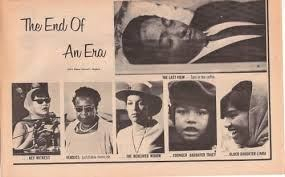
 

Sam Cooke in Death


There are photographs of Sam Cooke lying in repose. It is December 18, 1964, Chicago. Over 200,000 people have come to view him. He is in a glass covered casket. The photos are in black and white but you can still see the lump and bruising on his forehead that stage makeup failed to cover.

What you can’t see is that his nose was misshapen and obviously broken. And just by looking at the photos, there’s no way to tell whether or not he was internally decapitated, i.e., the ligaments that attach and stabilize the skull to the neck are severed.
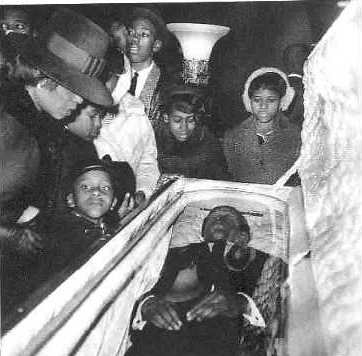
 

Sam Cooke in Repose

You can’t tell that…Nor can I…But his friend–the late, great r&b singer Etta James–said she could. She was there. At his funeral. She viewed his body early, with the family, before most people arrived. She wrote about it in Rage to Survive: The Etta James Story.

But, you can see, in one photograph, that something is clearly wrong with his hands. That’s apparent. Etta James said that Cooke’s hands were crushed. The above photograph is consistent with her claim. And that’s strange, considering the person who gave him such a vicious beating was a fifty-five-year-old woman by the name of Bertha Franklin.

Plus, there is a photograph of Ms. Franklin taken by the police shortly after she fatally  shot him in the chest. Unlike Sam Cooke, she looks only a little worse for wear considering the life and death struggle that she had just engaged in. To be fair, there are what appear to be little splotches of blood on her blouse and a nasty bruise on the inside the bend of her left arm that are consistent with her version of events. Bertha Franklin.jpg
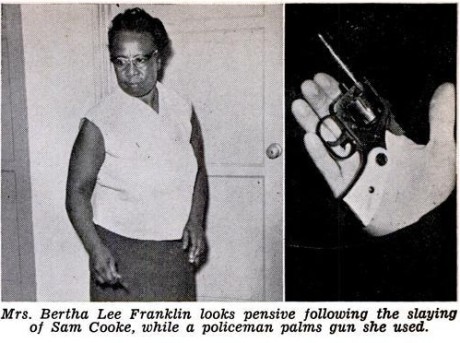
Franklin claimed that she did not know who Sam Cooke was when he checked into the Hacienda, a flea bag/brothel motel where she clerked. She said Cooke was a little disheveled and had obviously been drinking but that he complied when she told him that he and his companion would have to register as husband and wife per motel regulations. He signed the registry Mr. & Mrs. Sam Cooke. Franklin told police that the young lady who was with Cooke didn’t appear to be in distress.

A short time later, according to Franklin, the same young woman was at the office door, frantically knocking, begging to be let in. Franklin peered out the window but didn’t answer. The knocking subsided.

Then Franklin said she heard the deep rumble of a car engine and the screech of brakes followed by more banging on the door and yelling. This time it was Sam Cooke who was causing the commotion. Franklin, who was on the phone with the motel’s owner, told her she was afraid that he was going to beat the door down.

And that’s just what he did. Or, rather, he kicked it in. At least, that’s what they said.

“Where’s the girl?” Franklin said Cooke yelled. “Where’s my money?”

Except for a sports coat and one shoe, he was naked. Then, according to Bertha Franklin, he lunged at her, grabbing her arms.

“We tussled,” Franklin told the police. She got away from him. “I ran for my gun.”

Meanwhile, the motel owner, Evelyn Carr was listening to the struggle on her phone. When she heard gunshots she hung up and called the police. Unbeknownst to her, Elisa Boyer had already called them, claiming that she’d been kidnapped and sexually assaulted.

“Lady, you shot me!” were Sam Cooke’s last words, according to Bertha Franklin. Then, she said, he lunged for her again. He missed. She grabbed a broom and struck him over the head with it.

He straightened just a bit, looked up and then slid down a wall. That was it. He died.

During an inquest it was determined that Bertha Franklin had acted in self defense. Elisa Boyer testified that she asked Cooke to take her home after the two left PJ’s but he took her to the Hacienda Motel instead. She said Cooke forced her into the motel room against her will, that he pushed her on the bed and began tearing off her clothes. She said she knew he was going to rape her–maybe worse.

Inexplicably, Cooke interrupted the assault and went to the restroom. According to Boyer, that’s when she escaped the motel room, taking his clothes with her. No mention was made of the huge money roll that Cooke was seen flashing at Martoni’s and PJ’s. It was never recovered.

The attorney who represented Sam Cooke’s interest barely spoke a word at his clients inquest. Witnesses said that he seemed timid and afraid of the judge. It has also been reported that Cooke’s business manager Allen Klein hired the guy. Technically that is true. But Klein and that attorney, his attorney, Martin J. Machat, did business together. It was a lawyer client relationship–yes–no question. And, as such, they engaged in business matters. Of course. Generally speaking, Allen Klein’s clients were Marty Machat’s clients.

But it was more than that.

Machat was Allen Klein’s fixer. His legal sledgehammer. He was a very shrewd, extremely capable lawyer who counted boxer Sugar Ray Robinson and recording artists The Coasters, The Platters, The Drifters and Clyde McPhatter as his clients.

Even so, he was a light weight compared to his client Allen Klein.

Business manager Allen Klein was friends with the powerful record and promotional impresario Don Kirshner. And–yes–he had famous celebrity clients, too, but his most valued associations were with the behind the scene movers and shakers of the recording industry.

For instance, he was close to client and record producer Jimmy Bowen. And Jimmy Bowen was close to Frank Sinatra. Bowen produced some of Sinatra’s most successful records. He was also the trusted producer for Frank’s daughter, Nancy Sinatra.

And though Sinatra was certainly a celebrity (he was, in fact, “the celebrity”), he was more than that. He had friends in very high places.

In any event, perhaps, the greatest testament to Allen Klein’s power was his total subjugation of Roulette Records founder and CEO, Morris Levy.

As a boyhood friend of Genovese crime family enforcer, Vincent “Chin” Gigante, Levy operated with near impunity, routinely and famously robbing his artists of their royalties. It is said that the character “Hesh” of HBO’s famed series The Sopranos is based on him. Yet when Levy was approached by Klein, who was acting at the behest of his clients, rockabilly pioneers Buddy Knox and Jimmy Bowen, the Genovese front man couldn’t cough up the missing royalties fast enough.

Sam Cooke was introduced to Allen Klein by his friend Jocko Henderson. As “the Dick Clark of r&b in New York City”, Henderson became a power broker by booking and promoting concerts for Harlem’s famous Apollo Theater. The Apollo was the gateway to the big time for r&b artists. In addition to his television program, his radio program Jaoko’s Rocketship Show was broadcast on several major East Coast stations. He and Klein formed a promotion partnership for which they booked concerts for venues in Philadelphia.

Henderson told Cooke about what Klein had done for Buddy Knox and Jimmy Bowen. Cooke was impressed. For years he had been trying to get a deeper look at his contractual obligations per RCA Victor, as his calculations of his label’s cut into his fortune differed from theirs. Yet, RCA Victor wouldn’t open the books. So he hired Allen Klien as his business manager. Klien used Machat, to legally threaten RCA Victor into exposing those books to his forensic lens.

And he found errors.

So many errors that RCA Victor renegotiated Cooke’s contract. And it was a rich contract, not just rich for an African American artist rich, but white artist rich–truly, a ground breaking feat in 1964 America.

Klein wasn’t an attorney. He was an accountant, though not a certified one. He didn’t bother to show up for his CPA’s exam. He was, however, a mathematical genius.

Only a few months after Klein’s hire, Sam Cooke was shot dead at the Hacienda Motel on a hookers stroll in Los Angeles. He was thirty three.

To be continued…


5 Sweet, Family Films That I Actually Like—A Lot

5. My Bodyguard (1980); directed by Tony Bill; coming of age drama.  A portrayal of boyhood and friendship that manages to be realistic and poignant without wading into sexual pranks and gross-outs.

Normally sardonic character actor Martin Mull interacts effortlessly with the two unknown leads, Adam Baldwin and Chris Makepeace, both outcast, in a spin off the Of Mice and Men dynamic. Matt Dillon exudes the thuggish sensuality that made him an object of desire to women my age. Like with Rocky, we cheer for what we want without shame–or the intrusion of irony. Refreshing.

4. The Incredible Journey (1963); directed by Fletcher Markle; Walt Disney Productions; live action, family drama. A beautifully photographed natural drama about a Bull Terrier, a Golden Lab and a Siamese cat who become separated from their family and embark on a 250 mile trek back home. Along the way, they encounter an angry mother bear, a raging river and a hungry lynx all the while battling cold and hunger with the help of kindly strangers. Rex Allen–the Arizona Cowboy–masterfully narrates.

3. That Darn Cat (1965); directed by Robert Stevenson; Walt Disney Productions; family friendly thriller. Cute flick about a sleek and indifferent Siamese cat (a.k.a., D.C.) that belongs to two sisters–one a teenager, Pattie (Haley Mills) and one a young adult, Inkie. (No, I’m not kidding. It’s Inkie, played by Dorthy Provine.) To all intents and purposes, D.C. belongs to the whole upper middle class, artisan white bread, neighborhood. Everybody either feeds him or admires him.

Sooooo…D.C. starts hanging out with a couple of bank robbers and their bank teller hostage. (Yeah, they’re hiding in plain sight in Leave it to Beaver land, which is, actually, pretty darn smart.) The hostage exchanges D.C.’s collar with her wrist watch, but not before she scratches “HELP” into the back of it. Pattie discovers it and becomes convinced that the watch belongs to the kidnapping victim that’s all over the news. And guess what? Nobody takes her seriously. And you know what else? Somehow director Robert Stevenson pulls it all off. Saccharine, but good. Kind of like an occasional Nu Grape soda.

2. Pollyanna (1960); directed by David Swift: Walt Disney Productions; family drama. Wholesome production about an eternally optimistic, orphaned daughter of missionaries (Haley Mills) whose wealthy namesake aunt, takes her in out of duty instead of love. Pollyanna makes the best of her situation, befriending the townspeople including, even, the notoriously mean Mrs. Snow.

Everyday, Pollyanna, passes lavish empty bedroom suites as she trudges up and down servants steps to and from her attic living quarters, more befitting the servants. Being a precocious, adventurous child, she climbs a magnificent oak tree as a short cut to her room. One day she falls and critically injures her spine. For the first time her sunny disposition is threatened just as her emotionally distant aunt realizes what a…well, you know…she’s been. A life affirming film and suitable bookend to Frank Capra’s It’s a Wonderful World.

1. La La Land (2016); directed by Damien Chazelle; musical. Pure joy. A treasure. A marvel in cinematography and score, Chazelle’s brilliant, exuberant film has an opening dance scene that ranks with Gene Kelley’s athletic frolicking in Singing in the Rain and Liza Minnelli’s no hold’s barred revue, Liza With a Z. Ryan Gosling is predictably charming and earnest and sexy. So much so that we can forgive his middling dancing. But it’s Emma Stone’s show. She’s fantastic…And then there’s the love story…And the jazz. Choreographer Mandy Moore gets the slow clap.

Great Cinematic (TV) and Literary Character Series: Christopher Moltisanti (as portrayed by Michael Imperioli); The Sopranos


Most of us have known a kid like that. A kid who didn’t bathe every night. (Or–even–every other night.) One who didn’t have clean clothes and never wore socks…A kid with a constant fever who ate a lot of cereal.

A kid like Christopher Moltisanti was.

See, that’s what’s wrong with Christopher now. He’s never had much of a chance in life. His mom had a lot of problems…Still does, but she especially did then…When Christoper was a kid. Too many boyfriends. Substance abuse. Except for being pissed over the “whole inconvenience of being a mother thing” she was always unconcerned.

His dad wasn’t any better, though Christopher likes to think so. The guy was just another low life hustler with mob connections. He got whacked by a dirty cop who was doing a favor for those same mob connections.

There’s no tellin’ what would have happened to Christopher if Tony Soprano hadn’t taken him under his wing. It was a cool thing to do, especially since Tony was a teenager and Christopher was just a snot nosed little kid. Tony started calling him “nephew”–even though he’s not; he’s Camella’ s second cousin- and letting him tag along with the guys. That’s why Christopher is so loyal to Tony.

Well…He’s loyal..Up to a point.

Just like Tony treats him like a son…Up to a point.

Just like he finally belongs somewhere…Up to a point.

It’s no wonder he’s always getting clobbered by his own angst. And angst is one thing. Angst is cool. James Dean had angst.

But Christopher’s main problem–if you boil everything down to it–is insecurity. That’s why he struts around like he does. That’s why he dresses the way he does–showy, like a black velvet painting in a gold leaf covered frame. That’s why he medicates himself–with heroin.

And that’s why he’s so hair triggered. So dangerous.

There was one person, though, who soothed Christopher’s angst and tamped down his insecurity. Adriana La Cerva. She was totally devoted to him, dressing just like he wanted her to. Plus she listened to him. She believed in his dreams of being a screenwriter and filmmaker.

Christopher rewarded her for that.

Get this–he listened to her. It turned out Adriana had dreams too. She wanted to promote rock bands. So he invested in a band she believed in and let her take over one of the clubs he had busted out. That’s huge.

Okay. So it didn’t work out. That’s not the point. The point is–he cared. He even asked her to marry him and put three carrot diamond ring on her finger.

But here’s the thing with Adriana. And it’s something she never knew. Sometimes, when Tony and Paulie and Sil would be holed up with their gumars (girlfriends) at some fancy resort or whorehouse, whatever…Sometimes, he wouldn’t hang out with them. Not that he didn’t have a few girls on the side now and then. He did. But most of the time he’d rather be with Adriana.

He loved her.

But Tony ruined that for him. Tony made him choose between “the life” and life with Adriana. And that’s no choice at all. That’s like when the Godfather tells Tom Hagen, “we’re gonna make him an offer he can’t refuse.”

So you can’t really blame Christopher for resenting Tony. Or even hating him.

Still…He loves Tony… And Tony loves him…Up to a point.


Antisemitism: Jack the Ripper’s Accomplice Hype: His Disguise


He may have left Poland because of persecution. It was tough to be Jewish in the latter part of the 19th Century, especially in Eastern Europe and its bordering areas of Central Europe. There were lots of tensions.

To boil things down to the skeletal remains, a burgeoning movement of the moment was catching fire, i.e., Communism. It beguiled the intelligentsia and fueled the resentment of the serfs. At the same time it headbutted its more moderate kin, i.e., Socialism. Both ideologies railed against the status quo and splintered into simmering subsets.

And everybody blamed the Jews.

In the eyes of many Russians, Emperor Alexander II was lifting too many sanctions,  rules and regulations on the Jews who lived in the conquered land of Poland. To these Russians no Jewish infraction was too small. These Russians were loud with their verdicts and pronouncements. They influenced people. They fanned flames.

Unsurprisingly, the Jews became the common enemy of an increasingly fractured Russian populace. Then Alexander II was assassinated. Sweeping riots targeting Jewish settlements broke out. Jews were beaten. Robbed. Killed. Some of them fled their homeland to other lands that did not welcome them.

In any event, Aaron Kosminski would have been young when he left Poland. From there his family most likely settled in Germany, but only briefly. Somewhere along the way his older sisters wound up in London and sent for him. He lived with them in the slums of the Whitechapel district when he wasn’t roaming the streets, sleeping in doorways and eating out of the trash. At the time he was twenty-three years old.

Kosminski was very obviously, very seriously, mentally ill. He was in the throes of schizophrenia at a time when it–like syphilis and gonorrhea– was a terminal disease. There was no medicine for these conditions. No satisfactory treatment. People routinely died from strep throat and were locked away in crude mental facilities just for being depressed.

It is reasonable to presume that there were times when Aaron Kosminski teetered on the brink of normalcy. Schizophrenia waxes and wanes. He was a barber. He had knowledge of sheers and razors.

It is also pretty safe to presume that he harbored a deep seeded resentment of women independent of, though informed by, his disorder. Schizophrenics are rarely violent.

That’s pretty much the gist of the backstory. By Information Age standards, they didn’t keep the best records in those days but when prostitutes started showing up in the gutters and alleyways of Whitechapel in stages of disfigurement to disembowelment, they–i.e., the press–became very particular with dates, locations and gruesome details even though the victims were desperately impoverished, living on the fringe of society. Such was the case September 30, 1888, the date of the so-called Double Event.

The Double Event was almost “just”another double murder. Almost, but not quite. The crimes were two different murders, separated by a block and forty-five minutes, committed by the same killer. Most historians and police officials have theorized that the reason there was a Double Event was that the killer was interrupted before he could eviscerate prostitute Liz Stride to his liking.

There was a witness who initially came forward and identified the killer, then quickly recanted his statement. He later refused to go on record or to testify about what he saw on the early morning of September 30th.

That witness was probably Israel Schwartz. Schwartz happened on the scene as the murderer was likely killing Liz Stride; her body was still warm when found. He admitted to the police that he observed Stride talking to a man–a dirty, disheveled man. At the time, the press reported that Schwartz could not identify the disheveled man.

Unable to fulfill his escalating modus operandi the murderer had to satisfy his sick blood jones with another victim. Catherine Eddowes.

With Eddowes, the murderer took outrageous risks. Even though he had been very nearly caught in the act only minutes before, even though there was panic in the streets, he took his time with her.

The serial killer’s M.O. was to approach a prostitute, lure her into a dark corner of the street, slit her throat, mutilate her body, masturbate and then disappear into the shadows. (Whitechapel was very dark, not just from London fog, but from the excessive burning of coal.) With Eddowes he ripped open her abdomen, pulled out her intestines and removed her left kidney, taking it with him.

Typical of the homeless, Eddowes wore many layers of clothing. Some of it was left strewn around her body. Incredibly, a policeman picked up Eddowes’ shawl thinking that his wife might like it. When he presented it to her she was predictably horrified. It was stained with blood and, as it turned out, other bodily fluid.

The wife boxed it up and put it away. Over many decades it was handed down and finally sold to author Russell Edwards who submitted it for mitochondrial and epithelial DNA testing in 2014.

On October 16th, 1888 the killer sent a letter and a portion of a human kidney–a left human kidney, medical science was then able to conclude– to George Lusk, the president of the Whitechapel Vigilance Group. The letter read:

From hell.

Mr Lusk,
Sir
I send you half the Kidne I took from one women prasarved it for you tother piece I fried and ate it was very nise. I may send you the bloody knif that took it out if you only wate a whil longer
signed
Catch me when you can Mishter Lusk

The news spread like wildfire. Wildfire is known to jump creeks and rivers. News of the Double Event, the letter and the kidney jumped oceans.

The whole world was riveted and unnerved as it speculated about grandiose suspects like: American physician and con artist, Francis Tumblety, famed artist, Walter Sickert and Queen Victoria’s grandson, Prince Albert. All of these men enjoyed varying degrees of wealth. All of them snazzy dressers.

There was another witness who might have identified the killer and recanted. According to press accounts, Joseph Lewende saw Catherine Eddowes either talking to or scuffling with a dirty, disheveled man right before she was killed.

It is reasonable to presume that both Lewende and Schwartz knew the murderer. He was a notorious character from the slums they all three lived in. Lewd, filthy, he was known to bother women. But the witness(es) knew even more than that.

The witness, whoever he was, knew Aaron Kosminski and Jack the Ripper were one and the same. But he could not tell. He could not tell because he–like Kosminski–was Jewish. And the Jews of Whitechapel were the most marginalized of the marginalized.

Assistant Commissioner Sir Robert Anderson of the Scotland Yard wrote in his memoirs that “Jack the Ripper was a low class, Polish Jew.” Colleague and lead Ripper investigator, Chief Inspector Donald Swanson wrote in the margins of his copy of his boss’s memoirs, “Kosminski”. This was in 1910.

“If nonsense were solid, the nonsense that was talked and written about those murders would sink a Dreadnought. The subject is an unsavoury one, and I must write about it with reserve.

But it is enough to say that the wretched victims belonged to a very small class of degraded women who frequent the East-End streets after midnight . . . one need not be a Sherlock Holmes to discover that the criminal was a sexual maniac of a virulent type; that he was living in the immediate vicinity of the scenes of the murders; and that, if he was not living absolutely alone, his people knew of his guilt, and refused to give him up to justice. . . . The conclusion we came to was that he and his people were certain low-class Polish Jews; for it is a remarkable fact that people of that class in the East End will not give up one of their number to Gentile justice.

And the result proved that our diagnosis was right on every point.

For I may say at once that undiscovered murders’ are rare in London, and the Jack the Ripper crimes are not within that category.”

Sir Robert Anderson

The Lighter Side of My Life

While the witness, Sir Anderson and Chief Inspector Swanson lived with the terrible truth, Mary Kelly did not…Live, that is.

She was murdered by Aaron Kosminski, November 9, 1888. She is probably his last victim. Hers was the most brutal murder.

After the Kelly homicide, Scotland Yard put Aaron Kosminski under near constant surveillance until he was forcibly admitted into Colney Hatch Lunatic Asylum on February 7, 1891.

One hundred twenty-eight years later, March of 2019, results of the 2014 mitochondrial and epithelial DNA testing initiated by Russell Edwards were confirmed by scientists from the prestigious Liverpool John Moores University. Results from the Moores scientists testing were published in Journal of Forensic Sciences. Edwards wrote a book about his research and testing entitled Naming Jack the Ripper.

He wasn’t Hannibal Lecter. He wasn’t even Ted Bundy.

He was Aaron Kosminski.


The Sisters Brothers, (2018); A Film Directed by Jacques Audiard; Cinematographpy by Benoît Debie. Revisionist Western/Black Comedy


I know I said I wasn’t going to do this anymore but c’est la vie. Along came a beautiful film and I just had to write about it.

There are so few beautiful films these days. Or, perhaps it’s just me.

Perhaps if I was, say, ten years younger I would write something like, What a privilege it is to be alive in the cinema world of 2019! And what a beautiful cinema world it is!

Maybe…Anything is possible.

Now keep in mind that I used the word beautiful as opposed to the word good. I could have used the word good, but that would be a different debate-one that I’m not prepared to have.

Anyway, if you’ve seen The Sisters Brothers, you might be disconcertingly meh about it. Sure…That could happen…Or, you may just not like it.

You may find the film ostentatiously strange. Or overwrought in length and plot. Or both.

But one thing for sure: You will think it’s beautiful. If you appreciate cinematography.

In fact, it may be too beautiful–like much of the late 60s television series photography  that mimicked the musicals of the technicolor film era. Pretty boy beautiful, like George Hamilton was.

(For those of you who don’t know who George Hamilton is, here’s a more contemporary reference:) Like Justin Bieber was.

Cinematographer Benoit Debie filmed The Sisters Brothers in 35 mm. He mimicked the color palate of the Godfather II (1974), the last film filmed in classic technicolor. Like Godfather II, the core colors of the film are warm, black to varying hues of brown and gold. But Debie doesn’t stop there. He channels inspiration from Sam Peckinpah’s, Ride the High Country (1962) and–dare I say–Victor Fleming’s mother of all technicolor films, The Wizard of Oz (1939).

To be fair, Debie always shoots in 35 mm. And it shows. Lushness is a Debie trademark and he goes bonkers with it in The Sisters Brothers. That is, when he is shooting a surrealistic sequence. Otherwise he sticks with his core colors with and an occasional pop of technicolor inspired red, or blue and the sudden swoosh of white.

The Sisters Brothers is a film about waking up in a nightmare that happens to be life. That’s the reality that Eli Sisters (John C. Reilly) finds himself in when he assumes the lifelong responsibility of looking out for his younger brother Charlie (Joaquin Phoenix). Eli bears the cross of guilt.

When the boys were teenagers Charlie shot and killed their abusive, sadist father. Eli, the gentler, mentally healthier brother, couldn’t bring himself to pull the trigger and–in his eyes–since he was older, his father’s killing was supposed to be on him.

Consequently, the Brothers Sisters had to go on the run. Somewhere along the way they became hit men for a wealthy land baron that goes by the title “the Commodore” (Rutger Hauer). That’s all he goes by. He doesn’t admit to a real name.

To add insult to Eli’s plight, the bothers found themselves in a “Boy Named Sue” situation and they had to be even meaner hit men than they would have been without the family moniker. Again, Charlie leads the way and Eli follows him.

Charlie likes his work. Eli does not. Both are very good at what they do, but Eli is better. That’s because Charlie often lets his impulsivity and immaturity get the best of him, though he’s definitely the more creative one.

Eli is an efficient, robot-like killer. He also pines over a shawl. He folds it obsessively when he thinks Charlie is asleep. It is the shawl of, probably, the only woman Eli has ever kissed. He fantasizes about having a family with her.

The Commodore sends Eli and Charlie after an idealistic, docile, totally zen chemist (Riz Ahmed) who has invented a formula that, when mixed with water, illuminates gold to a florescent green so that it can be fished out of rivers and streams nocturnally. The plan is to intercept the chemist and his Marshall handler (Jake Gyllenhaal), who also happens to be on the Commodore’s payroll. The Marshall will, ostensibly, hand over the thoroughly duped chemist to the Sisters brothers who, in turn, will torture the chemist until he spills the beans, his guts and the formula. Then they will dispose of the chemist.

But the plan is fraught with unforeseen obstacles, as plans usually are–as they especially are–in movies. There are bushwhackers who have got wind of the formula too. There’s the Marshall–a rouge romantic, dabbling in poetry and spewing flowery language–who grows enamored with his quarry’s intellect and humanity and decides to form a partnership with the chemist instead of supervising his demise. The Marshall is also very good with a gun.

And, then, there are the brother’s themselves. How long can Eli keep Charlie on the rails of sanity before the latter drags the former into hell? Is there one iota of hope for them?

Assuredly there is much screwball bungling and tongue-in-cheek hi-jinx mixed with two bothers just screwing around. Hence the comedy.

So what of the Revisionist Western thing? How so?

Well, violence–that old stalwart of the Western formula–is not the point of The Sisters Brothers, though it does have a strong presence in it. You may even say it is the tip of the spear. The foray, however, is in the psychology of the brotherly bond.

It doesn’t get more Revisionist than that.

Be that as it may, you might not click with The Sisters Brothers. But you can’t hate it either.

You can’t hate it because it’s beautiful. Watch it a second time and you will like it more.


A Change of Direction

A little over a year ago a few comments from the blog Twenty Four Frames, showed up in my email. I was intrigued. The writing was solid and the subject matter–film critique– was right up my alley. I posted some comments and the blog’s author, John Greco, graciously responded. At the time, I was shopping a novel I had written–trying to get an agent. There were a few nibbles.

One of the agents that was interested and ultimately turned me down generously offered some advice. She said I had no online presence and that was a red flag for any agency willing to seriously consider new talent. There were other criticisms too, of course. If I had written–let’s say–the next Gone Girl, I’m sure I would have agents swallowing the bait, the hook, line and sinker, presence or no presence.

Anyway, to make a long story shorter, I started blogging. I wrote about my love for cinema, for literature and for true crime stories. As the old adage goes–write about what you know. Write about what you love.

Of course, I had no idea how this blogging thing worked. It was an experiment for me and as I swam in unfamiliar waters, I was the one who got hooked. I found that I loved blogging, that I loved being complimented, that I loved engaging–and that I had made some new friends. Pretty soon, my novel was on the back burner and the new novel that I had been working on had stalled out.

There were other things too. My husband and I are self-employed and little by little my blogging activities eclipsed my professional and personal responsibilities. But the most disconcerting thing for me was/is how I let blogging affect my spirituality. You see I write about very dark things–all of the time…And I’m a Christian. As such, my constant immersion into deviant, criminal and violent behavior is incompatible with my personal beliefs and my relationship with my Lord and Savior.

Undoubtedly, this is my fault. A blog is a medium, if you will, that can be used for good or bad depending on how it’s used and who’s using it. Likewise, Gothic and psychological horror, noir, true crime, capers, black comedy, etc., are all worthy art forms that can be  useful, insightful, cathartic means of expression and entertainment; but, for me, the focus, analysis and constant scrutiny of this subject matter is unhealthy.

And, yes, I could focus on other genres, but that is not where my interest lies. I have tried to dial it back, to take breaks, but those attempts have been unsuccessful. When I returned, I fell right back into my unhealthy blogging habits.

That being so, I am now writing my last post on All Things Thriller. I am, however, going to keep it open. In spite of everything I’ve just expressed, I am proud of my site. I think I’ve written some good posts and I hope that this blog will be a useful tool in my endeavor to become a published novelist with agency representation.

Certainly, I have enjoyed this experiment. I have loved getting to know many of you, reading your fabulous blogs and indulging in your talents as writers, editorialists, photographers, scholars, poets, painters, cartoonist, critics and first class cooks. I will drop in on your blogs from time to time and comment.

At some point–Lord willing–I may return to blogging in a more limited capacity and with a new site focusing on my walk with the Lord. As the old and beautiful saying goes (I’m paraphrasing)…Sometimes I’ve walked. Sometimes I’ve ran. Sometimes I’ve crawled. Most of the time He has carried me.

May God’s blessings reign on you all.

Pam

Slasher: The evolution and prototyping of a sub genre

Aspiring American movie producer Irwin Yablans was very impressed with John Carpenter’s sophomore full length feature thriller. Made on a minuscule budget of $100,000 Assault on Precinct 13 was daringly original with its distinctive color pallet, gritty realism, eerie soundtrack and solid acting.

In fact Yablans was so impressed–and inspired–that on a flight back to Los Angeles from the London Film Festival, he mapped out the idea for a horror movie that suddenly dawned on him. He set up a meeting with Carpenter at the Hamburger Hamlet on the Sunset Strip and pitched it to him.

“I said, I have this idea to do a movie about a bunch of babysitters being terrified on Halloween. But I want it to be theater of the mind. Think Psycho and The Exorcist. We won’t show any blood and gore. I said it was like a radio show. You set the audience up and let them scream. John and I, we connected immediately. He said, ‘I know exactly what you want to do.’ ” 

Collaborating with then girlfriend and fellow screenwriter Debra Hill, Carpenter wrote the script in ten days tentatively naming it The Babysitter Murders. Yablans suggested the title Halloween instead and Carpenter, who had demanded full creative control (writing, directing, and scoring the musical soundtrack) in exchange for accepting a paltry salary of $10,000 and ten percent of the profits, agreed.

Filmed in twenty-one days on a budget of $300,000, Halloween premiered in Kansas City, Missouri on October 25, 1978. The premier garnered respectable numbers for an independent film. The next night, though, was a harbinger of the success to come.

“The numbers were double. The third night, they quadrupled. This means everybody who saw this picture felt compelled to go home and tell somebody else to go see it.” Irwin Yablans 

Halloween went on to gross 70 million dollars, making it the most profitable independent film in cinematic history, until The Blair Witch Project bested it some twenty years later. The movie established John Carpenter as viable directorial star by showcasing his own distinctive film signatures, e.g., minimalism, natural lighting, claustrophobic framing, innovative music score, indestructible killer with tropes borrowed from other horror sub genres, molding a template for the slasher film prototype. In 2006 John Carpenter’s Halloween was selected for preservation in the United States National Film Registry by the Library of Congress.

Precursors of the Halloween prototype:

The Scarlett Claw (1944) – director, Roy William Neill, starring Basil Rathbone, Nigel Bruce – A Sherlock Holmes movie, that employs the use of a distinctive weapon (a gardening tool) to dispatch victims. The camera focuses on the disguised killer’s arm as he raises “the claw” menacingly in the air and then repeatedly strikes. Fine use of special effects, camera work and music.

The Spiral Staircase (1946) – director,Robert Siodmark, starring Dorthy McGuire, George Brent, Ethel Barrymore – Sophisticated thriller that blends elements of Gothic horror, psychological horror and film noir. Early use of mystery killer’s first person camera perspective, victim stalking and menacing black leather gloves visual.

Psycho (1960) – director, Alfred Hitchcock, starring Janet Leigh, Anthony Perkins – Undoubtedly the quintessential psychological horror film and precursor to the slasher. The first American film to thoroughly, unashamedly examine erotic violence. Tremendous use of musical score, foreshadowing, the light to dark motif, setting and subliminal terror. A harrowing, unabashed masterpiece. British director Michael Powell’s Peeping Tom proceeded Psycho by a few months and is an equal masterpiece in many respects and is similar in theme.

The Texas Chainsaw Massacre (1974) – director, Tobe Hooper, cinematographer, Daniel Pearl, starring Marilyn Burns, Allen Danziger, Paul A. Partain – Shoestring budget exploitation film that emphasizes the dreaded remote location with documentary style camera work and disconcertingly, beautiful cinematography.  Utilizes the “final girl”, “masked, lumbering killer” and “unusual weapon” trope.

Black Christmas (1974) – director, Bob Clark, starring Olivia Hussey, Margot Kidder, Keir Dullea – Canadian, horror, mystery that employs the killer’s first person camera perspective, creepy, obscene phone calls, i.e., Get out! The call is coming from your house!! juxtaposed against a holiday setting. Deploys ensemble college age cast, strong female lead, feminist themes and ambiguous ending.

Deep Red (1975) – director, Dario Argento, starring David Hemmings, Daria Nicolodi, Gabriele Lavia, Giuliana Calandra – Stylistic, Italian horror film with a complex plot, gobs of gratuitously choreographed violence and buckets of blood. Features an unidentified killer wearing black leather gloves, serial killings during the Christmas season, an unusual, deeply unsettling method of killing, a spooky children’s song and creepy doll. Deep Red is considered a horror masterpiece. View with caution.


The Killers, A “Nick Adams” Short Story by Ernest Hemingway; Abridgment and Analysis

In The Killers, if not for a catalytic stint as a messenger boy, presumably, searching the same streets for the same address as two hit men, Ernest Hemingway treats reoccurring character Nick Adams with incidental indifference. He achieves this by writing from a particularly sterile third person multiple character point of view.

This cavalier treatment of the subject of his series of short stories alerts the familiar reader that this story is going to be different. Indeed it is. The famed economical prose is rationed. The tightly rhythmic dialogue is cropped. The edges are sharper. The angles, steeper. Hemingway’s alter ego, Nick Adams, has come of age.  We know this when we read the fifth paragraph:

Outside it was getting dark. The streetlight came on outside the window. The two men at the counter read the menu. From the other end of the counter Nick Adams watched them. He had been talking to George when they came in.

The men are dressed expensively, but their physiques strain against the fabric of their almost identical ensemble of overcoat, derby, gloves and muffler, too ill fitting to be considered fashionable.

Behind the counter is George–the proprietor of the place. Nick Adams–probably about eighteen or nineteen–sits at the opposite side of the counter. Nick either works at the diner or he is a regular customer as he and George seem to know each other well.

One of the men orders pork roast and mashed potatoes. George politely informs him that the pork roast isn’t ready yet.

The other man, who the pork roast guy calls Al, decides on chicken croquettes. George tells him the croquettes aren’t ready either. The air, stilled when the strangers walked in, is sucked out of the room.

What is this? Some kind of conspiracy? The men’s irritation is palatable. George’s blood pressure rises with the clenching of their jaws and the hardness of their eyes. Then they begin a not so friendly game of let’s push our weight around this joint.

At first George gets plummeted. Then Nick.

The tension continues to escalate as Al and his companion lob one insult after another at George and Nick, while simultaneously feigning insult over the dominated men’s slightest, most innocuous utterances. Mercifully the escalation breaks when Max–Al finally refers to him as such–orders Nick around the other side of the counter with George. Nick puts up a bit of obligatory  resistance before he obeys. No guns are drawn.

“Whose out in the kitchen?” Al asks. George answers with a racial slur, referring to the cook, Sam.

Al orders Nick to go into the kitchen with Sam. Then he follows, leaving Max and George at the counter.

“What’s this all about?” George asks. Max then proceeds to explain. They are there to kill a big Swede, an ex boxer named Ole Anderson.

George admits that he knows Anderson and then asks,

“What did he ever do to you?” 

“He never had a chance to do anything to us. He never even seen us.”

“What are you going to kill him for, then?” 

“We’re killing him for a friend. Just to oblige a friend, bright boy,” Max tells George.

Al ties up Nick and Sam and gags them while George handles a smattering of customers that come and go.

“Sam stepped out, will be back in about a half an hour,” he tells one guy who wants supper. He makes another guy a ham and egg sandwich to go, and tells, yet, another cranky, hungry customer that Sam got sick and left.

Why the hell don’t you get another cook?” the man asked. “Aren’t you running a lunch counter?” He left.

Meanwhile the strangers know “the Swede” takes his supper in the diner at around six o’clock most evenings. Max watches the clock. Al watches Nick and Sam. He has pulled out a sawed off shotgun concealed beneath his overcoat. It rests across his lap. He sets on a stool, bored but resolute.

“What you going to do with us afterward?” George asks Max. “That’ll depend,” Max said. “That’s one of those things you never know at the time.”

At ten after seven, they decide the Swede isn’t going to show.

“Come on, Al,” Max said. 

“What about the two bright boys and the n@**$r?”

“They’re all right.”

“You think so?”

“Sure. We’re through with it.”

“I don’t like it,” said Al. “It’s sloppy. You talk too much.”

“Oh, what the hell,” said Max. “We got to keep amused, haven’t we?” “You talk too much, all the same,” Al said. He came out from the kitchen. The cut-off barrels of the shotgun made a slight bulge under the waist of his too tight-fitting overcoat. He straightened his coat with his gloved hands.

“So long, bright boy,” he said to George. “You got a lot of luck.”

“That’s the truth,” Max said. “You ought to play the races, bright boy.”

And without further ado, they walk out of the diner and into the night.

George rushes into the kitchen and unties Nick and Sam. Nick is obviously relieved, but he tries to play it off.

“Say,” he said. “What the hell?” “They were going to kill Ole Anderson,” George said. “They were going to shoot him when he came in to eat.”

They decide that Nick will go tell Anderson though Sam warns him not to get involved. Nick, too, walks out into the night, making his way along the dimly lit streets to the boarding house where Anderson resides.

The manager of the house answers the door and tells Nick that Anderson is in his room and hasn’t left all day. He follows her up the stairs and she knocks on the Swede’s door.

“Who is it?”

“It’s somebody to see you, Mr. Anderson,” the woman said.

“It’s Nick Adams.”

“Come in.”

Nick opened the door and went into the room. Ole Anderson was lying on the bed with all his clothes on. He had been a heavyweight prizefighter and he was too long for the bed. He lay with his head on two pillows. He did not look at Nick.

“What was it?” he asked.

Nick proceeds to tell Anderson about being held by the two men at gun point and about the reason he was held that way. To his alarm, Anderson seems unfazed.

“I’ll tell you what they were like.”

“I don’t want to know what they were like,” Ole Anderson said. He looked at the wall. “Thanks for coming to tell me about it.”

But the young man persists. He asks to go to the police. “No,” Anderson says.

Maybe it’s just a bluff. “No bluff,” Anderson says.

“Couldn’t you get out of town?”
“No,” Ole Anderson said. “I’m through with all that running around.”  “Couldn’t you fix it up some way?”
“No. I got in wrong.” He talked in the same flat voice. “There ain’t anything to do. After a while I’ll make up my mind to go out.”
“I better go back and see George,” Nick said.
“So long,” said Ole Anderson. He did not look toward Nick. “Thanks for coming around.”

Back at the diner George is wiping down the counter when Nick comes in. He asks if Nick talked to Anderson.

“Sure. I told him but he knows what it’s all about.”
“What’s he going to do?”
“Nothing.”
“They’ll kill him.”
“I guess they will.”

Then the two converse about what the Swede could have done to warrant a visit from two hit men. They mutually decide he must have double crossed somebody in Chicago.

Nick tells George he plans to leave the town himself. George tells him that would probably be the best thing to do.

Analysis:

The Killers is a coming of age story a quarter shy of its destination. Only by the dogma of the law is Nick Adams considered an adult. Still, he is following the trajectory of manhood and witnessing the precise, yet, brutal effect of an especially sharp knife without the armor of youth.

Nevertheless, Nick is spared from what experience informs George. When Al forces him into the kitchen, Hemingway removes Adams from a third of the story, leaving George and Max to hash out the implications of their encounter. In this way, the author demonstrates the demarcation line of maturity, i.e., what you don’t know won’t hurt you and that’s a good thing since other–older--people will control your life.

Sure, Nick knows things are serious–he’s bound and gagged and a hood is guarding him with a sawed off shotgun–but he is blissfully unaware that the odds of him walking out of the diner alive are within the width of a cat’s whisker, or two. Max and Al expect Ole Anderson to show up at around six o’clock for supper and they expect to kill him when he does–and anyone else who has the misfortune of being in the diner at the time. George and the cook Sam know this.

When Anderson doesn’t show, Al wants to dispose of the witnesses. It’s just good business, but Max isn’t so keen on the idea.

Max has carefully observed George; he has recognized the older man’s attempt to play tough by referring to Sam with a racial slur and called him out on it–but he also begrudgingly admires the man’s humility and dignity. He decides to let the men slide. “We’re done with it,” he tells Al. This conveys that the hit men are leaving town without killing Anderson and, more importantly, that the force of fate can spin on the head of a pin.

After the hit men leave, George unties Nick and suggests that he go warn the Swede. Nick agrees. Sam warns him not to get involved, signifying that he is cognizant of George’s exploitation of Nick’s youthful indiscretion .

Nick makes it to the boarding house only to find Ole Anderson, an ex boxer and pillar of masculinity, pitifully apathetic to the encroachment of his demise. Likewise he barely acknowledges Nick’s risk to save him.

With The Killers, Hemingway continues to explore his pet themes of masculinity, naivete, compassion, bravery, betrayal and emasculation through character, Nick Adams. By this time, the familiar reader has observed Nick since he was a boy and has grown quiet fond of him.

The Killers, is decidedly colder and even less sentimental than Hemingway’s other Nick Adams offerings such as Indian Camp and The Battler. Accordingly he prepares the young man for his estimation of true manhood and for war.


A Prophet, a Film Directed by Jacques Audiard, 2009 (French); Crime/Prison/Mob Drama

In the male prison subculture there is a stark difference between the convicts and the inmates. Convicts are criminals, not by happenstance but by design. Crime is their career. Hence they occupy the upper tiers of the prison yard pyramid. They are the mob connected conspirators, bank robbers, drug dealers, counterfeiters and contract killers.

At the very top of the pyramid is the highest ranking mob member unlucky enough to be doing time. The bottom is comprised of the despised sexual deviants. In the middle is everybody else. The fish, as they are called. The inmates.

Every ethnic group has a pyramid. The prisoners segregate themselves accordingly.

The convicts run the prison or, in their vernacular, the college. They are the administrators and the professors. They decide who gets in and who languishes on the outside. Unless you are one of the sincerely religious--and they will test you on this–you really, really need to get into college, that is, if you want to survive.

Malik (Tahar Rahim) is a hapless nineteen year old who finds himself in an adult prison for the first time, doing a six year stretch. As a French Algerian he is presumed to be Muslim, though he is not religious. This inconsistency brands Malik an outsider, so he resides in the lower middle regions of the pyramid as an inmate.

Doe-eyed and baby faced, Malik seems painfully out of step among the convicts. When he must strip, he covers his nakedness with his hands. He is like a deer in the proverbial headlights.

But there is a different side of Malik too–he is serving time for assaulting a police officer. Plus there are the unsettling knife scars that run across his back and a faint one under his eye. When he is propositioned in the shower, he indignantly, menacingly bangs his head against the stall. Again…And again.

Cesar (Niels Arestrup) is a stoic, grizzled convict who leads the Corsican mob. He notices that Malik is always alone and sums him up as an easy, vulnerable fish.

Normally Cesar would never stoop so low as to approach a Muslim, especially such a lowly one, but his Corsican bosses have issued a hit on a drug dealer named Reyeb…And Reyeb is Muslim. He also happens to be the prisoner who propositioned Malik in the shower. Cesar has spies everywhere, so he knows this. He sends his thugs to threaten Malik into killing Reyeb.

Malik is horrified by his dilemma. Repulsed by the idea of murder, he tries to beg off. He is beaten. He tries to snitch. He is thwarted by guards on Cesar’s payroll–and is beaten worse. Desperate, he joins in on a gang bludgeoning of a fellow inmate so that he will be thrown into solitary confinement. He is beaten again and a shank is put to his neck.

This is the last time, he is warned. If he does not follow through he will be stuck, bled and gutted like a pig.

In many ways Jacques Audiard’s chillingly complex drama, A Prophet, plays a lot like a tragedy. At first we see Malik survive an almost impossible situation. Yes, he kills Reyeb. He must. There is no other choice but death. In doing so he gains Cesar’s protection and entry into the lowest echelon of the Corsican mob.

Then, from a position of servitude, Malik observes and learns. With humility he hones an innate shrewdness and patiently begins his assent through the ranks of the Corsican mob until, finally, he is poised to vie for power.

But for a film to be considered a tragedy the protagonist must posses a fatal flaw. Malik doesn’t have one. Therefore A Prophet is merely a crime drama in which there are tragic elements, chiefly that Malik’s college has produced such a reluctant and unlikely, yet, so finely trained specimen.

Oppressively grim and excessively long, A Prophet is not an easy movie to digest. The plot takes off in a rabbit’s warren of unnecessary twists and turns revealed in subtitles. Its strength lies in an unadorned and cautionary depiction of criminality as a virulent contagion that thrives in a prison host.

Tahar Rahim plays the almost blank slate Malik convincingly–possibly too convincingly. Only in the most extreme circumstances do we really feel for him, though we understand his lack of emotion has been cultivated by neglect and abuse.

Likewise Niels Arestrup is coldly sterile as Cesar. His vestiges of humanity are only discernible when he gasping for breath.


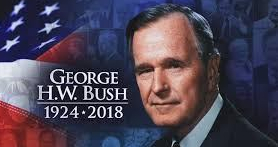
President George Herbert Walker Bush: An Elegant, Gentlemanly President

The year was 1989, my husband and I were new to Nashville and President George H.W. Bush was scheduled for an appearance here. My mother–a proud resident of Odessa, the sister city of Midland, Texas, the former home of our 41st and 43rd presidents–asked me during a phone call if I was planing to go see him.

“I wouldn’t walk across the street to see that man,” I replied.

My mother was taken aback. She knew I wasn’t a Republican (she was, though she claimed to be an Independent) but she had reared my brother and I to be respectful of the presidency. Once a president was elected, he was, in every way, my mother’s president and she treated him as such. She was disappointed in me.

“He is our president,” she said. “Well he’s not mine,” I shot back. “I didn’t vote for him.”

“That’s too bad that you feel that way,” I remember her saying. And that was that.

Now, almost thirty years later, I wish I hadn’t said that. More importantly, I wish I hadn’t thought that–and I’m sorry. I’m sorry for disrespecting the youngest U.S. Navy pilot of WWII, a hero who was shot down over the Pacific and rescued by a submarine–one of our’s, thank God–though his crew perished. I’m sorry for disrespecting an elegant, gentlemanly president, who rose through the ranks of politics and reached across the isle, yes, because it was expedient and because it was the right thing to do for the betterment of the country he led. And I’m sorry for disrespecting my mother’s example.

My mother’s gone now and, of course, so is President George H.W. Bush. As for me, I’m still not a Republican. But I am a lot older now and, thank the good Lord, I’m wiser. If I had it to do all over again I still don’t think I would go and see President H.W. Bush, but I would be a lot more gracious about not going and about my explanation as to why.

God’s speed President Bush…And much respect.

Newer Posts
Older Posts