Menu Close

All Things Thriller

A Celebration of Thrillers, Noire and Black Comedy by Pamela Lowe Saldana

A New Leaf (1971), a Film Directed by Elaine May, starring Walter Matthau; Black Comedy

Man about town Henry Graham (Walter Matthau) finds himself in a most loathsome predicament–he’s broke. Despite the various safety nets and warning bells afforded the upper crust, Henry (teetering on late thirties that he may have already toppled over) has extravagantly exceeded the principal of his trust fund. His checks are bouncing all over town.

What’s more, aside from being a pompous ass with the vocabulary to prove it, he has no bankable skills. In a matter of days he will be a wretched member of the unqualified snob club.

Understandably, Henry cannot call in favors from friends because he has done no favors and has no friends. Even gregarious glutton, Uncle Harry, (James Coco) delights in his nephew’s floundering. Still, he offers a twig to the drowning man. He will loan Henry fifty thousand dollars which must be repaid in six weeks. If Henry fails to pay within the allotted time, he will forfeit every dime of his estate.

With no other choice beside suicide–which he contemplates but grandiosely dismisses–Henry takes the loan and the advice of Harold, (George Rose) his gravely-concerned gentleman’s gentleman: marry a woman of wealth.

In A New Leaf, (1971) writer, stage actress Elaine May, takes her first turn as director with her own screenplay, adapted from prolific short story writer, Jack Ritchie’s The Green Heart. Starting with a strong cast of mostly stage actors, May produces a hysterical, comedic character study, sharpened with dark satire, brazen wit and unyielding good taste.

May completes the theatrical trifecta with her portrayal of Henrietta Lowell, the clumsy, skittish, yet brilliant horticulturist and heir to the estate of an industrialist father. Prior to her introduction to Henry, Henrietta has but one devout ambition–to identify an unknown species of fern.

Henry sizes her up as the perfect mark and sets about on an astoundingly short courtship that leads the two straight to the alter and then on to a burgeoning murder plot. But before that, Henry verbally eviscerates one of Henrietta’s snobbish tormentors, puts his wife’s affairs in order, rescues her from crooks and a toga-style nightgown, all while keeping the hors d’oeuvre crumbs brushed from her haphazard attire. Within the the doldrums of everyday life, Henry discovers the faintest glimmer of a purpose–and a conscience.

But is that enough? In black comedy one never knows.

Lenny; A Serial, Part IV

Lenny wasn’t what you call a morning person. He usually didn’t get into to bed until two or three a.m., so he didn’t get up until ten or eleven. And when he did get up, he wasn’t exactly a breath of sunshine. It was a quirk of his mostly otherwise affable disposition.

Of course, Trish knew this. So on her days off, she usually waited for him to call.

On that day Lenny got up a little earlier than usual. He went through his typical morning routine:

  • feed Griffin
  • clean the tank, feed the fish and count them, top off the water
  • dust, sweep and vacum
  • do 50 crunches and 100 push-ups
  • eat a bowl of Cap’n Crunch or Coco Puffs cereal
  • check the Ranchero GT for bug splatter, polish if needed (it didn’t)
  • take a shower and call Trish if she was off (she was)

Lenny let the phone ring and ring. She didn’t answer.

He didn’t think too much of it. There were plenty of things for him to do, so he did them. A couple of hours later he called her back. She still didn’t answer. So he drove to her apartment.

On his way, he worried. Was she okay? Did she trip getting out of the tub and hit her head on the toilet? He had a friend who did that and died from a blood clot to the brain.

And he thought about things, like why she never gave him a key to her apartment? And why she wouldn’t move in with him?

When he got there he bounded up the steps to her third floor apartment. There was an envelope taped to her door with his name written in her slanted, swirling script. He ripped it open. Inside was a letter.

Lenny,

I’m sorry. It was never my intention to hurt you, though I knew from the beginning that I would. Well, almost from the beginning. At first you were an indulgence, like a second piece of cake. But you were so much more than that…You are so much than that.

I was selfish. You made me feel alive. It felt so good to care, to laugh and to share things. It has been so long since I felt anything. I was relieved to know that I could.

There are so many things I wish I could tell you…I know you just want to know why. You deserve to know, but I can’t tell you…But I want you to know this…You are a nice man, Lenny. Not a nice guy…You’re not just some Joe Blow I met while slinging drinks…I’ve never really known a nice man before.

I wish I could be a nice woman because that’s what you deserve. But I can’t be what I’m not. I wish I could stay with you. I want to stay with you. But I can’t. 

You told me some things about Rachel…She wasn’t a nice woman either, Lenny. I don’t want you to end up with someone like her or me. You deserve so much better. You deserve someone who will share with you…Someone who will walk down a two way street with you.

That’s what I want for you. That’s what I hope for you.

Trish 

Lenny; a Serial, Part III

Bottles rattled as an enormous man–his hands, big as shovel scoops–pulled the dolly up the steps and onto the platform. Once there, he wedged it between the bar and himself, easing it into an upright position, careful not to upend the boxes stacked high, emblazoned with the names Jack Daniels, W.L. Weller, Makers Mark and Jim Beam.

He moved the top box–the Jack Daniels one–from the dolly to the bar and ran a box cutter through the cardboard.

A buzzer sounded.

The man’s hand jerked, arcing the razor blade through the webbing between his thumb and forefinger and into the meat of his other hand. Blood gushed.

“Shit!” the man yelled.

He fumbled frantically behind the bar searching for towels.

Again the buzzer juddered. And again.

A heavy-set woman in an expensive beige pantsuit appeared from a hallway behind the bar.

“What the hell?” she barked.

The man raised up, the mound of towels on his hand already red with blood.

“I sliced it. Bad,” he said.

She headed down the steps toward metal double doors with an exit sign above.

“Put pressure on it. Hard.”

Even in platform wedges she had to raise to the balls of her feet to peer out the peep hole.

Nobody.

She yanked one of the doors open and stepped halfway into the alley, looking one way around the door–nothing–and the next. He was about to turn the corner.

“Hey!” she yelled.

He turned and faced her. She motioned for him to come forward.

“Sorry. I was in the stock room.”

He didn’t move. He was slender, of medium height, older than she expected. Like her’s, his hair was startlingly white. But his was natural.

“Come on in. I don’t bite.”

He approached slowly. She held the door for him. Once inside, he stood with his back against the wall. She shut the door. The enormous man leaned on the bar, grimacing.

“What happened?”

“Cut himself.”

He removed his sunglasses.

“You Ranger?” she asked.

“I’d better be,” he answered.

She walked toward the bar. “Let’s go to my office.”

He followed her up the steps.

“Get Fletcher on the phone,” she ordered the enormous man. “Tell him you need stitches and you can’t make it to the office. Tell him Gee Gee or whoever’ll make it up to him. Then sit your ass down and keep your hand above your heart.”

They walked behind a curtain and a down dimly lit hallway to a wood paneled room with musty carpet. She plopped down behind a desk.

“Have a seat,” she said motioning toward a chair with a torn vinyl cushion.

He sat. She slid a manila envelope with an 8×10 glossy on top of it across the desk.

“I guess Zack filled you in.”

He examined the photo. “Yeah. But I’d rather hear it from you.”

“Nothin’ special. Smart enough. Lacey Cummings is her stage name. Her real name is Patricia Slate. I’ve heard the girls call her Patty.” She lit cigarette and offered him one. He shook his head. “No family to speak of. Mom’s dead. Dad never was in the picture. Went to school in Fort Wayne. We had an arrangement. She ran off owing me two hundred grand.”

“Wrong,” he said.

“Excuse me?”

He laid the picture on the desk. “She ran off owing Detroit two hundred grand.”

She blew a stream of smoke at his face. “So you’re a good boy. You did your homework.”

“Always.”

“We have a deal or not?”

He smiled. His teeth were small, clean and yellow. “Not for thirty we don’t.”

Her executive chair groaned as she shifted. “How much?”

“Fifty.”

“Because of Detroit?”

“Yep,” he answered.

You really break it off in a girl don’t you?”

“I don’t make a habit of it. But it happens.”

“Alright,” she grumbled. “You’ll get the extra twenty with the rest of it when it’s done.”

He pried open the clasp of the manila envelope and thumbed through two stacks. “I’m okay with that,” he said.

She got up and opened the office door. He finished counting, fastened the clasp and then walked out.

Halfway down the hall she called to him. He turned around.

“No pictures. I wanna see it.”

He bent his fingers into the shape of a pistol and pointed at her.

“Gotcha,” he said.

Lenny; a Serial, Part II

Before Trish, Lenny had been burned by love–once. Her name was Rachel and she was young. They were both young.

Rachel was a raven haired beauty with a great figure and fire in her veins. And she slept around–a lot.

Lenny knew this about her. The first time they had sex they weren’t even on a date. They were at a frat party. He fell in love with her that night.

For Rachel, Lenny would do anything. He would work hard, diligently, as an electrician’s apprentice at her father’s electrical contracting business, making slow but steady progress up the ladder of respectability.

Nobody saw that coming.

In turn, Rachel’s father and mother would take him under their protective wings, nurturing a relationship that they would have never approved of if Rachel had of turned out like they hoped.

Even so, Lenny was good for their daughter.

But Rachel wasn’t good for him. And it ended badly, with a dislocated shoulder for her and a police record for him–and one for Rachel’s father too…

A police record, not a dislocated shoulder.

That’s pretty much when Lenny called it quits on love. Oh, he had lot’s of girlfriends–all of them young, even as he got older. His mostly married friends teased him; they called him a lucky dog, but it had been too casual too long. Lenny longed for someone he could talk to–someone to share with.

And then, whoosh, just like that, Trish fell into his life like a godsend. It was the first time since Rachel that he was attracted to someone his own age.

If not for the Ecstasy windfall, he probably would have never had the nerve to approach her. Here’s what happened:

He was having a 3 0’clock lunch at Carrows. Carrows was a 24 hour restaurant that had a small bar in it. It was his first time there.

Lenny sat in the bar but not at the bar. Trish was the bartender and she waited his table. She was pretty. Friendly, but not overly so. She didn’t grovel for tips.

Lenny watched as she tended the bar. There were five high-backed chairs at the bar. Five men sat in the high-backed chairs. Middle age men. Regulars, he could tell. Trish was professionally attentive toward them. Nothing more.

He left a twenty dollar cash tip on the table. The next day he went back to Carrows for lunch.

And the day after that.

On about the fifth day, she asked him when he was going to take her to dinner. And that’s how it started.

Trish was smart. She knew about a lot of things that Lenny didn’t. For instance, she knew about wine. Lenny didn’t know jack about wine, he knew his way around a few cocktails, mostly frozen tropical drinks.

Trish thought that was funny.

Another thing Trish knew about was food. One time, when they were on a picnic, she insisted on grilling the steaks herself. “All right, suit yourself,” he said.

Trish didn’t want to use charcoal so they gathered wood from around the barbeque pit. She pulled off some hickory chips from a nearby tree and threw them into the fire that she had kindled with one match, no lighter fluid. She said she learned the technique at YMCA summer camp.

When Lenny told her wanted his steak well done, she refused to cook it that way. She served it to him medium instead, with charred pineapple and asparagus on the side. It was the best steak Lenny ever had.

Lenny taught Trish about things too, lots of stuff about salt water fish tanks, about the gravity level, about the water temperature, the marine salt, the conditioner and filters, and about the tropical fish that lived in his “50 galloner.”

Let’s see…there where the lavender Threadfin butterflyfish with their vibrant yellow tails and black zebra stripes. They were nice fish, Lenny said.

Then there were the finicky, frog-like Mandrinfish, ugly, if not for their startling array of neon colors. Lenny claimed they were “a bitch to keep alive”.

Trish’s favorite were the Yellow Tangs. She loved the way they pressed their noses–Lenny called them nares–against the tank when she looked at them. She also liked the Powder Blue and Powder Brown Tangs that, according to Lenny, cost “a butt load of money.”

Lastly there were the orange and white Ocellaris clownfish. They were the hardiest and the most plentiful fish in the tank. Lenny said he wanted a smaller tank with just clownfish because they were so easy to take care of.

Lenny also educated Trish about his baby–his 1970 Ford Ranchero GT with its 429 Cobra-jet engine and shaker hood that he kept polished to a wet, glossy sheen. He explained that he repainted it the original color, dark ivy green, even though he didn’t like green, because it was the stock color and stock was better. He taught her about numbers matching up and that every time you put an after market part in a classic car it throws the numbers off and the value of the car drops “like a ton of bricks.”

He taught her about all of these things and more. And for the most part she was genuinely interested in them.

They talked about all sorts of things. And they did all kinds of things together. They even adopted a cat–a scrawny gray tabby kitten–that they almost ran over in the Steak N Shake parking lot.

That night, after buying Fancy Feast, kitty litter and toys, they brought the kitten back to his place. That’s when Lenny first asked Trish to move in with him.

She was nice about it, happy that he asked, but she turned him down.”Let’s not rush things. Let’s just see how it goes,” she said.

Lenny kept the kitten at his house, in the utility room where he built a multi level, multi room cat house out of scrap lumber and indoor/outdoor carpet. They named him Griffin.

Even though he was disappointed about the living arrangements, for the first time in a long time, Lenny was happy. But he didn’t tell Trish about the Ecstasy and he didn’t ask questions about her past.

She told him not to.

Lenny; a Serial

So here’s the thing about Lenny–he was lucky. And he was happy-go-lucky.

Back in the day, Lenny was totally cool with couch surfing. He lived in a few basements too, basements that he was supposed to remodel in exchange for rent and never did.

Consequently he moved around a lot, but was never homeless. He lived in some cool places too, like in the guest house of the lead singer for Dr. Hook–he was dating the guy’s daughter–and on the houseboat of a rich old man.

Lenny was a good-looking guy–he looked like a rugged version of George Michael if George Michael was from Chicago–so it might surprise you that he had some geek hobbies, like metal detecting on the beach and magnet fishing in the lagoons around the business district. Then again, knowing what you already know about him, it might not surprise you at all.

So one day, Lenny was magnet fishing and he pulled up a safe that had Herring, Hall, Marvin 1943 engraved on the bottom of it. There were tool marks where it had once been pried open and the combination lock was smashed, but it was in surprisingly good shape and sealed tight as a drum. Lenny managed to get it into the truck-bed of his 1970 Ford Ranchero, but just barely. The thing weighed a ton. He put a nasty scratch on the Ranchero too in the process.

From there he took the safe to his storage locker where he was living at the time. Not that he was living in the locker, mind you, he was the head security guard/maintenance man for the facility so he had an apartment there.

Lenny was good with tools. He took mechanics in high school and was a certified boat mechanic. When he worked as a boat mechanic he made good money, but the shop hours didn’t jibe with him. Saturday was the boat shop’s biggest service day and it was also his biggest day on the beach. It got old not having Saturday’s off.

Anyway, Lenny had thousands of dollars of tools. Good tools. Nothing below Snap-On quality. Plus, Lenny was smart. He got that safe open.

And guess what?

It had nothing but change in it…old change. Lots of Washington quarters, walking liberty half dollars and Roosevelt dimes. Bunches and bunches of Roosevelt dimes. All of it at least 90% silver. A small fortune of it.

With the proceeds from the silver currency, Lenny bought a nice condominium that needed a little work. He made that place into a show piece; he really did. And he put a green paint job on his Ranchero, a stock ivy green that looked a lot like avocado green.

Everybody was surprised by that.

He built a bar for his condo that had a saltwater tank in it and put some gorgeous tropical fish in it. He turned one of his bedrooms into a mini theater/gaming/stereo room that he called a “media room”. He bought a three thousand dollar mattress and a 50″ 720p television set before 720p was a thing.

A Sony.

And he invested the rest of it into Molly, or what people use to call Ecstasy. Lenny did very well with the Ecstasy. It was back in the early days of raves and techno and he knew all those people.

And that’s when he met Trish.

The Stepfather (1987), A Film directed by Joseph Ruben, starring Terry O’Quinn; Psychological Thriller Slash Slasher

Sometimes, ever so rarely, a movie will come along from a junk genre, like exploitation–I’m thinking Texas Chainsaw Massacre here or, possibly, Wolf Creek–or slasher–Halloween, Nightmare on Elm Street–or Blaxploitation–Across 110st Street and Sweet Sweetback’s Baadasssss Song, a movie that transcends it’s genre and wades into mainstream cinema. I have a soft spot for such films because they exceed the purpose of their existence, which is to make money at the expense of a less than discerning audience.

The Stepfather is one of these films and from the opening shot it represents. It’s like a basketball team that executes the pass, pass, PASS shoot! fundamentals to the extreme. (Those teams can be murder to play, by the way. You get run ragged, while they barely get winded.) The Stepfather takes you by surprise. It’s not supposed to be that good.

The opening credits flash in red block letters on a screen of black, as keyboards clang, jumping from minor chord to minor chord. A man, pretty much dripping with blood, cleans up in a bathroom sink. He washes the blood streaks from his face and then removes a fake beard. Then he steps into the shower. He’s naked. There’s a brief shot of tasteful, frontal nudity.

Then the camera hoovers and sweeps above a fall afternoon on an upper middle class street. The leaves of the trees are red and the homes are tidy; the music is cheerful yet, the day is gray.

A wholesome, high-school girl pedals her old-school ten-speed windingly, dreamingly down the street. She steers her bike into the driveway, disembarks and leans it against wide boards of a nice house. Then she skips around the corner of the house…

And her mother throws a bucket of leaves in her face. And they wrestle…

In the leaves.

The mother, Susan, (Shelly Hack) warns her daughter, Stephanie, (Jill Shoelen) to settle down when she is threatened with her own medicine–a bucket–literally teaming with leaves. She is only half kidding, you know, the way that mother’s do. She tells Stephanie she had better get cleaned up before Jerry gets home.

Stephanie recoils and makes a face. She clearly doesn’t like Jerry. She tells her mom she thinks he’s weird. Susan tells Stephanie to give Jerry a chance and glides toward the house. Stephanie dumps the bucket of leaves onto her own head. Just before Susan goes inside, Jerry turns the corner and it’s the guy in the mirror.

You know, the one with the blood streaks and the fake beard.

Yeah. Tasteful, frontal nudity guy. He’s not half bad, either. Nicely dressed. Nothing showy, just good quality casual wear. He’s got a decent haircut. Then he opens his mouth…

And Stephanie’s right. The guy’s weird.

Of course we know that already. Remember the blood streaks? The fake beard?…and I didn’t even mention the butchered family that Jerry literally steps over on his way out of their upper middle class home and his fake identity, when his name was Henry.

You see, Jerry–or whatever his name is–is a family annihilator, like that guy John List. You know that super wholesome guy that killed his whole family (and there were like six kids) in the affluent suburb of Westfield New Jersey?…yeah, that guy.

Jerry surprises Stephanie with a new puppy before he tells her to go wash up. She loves the puppy but doesn’t tell Jerry thank you. Her mother tells her to. She does, reluctantly, and then goes into the house.

Jerry tells Susan he hopes Stephanie doesn’t think he’s trying to buy her love.

That night, at the dinner table, we learn that Stephanie is having trouble at school, getting into fights, talking back to teachers that kind of thing. Jerry can’t believe that girls get into fights.

After dinner Stephanie holds up in her room with her new puppy. She’s pretty bummed. It’s only been a year since her dad died unexpectedly. That was bad enough. Now she’s gotta contend with a stepfather. Mr. Perfect. To make matters worse, he has taken over the house. Her dad’s house.

Plus, Mr. Perfect’s a real horn dog. She can hear him and her mother in the room next to her’s.

She puts on her headphones and wishes she was dead…

You get the gist. In the parlance of the 80s, The Stepfather is wicked. It’s smart and sophisticated too, in its own way. It doesn’t soak us in satire the way that American Psycho does; no, it rolls in the hay with it, and with us instead…and then it slams on the handcuffs and puts a knife to our throats, lest we forget that Jerry is a psychopath, a serial killer and that we are watching a slasher film.

Journeyman character actor Terry O’Quinn is astonishingly good as Jerry/Henry/ Bill. He threads eye of a fine needle, blending melodramatic villainy and Leave it to Beaver humor into the psychology of Father Knows Best gone guano crazy. Director Joseph Ruben, Dreamscape, Joy Ride, True Believer sticks with the slasher template, but cloaks it in respectability, with good acting, a smart script and beautiful photography (John W. Lindley).

Even so, something’s a little off. The blood’s a little too red…too watery. A raised eyebrow lingers a bit too long, the rouge in the cheek is a bit too rosy and we laugh. And we forget, just for a moment, what we’re watching and The Stepfather lets us have it…

With a two-by-four.

Robert Wise: The Motion Pictures, a Filmography by J.R. Jordan

I hate to be a kicker

I always long for peace

But the wheel that squeaks the loudest

Is the one that gets the grease

–Josh Billings (1870)

He struck an impressive chord with his designer frames, tailored button up shirts and v-necked sweaters; his slacks sharply creased, his shoes polished new. If he erred, he erred on the side of class. He was even tempered and sported a businessman hair cut.

Robert Wise grew up in small town, middle America. He grew up loving movies. But it was his older brother that made the foray to Hollywood where he landed a big-shot accounting job at RKO studios.

When the Wise family fell on hard times during the Great Depression, Robert quit college where he was studying journalism. He followed his brother to Hollywood and got a job at RKO sweeping floors, changing light bulbs and running errands.

With a good head on his shoulders and a strong work ethic, Wise caught the attention of the sound effects editor who hired him as his first assistant. From there he worked his way into film editing and became the studio’s premier editor editing two Orson Welles masterpieces, Citizen Kane, earning an Oscar nomination for Best Film Editing and The Magnificent Ambersons.

Robert Wise’s first foray in the director’s chair was with The Curse of the Cat People (1944) where he replaced fired Gunther von Fritsch who was behind schedule. Fittingly, this is where J. R. Jordan’s meticulously researched book, Robert Wise The Motion pictures, kicks in.

Jordan goes behind the scenes and takes us into the machinations of the production. We learn that famed RKO horror producer and script writer Val Lewton was a notoriously cheap and demanding task master. Yet, Wise endured himself to Lewton with his artfully concise and understated style. The Curse of the Cat People earned Wise a directing contract with RKO.

Thus began the long and illustrious career of an artist who would rise from the low budget horror basement of RKO where he directed legends Boris Karloff and Bela Lougosi in the eerie adaptation of Robert Lewis Stevenson’s The Body Snatcher (1945) to the terrific, twisty film noir Born to Kill (1947) with Claire Trevor and Lawrence Tierney.

Wise fondly reminisced about RKO as well as Born to Kill’s clever script. “It was just fine working at RKO,” he said. “It was one of the smaller studios, but very good, and they got some good properties. It all depends on the property and that script. If you’ve got the right script and you cast it right, and you get enough time and money to make it, it’ll turn out…Born to Kill was a step up for me; better script, better picture, better cast…everything was considerably up.”

Robert Wise The motion pictures – pg. 56

Wise carried this humble understated quality with him to the greener and more prestigious pastures of Twentieth Century Fox where studio head Darryl F. Zanuck personally tapped him to direct The Day the Earth Stood Still (1951) which would become one of the most acclaimed and influential science fiction films in cinematic history. J.R. Jordan takes the reader onto the iconic set and into the script with a superb interview with Billy Gray, best known as “Bud” on Father Know’s Best, who played Bobby in the film.

Gray tells of experiences working with Lock Martin, the 7 foot 7 giant (his height is disputed; Wise said he was 7 foot 1) who played the immensely powerful Gort. We learn that in life Martin was, sadly, anything but powerful. (Martin died, probably from Marfan syndrome, in 1959 at age 42.)

“He was a big guy but not a very vital person. Actually he was kind of frail. He could only be in the suit for about ten to fifteen minutes. If conditions ever became too hot, he would then request to be released from the suit. The crew had him on a watch list, so to speak, in order to prevent him from fainting and toppling over.”


Billy Gray pgs. 123-24

Robert Wise would famously go onto to win Oscars for Best Direction and Best Picture twice with the films West Side Story (1961) and The Sound of Music (1965). West Side story swept the Oscars with eleven nominations and ten wins, captivating critics and fans alike and The Sound of Music would become an American cultural touchstone, bonding generations of fans swept away by Wise’s inspired direction of panoramic spectacle, song, courage and fidelity earning a jaw dropping 2.5 billion dollars world wide when adjusted for inflation.

Perhaps the most astonishing and defining aspect of Wise’s career was his chameleon directorial style in which he produced critically and commercially successful films in every genre save animation. Paradoxically, this characteristic would be used against him by critics who insist that a directors trademark radiate from every frame.

Wise’s trademark–that of devotion to the script, allegiance to the characters and to the actors who portrayed them, along with a commitment to unembellished realism–binds his films together. His Oscar wins, particularly The Sound of Music, are the films that most define his career, yet, they are the least emblematic of his style.

Take the gritty noir boxing melodrama The Set-Up (1949) for example. Wise researched the subject by hanging out in the dressing rooms of a seedy boxing arena where he observed the mannerisms and rituals of its low rung fighters. He absorbed atmosphere of the arena, the grim pageantry of the fight, the sound of gloves hitting sweat soaked skin and social construct of the crowd, even casting famed crime photographer “Weegee” as the time keeper. Then he painstakingly duplicated his observations on screen in what is considered one of the most realistic depictions of boxing in all of cinema while provoking the best performance of character actor Robert Ryan’s career.

Nine years later, Wise took his commitment to realism leaps and bounds further when he attend an execution in California’s gas chamber while researching the script to I Want to Live! autobiographically based on convicted murderer Barbara Graham.

“There’s an outside section where the witnesses sit, and there’s an inside section where the warden and the doctor and the guys who do the acid are. I was inside with the doctor. I didn’t know if I could watch without getting sick. The prisoner was a young man who’d killed two women in Oakland and, like Barbara in her day, he’d run out of appeals.

Robert Wise – The Los Angeles Times, February 15, 1998

I Want to Live! (1958) earned Robert Wise an Academy Award nomination for Best Director and under his direction Susan Hayward won the award for Best Actress for her portrayal of the condemned party-girl. The final scenes of the on again off again execution as the lawyers lobby for Graham’s life while she, finally, bravely, resigned to her fate, makes her walk into the chamber only to be hurriedly removed and then brought back again, are agonizingly intense. Her final moments, right before and after the pellets are dropped, are even more so.

“After Barbara gets a whiff of the gas,” Wise says, “you presume she doesn’t feel anything anymore. A couple of times I cut to her hands twitching. But in actuality that twisting and fighting the straps goes on for seven or eight minutes. There are so many systems in the body it takes that long for them all to shut down. Terrible to watch. Terrible. After the young man died, I thought to myself, ‘What the hell good is this doing?’ ”

Robert Wise – The Los Angeles Times, February 15, 1998

And yet, for all his success, both commercial and critical, Robert Wise is often herald as the greatest director you’ve never heard of. J.R. Jordan’s compelling filmography, Robert Wise The Motion Pictures, aims to right that miscarriage of anonymity. A must read for the cinematically astute, it is a labor of love, consisting of forty chapters detailing the forty films of a master filmmaker, a humble and elegant artist who approached film-making as a team sport allowing integrity, subtlety and good taste to be his directorial signature.

Robert Wise The Motion Pictures is available for purchase at Amazon.

Liberty and Justice for All

Remember, remember always, that all of us, and you and I especially, are descended from immigrants and revolutionists.

Franklin Delano Roosevelt
African American Soldiers of the Union–Vicksburg, Mississippi

The Politics of Sadism and Covid-19

In general, I don’t enjoy talking about or writing about politics. I rarely discuss them with my friends and family because–shock, shock–I have friends and family with opposing views on the subject matter; views that differ from my own.

Is that selfish?

Yes, it most certainly is.

In fact, I’m so selfish that sometimes I refrain from talking politics with my husband even though our views are remarkably similar.

Why?

Because I don’t want to argue about it.

Those who know me would be surprised by that, as I am known to be an opinionated person. And opinionated people tend to be argumentative.

I could give some anecdotal examples of my argumentative tendencies and for the sake of good writing, I should–but, I’m too exhausted, disheartened and fed up with all the arguing, the divisiveness and the demonization of “the other” to be chatty.

This isn’t lighthearted stuff. It’s not funny.

And, yes, I’ve tip toed around this subject matter before on this blog. My series “How’d He Get This Way? (A Profile In Narcissism)” about a nameless despot/master of the universe type is a case in point.

But I’m through tiptoeing around.

So even though it goes against my grain and I’ll make enemies out of some who use to be friends, I’m going to share this. And even though I know sharing it probably won’t convince anyone, that it won’t change anybody’s mind and that my voice is small, still, I have to use it.

I have to speak out. Too many people are dying.

Dr. John Gartner is a practicing Baltimore psychologist of world renown who specializes in the treatment of borderline personality disorder. He served as a part time assistant professor of psychiatry at Johns Hopkins University Medical School in Baltimore for 28 years. He graduated magna cum laude with a BA in psychology from Princeton University, received his Ph.D. in clinical psychology from the University of Massachusetts, completed his internship at Bellevue/NYU Medical Center and his post-doctoral training at New York Hospital-Cornell Medical School.

The following is an excerpt of an April 25, 2020 article and interview of Dr. John Gartner by writer Chauncey Devega for Salon online magazine entitled, Psychologist John Gartner: Trump is a sexual sadist who is actively engaging in sabotage 

Donald Trump’s behavior is very predictable. He has a very simple mind. Why do so many people treat him as some type of mystery? Why do they claim to be so “surprised” by his vile behavior?

Yes, Donald Trump is simplistic. But an atomic explosion is also very simple.  

How does the human mind remain in denial about Trump’s nature when on an almost daily basis he reveals his true nature through his cruelty, lies, violence and other anti-social behavior? There are many Americans who oppose Trump who continue to claim that they are somehow surprised by his behavior?

Malignant narcissists are very sick people. They are sick in such a deep, disturbed and dark way that a normal person cannot comprehend such behavior. Therefore, normal, mentally healthy people cannot imagine or understand the mind of a malignant narcissist.

As a mental health professional, what do you see when you watch Trump’s so-called briefings about the coronavirus pandemic?

Trump is both denying responsibility by saying things such as, “I take no responsibility. We’ve done everything right.” But at the same time, Trump is also sabotaging the efforts to stop the coronavirus pandemic. This is a very important aspect of Trump’s behavior. Trump is not just deflecting blame onto the governors, he is actively interfering with the governors’ ability to do their job. Trump is not just incompetent. He is actively engaging in sabotage.

How does someone with his type of mind reconcile claims like “I have total power” with “I take no responsibility”? He has said both things within a few days of each other.

That is a function of how the psychology of a malignant narcissist is structured. When Trump says things such as, “I have total power,” that’s the grandiosity. “I’m in total control” is a function of Trump’s paranoia, where everything bad is projected outward. Therefore, anything negative or bad is someone else’s fault.  Bad things are other people in Trump’s mind. The grandiosity and “greatness” are all him. Trump’s mind runs on a formula which bends and twists facts, ideas and memories to suit his malignant narcissism. This is why Trump contradicts himself so easily. He lies and makes things up. His fantasies all serve his malignant narcissism and the world he has created in his own mind about his greatness.

The fourth component of Trump’s malignant narcissism is sadism. That part of Trump’s mind is more hidden. People such as Trump are malignant-narcissist sadists because they, at some deep level, are driven to cause harm to other people. Trump’s life is proof of this. He enjoys ripping people off and humiliating people. He does this manically and gleefully. He has lied more than 16,000 times. He threatens people online and elsewhere. I believe that Donald Trump is also a sexual sadist, who on some basic level enjoys and is aroused by watching people be afraid of him. In his mind, Trump is creating chaos and instability so that he can feel powerful.

Professor of psychiatry and psychoanalyst Otto Kernberg called that phenomenon “omnipotent destructiveness.” The bullying, the violence, the destruction, frightening people, humiliating people, getting revenge and the like — such behavior is what Donald Trump has done his whole life. It is who Donald Trump really is. Unfortunately, too many people are still in denial of that fact.

If Donald Trump is primarily obsessed with omnipotent destruction, how is that fueling his behavior?

Donald Trump has to create a field of negative corrupting energy around himself. For example, he pressures the scientific experts to bend the truth to his dreamworld during his press conferences. The scientists are basically Trump’s hostages. The American people are hostages as well to Donald Trump. We are being abused by him. We know that Trump is lying. We know that he’s doing nothing to help us. We feel helpless to do anything to stop him. It is causing collective mental despair. In this way Donald Trump is inducing feelings of rage and outrage — and he keeps doing it. It is not that all Americans are suckers or dupes, it is that Trump is a master at such cruel and manipulative behavior. Donald Trump knows exactly what he is doing to the physical and emotional health of the American people.

I envision Donald Trump as a megalomaniacal puppet master. The American people are his little marionettes. The American people must acknowledge that relationship to cut the strings.   

That is a great analogy. Donald Trump is a master at getting negative attention, and the more people he can shock and upset, the better. Donald Trump has been doing such a thing for years.

The pandemic has provided Trump with the opportunity to use his skill at doing such things into overdrive. America, with this coronavirus crisis, is now “The Trump Show.”

Society is a type of family. Leaders are fathers, mothers, and other types of parental authority figures. In that role, Donald Trump is abusing the American people.  

Yes, the American people are being abused by Donald Trump. This is a key dimension of sadists. I also believe that Donald Trump is democidal. I would even go so far as to say that he is a “democidal maniac”. If you look at human history there is one trait that all malignant narcissistic leaders have in common: They kill mass numbers of their own people. Why would Donald Trump be any different? 

Trump has had many public moments where one can see the convergence of his rage, misogyny and violence. Trump’s press conferences have been a showcase for his pathologies. There is so much rage when a reporter makes clear that Trump is lying or asks him a basic question that challenges his self-delusions and fantasies. Trump’s rage at women who challenge him, in particular nonwhite women such as PBS reporter Yamiche Alcindor, is palpable. 

It is probably not lost on Trump that the people who are being disproportionately killed by the coronavirus are people in Democratic blue states and cities: nonwhite people, poor people, other marginalized people in this society, working-class people. These are the people who Donald Trump sees as “less than,” inferior to him, the types of people he likes to grind down under his heel.

In the course of a week, we literally had Trump’s cultists, his spokespeople, saying, “People should sacrifice themselves for the economy.” Literally go out and die. Of course the real meaning there is, “I want you to go out and die so that I can be re-elected because I’m dependent on the economy.” Trump and his allies have been telling people to go out and risk their lives as an act of loyalty to “the economy.” And of course Trump is willing to see people die to ensure — at least in his mind — that he will be re-elected. In many ways he is positioning himself as a god who demands human sacrifice.

Such behavior and beliefs are common among malignant narcissists. Malignant narcissists like Donald Trump view other human beings as kindling wood to be burned for their own personal enrichment and enlargement and expansion.

Beyond mere negligence, much of Trump’s and his regime’s behavior is malevolent. Trump and his sycophants knew that potentially millions of Americans could die but chose to do nothing. His administration has gone so far as to purge people from the government who were trying to warn the public.

Again, that behavior is part of the psychology of malignant narcissistic leaders. They are democidal. Malignant narcissistic leaders kill many of their own people through wars and political terror, but also through willful incompetence. These types of leaders actively do things that will kill large portions of the population. Causing harm is a type of addiction for them. Donald Trump’s addiction is only getting worse.

Donald Trump is a human predator. That is what he does. He will not change. At this point, I hold the American people, the news media, the Republican Party and its voters ultimately responsible for the calamity that is Trump’s reign. 

The 2020 presidential election will decide either the life or death of America.

What would you tell those Americans and others who would object to your analysis of Trump and the danger he represents? Because many people would protest that whatever Trump’s flaws may be, of course he loves America, and it’s inconceivable we would have a president who would actively seek to harm the American people.

Follow the facts to the obvious and true conclusion. If all the facts show that Donald Trump is a malignant narcissist with these powerful sadistic tendencies, this omnipotent destructiveness, where he’s getting pleasure and a sense of power from dominating people and degrading people and destroying people and plundering people and laying waste to people, both psychologically and physically, then to deny such obvious facts is willful ignorance.

What do you think Donald Trump will do if, shortly before Nov. 3, it appears clear that he is going to lose the election?

Rather than making a prediction as to Trump’s specific actions, it is more helpful to describe the type of actions he will take. Rather than trying to say, “This is the move he’ll make.” Like in a relationship, Donald Trump is the abuser. He is the husband or father who is abusing his partner or children or other relatives. The American people are like a woman who is leaving her abuser. She tells her abuser, “That’s it! I am done with you!” She has her keys in hand and is opening the door of the house or apartment to finally leave. What happens? The democidal maniac Donald Trump will attack us, badly. Make no mistake. Donald Trump is going to find a way to attack and cause great harm to the American people if he believes that he will lose the 2020 election.


Let Me In, A Film directed by Matt Reeves; Horror (2010)

Before zombies, vampires were the ghouls who ruled. And some of them were quite sexy.

For instance, I found Frank Langella’s portrayal of the Transylvanian count very appealing. Then again, I was thirteen when I saw Dracula (1979) and much like my taste in cuisine, my opinion of what constitutes sexiness has changed. So, for sake of authenticity–and experiment–I watched a portion of the film the other night.

Frank Langella still holds up. The movie?…not so much. I had to bail.

Then there’s the vampire Jason Patrick–that’s the actor, not the vampire’s name–in Lost Boys. Now that’s a sexy vampire.

Chris Sarandon is sexy too, in Fright Night, (1985) but he’s too-too diabolical to be full blown sexy. (I know. The too thing is a bit much, but I’m keepin’ it. Obviously.)

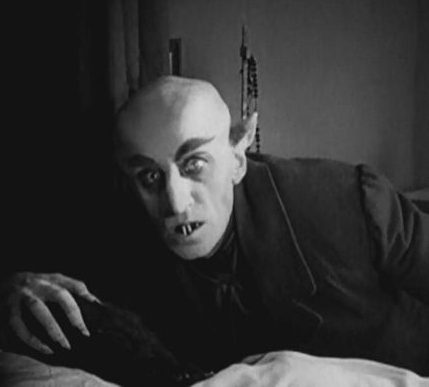
But vampires aren’t always sexy. Nosferatu, the 1922 original, comes to mind.

The vampire in Matt Reeves’ 2010 psychological/romantic horror film, Let Me In, isn’t sexy either. And that’s a good thing since she’s a twelve-year-old girl.

Of course vampires are no tellin’ how old because they are doomed to sameness of their birth until someone puts a stake through their hearts or until the sunlight burns them to a crisp. In this regard, Abby (Chloe Grace Mortez) is no different from her ilk.

But she is unique.

For one thing, her skin emanates a hue of blue. Not that she’s the color of a smurf or–God forbid–of a humanoid Avatar. No. She’s more the color of an infant born without enough oxygen in the blood. The illness is called blue baby syndrome and the discoloration is subtle.

Abby is subtle too. She wears a drab hoodie and appears to be always cold, except that she isn’t. She walks barefoot in the snow without so much discomfort as most us have walking barefoot on the beach in 90 degree weather.

Oddly, the boy who lives next door to Abby has the same blue pallor. He too is twelve and, like her, he is an only child living with a single parent in dreary apartment complex. His name is Owen (Kodi Smit-McPhee).

Owen’s not a vampire. But he is creepy. He likes to spy on his neighbors with his telescope.

Okay, that’s a no-no, but it’s not beyond the pale of early adolescent boyhood–or so I’ve been told. (I have girls.) It certainly doesn’t justify his complexion.

All right. Then try this on for size:

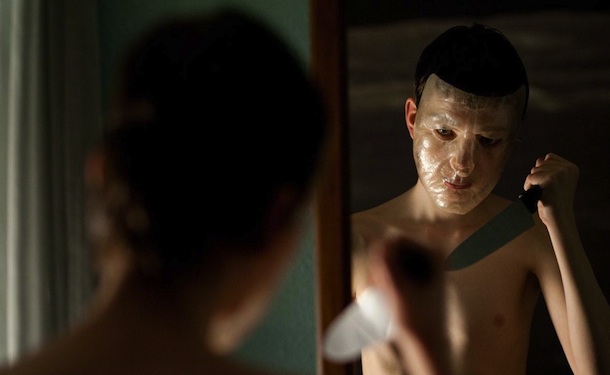
Owen likes to don a Michael Myers mask while he’s spying on his neighbors and he soothes himself by lunging at imaginary school girls with a butcher knife.

So yeah, this kid needs help.

And that’s too bad because he’s not going to get it from his mother, who is on a fundamentalist Christian/alcohol induced tear, or from his father, who is too preoccupied with the terms of their divorce to listen to the language of his son’s off kilter angst. What’s more, he’s a skinny little loner with big eyes and a pretty mouth, which makes him the easy target of a sadistic bully with homosexual urges.

One evening, Owen is taking out his frustrations on a tree with his newly purchased pocket knife.

“Are you scared? Are you scared little girl?” he jeers as he stabs the bark of the tree.

When he turns around, Abby is standing there.

“What are you doing?” she asks.

“Nothing,” he answers.

“Just so you know, we can’t be friends,” she says.

“Who says I want to be,” he answers.

But, of course, he does. Desperately.

Owen has observed this strange, pretty girl before, but this is first time they’ve talked. Little by little she warms to him. And before long they are holding hands and he is giving her gifts. She reciprocates with a gentle kiss on his cheek.

Meanwhile, a disheveled detective (Elias Koteus) is investigating a series of ritualistic murders perpetrated by a man in a mask made out of a garbage bags with cutout eye holes. Two teenagers from Owen’s school have fallen victim to the fiend.

Then a neighbor and object of Owen’s voyeurism is murdered. Though the murder appears to be unrelated to the ritualistic killings, it draws the detective to Owen’s door and into the orbit of all-consuming first love.

And perilously close to the duplicity of evil.

Director, Matt Reeves insists that Let Me In is not a remake of Thomas Alfredson’s critically acclaimed 2008 Swedish film, Let The Right One In. He doth protest too much.

That is not to say that his film is subpar. It isn’t.

Where Alfredson’s film is artfully stark, Let Me In is stylishly sleek. The difference is as American and as subtle as an electric blue IROC Z28.

And that’s a good thing.


Newer Posts
Older Posts